
Why Does Escalator Step Roller Bearing Failure Cause Operating Noise?
In an escalator operating system, the escalator step roller plays a vital role in supporting the steps and ensuring smooth movement along the guide rails. At the heart of the step roller is the escalator bearing, which enables low-friction rotation. When the bearing becomes worn, loses lubrication, or fails, the rolling resistance of the step roller increases significantly, resulting in abnormal operating noise, excessive vibration, and even irregular step movement.
For this reason, step roller bearings are one of the most critical wear components that should be regularly inspected during escalator maintenance.
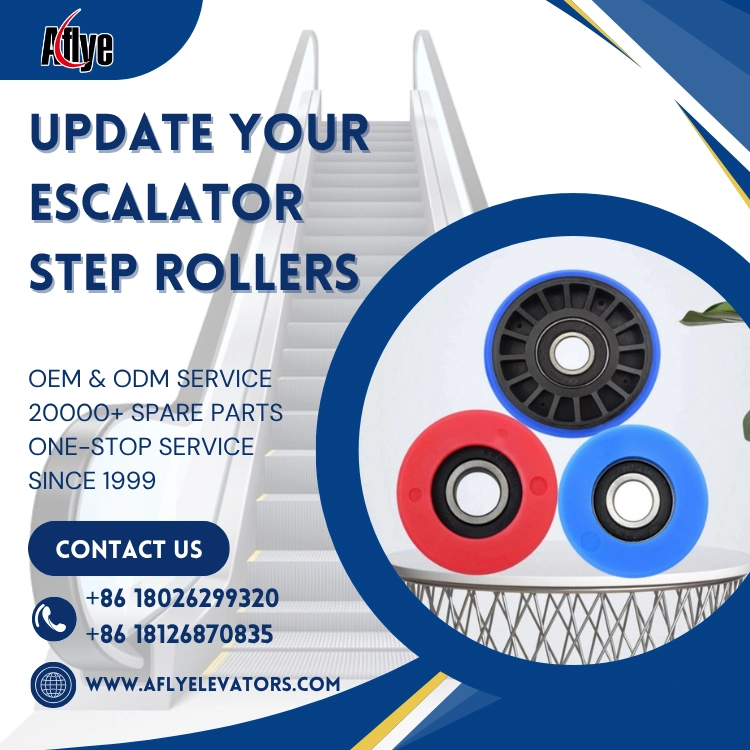
1. Bearing Wear Changes Rolling Friction into Sliding Friction
Under normal conditions, the step roller rotates smoothly on its bearing balls, creating rolling friction against the guide rail. When the bearing raceway becomes worn, the balls begin to spall, or the bearing cage is damaged, the roller can no longer rotate properly. As a result, part of the rolling friction turns into sliding friction.
Typical symptoms include:
Continuous humming or scraping noises
Increasing metal-to-metal friction sounds
Periodic noise as specific steps pass by
Louder noise at higher operating speeds
These symptoms are often a clear indication that the bearing is approaching the end of its service life.
2. Lubrication Failure Accelerates Bearing Damage
After long-term operation, bearing grease gradually deteriorates, leaks out, or becomes contaminated with dust, increasing internal friction.
Common causes include:
Dried or degraded grease
Aging or damaged bearing seals
Water or dust entering the bearing
Continuous heavy-load operation
As bearing temperature rises, wear accelerates rapidly, eventually causing noticeable noise or even complete bearing seizure.
Solution:Regularly inspect the sealing condition of the step rollers. For bearings that cannot be relubricated, the entire escalator step roller assembly should be replaced promptly.
3. Excessive Bearing Clearance Causes Step Vibration
As the bearing wears, its internal radial clearance gradually increases, causing slight movement of the step roller during operation.
Typical symptoms include:
Slight step wobbling
Increased escalator vibration
Guide rail impact noise
Unstable step travel
If left unresolved, excessive bearing clearance may also accelerate wear of the guide rails, step chains, and other escalator spare parts.
4. Bearing Seizure Increases Transmission Resistance
When the bearing becomes severely damaged, the roller rotates with much greater resistance, increasing the operating load of the escalator.
Possible consequences include:
Higher drive power consumption
Increased load on the main drive chain
Faster wear of the step chain
Reduced overall escalator operating efficiency
Therefore, when investigating abnormal operating noise, maintenance personnel should not only inspect the roller surface but also verify that the bearing rotates smoothly.
5. How Can Maintenance Personnel Determine Whether a Bearing Has Failed?
The following inspection points are recommended:
Whether the roller rotates smoothly by hand
Whether there is excessive axial or radial play
Whether the bearing shows abnormal heat buildup
Whether the roller surface has uneven wear
Whether the guide rails show abnormal wear
Whether the operating noise occurs periodically
For escalators with long service hours or heavy passenger traffic, a preventive replacement schedule for step rollers is recommended instead of waiting until complete failure occurs.
Escalator Step Roller Purchasing Recommendations
When purchasing escalator step rollers, the following specifications should be confirmed:
Roller outer diameter and width
Bearing model and brand
Bearing sealing structure
Roller material (PU, nylon, etc.)
Hardness rating
Installation dimensions
Compatible escalator brand and model
It is recommended to verify specifications using the original model number, technical drawings, or physical samples to ensure optimal matching between the roller and guide rail.
A-FLY Elevator & Escalator Parts Supply Capability
As a professional elevator and escalator spare parts supplier, A-FLY has been serving maintenance companies, engineering contractors, and spare parts distributors worldwide by supplying:
Escalator rollers
Escalator bearings
Main drive chains
A full range of elevator and escalator spare parts
A-FLY supports:
OEM/ODM customization
Sample verification
Drawing-based matching
Fast delivery
Based on different escalator brands and models, A-FLY provides professional matching solutions and one-stop spare parts support for escalator maintenance and modernization projects.
Conclusion
Failure of an escalator step roller bearing is one of the primary causes of increased operating noise and vibration, and it is also an important early warning sign of step system problems.
By regularly inspecting bearing condition, replacing worn escalator step rollers in a timely manner, and using high-quality elevator and escalator spare parts, maintenance teams can effectively reduce equipment failures, extend the service life of the escalator drive system, and ensure long-term safe and reliable operation.