
Why Do Escalator Step Yellow Demarcation Inserts Frequently Become Loose or Fall Off? Don't Overlook These 4 Causes During Modernization!
After years of operation, the yellow demarcation strips installed along the sides or front edges of escalator steps may become raised, loose, or even fall off.
These yellow step inserts not only help passengers identify the step boundaries but also contribute to the integrity of the step surface. If a loose insert falls off and is not dealt with promptly, it may create a tripping hazard or interfere with the normal operation of the escalator.
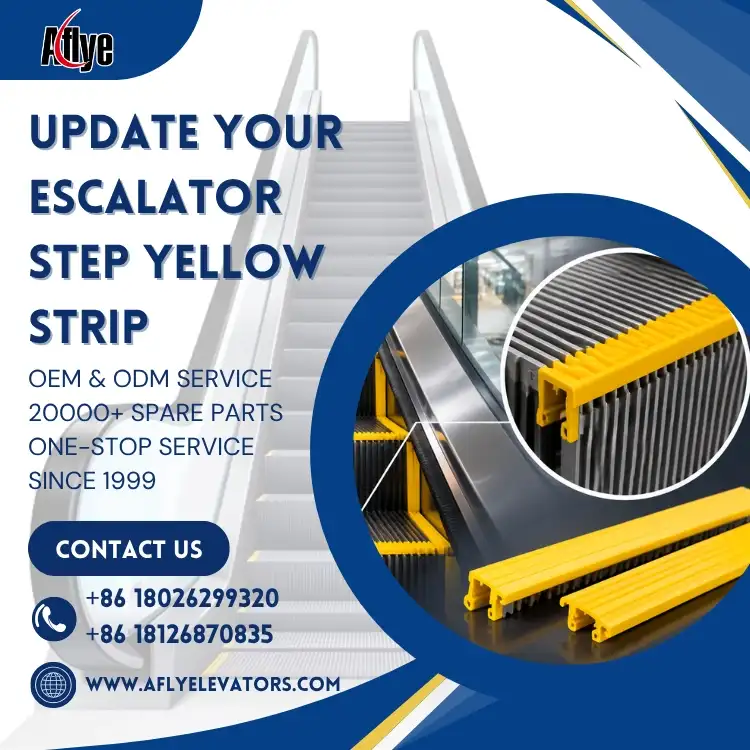
1. Why Do Escalator Step Yellow Demarcation Inserts Fall Off?
1. Aging Insert Materials
Long-term foot traffic, friction, and temperature changes can cause plastic or rubber inserts to harden or shrink gradually. As a result, the fit between the insert and the step groove becomes loose.
2. Wear of the Step Installation Groove
After years of escalator operation, repeated loading, impact, or corrosion may cause wear in the step insert grooves, reducing their ability to hold the inserts securely in place.
3. Incorrect Insert Dimensions
When replacing escalator step inserts, differences in width, thickness, or clip structure may result in improper installation, poor fitting, or raised edges.
4. Step Vibration and Passenger Impact
Worn step rollers, abnormal guide rail conditions, or unstable step movement may increase vibration and impact on the inserts, accelerating loosening.
2. What Risks Can Loose or Missing Yellow Step Inserts Cause?
When escalator step yellow demarcation inserts become loose, their edges may lift, sections may become detached, or fixing structures may become exposed.
This not only makes it more difficult for passengers to identify step boundaries but may also create risks such as footwear getting caught or passengers tripping.
If detached components enter the escalator step circulation area, they may also cause mechanical interference.
3. How Should These Problems Be Addressed During Escalator Modernization?
When loose inserts are discovered, the escalator should be stopped for inspection by qualified maintenance personnel.
Key inspection points include:
Insert condition and structural integrity
Step installation grooves
Clips and fixing structures
Overall escalator step condition
Inserts that are deformed, cracked, or unable to remain securely fixed should be replaced with correctly matched components.
If the step grooves are significantly damaged, replacement of the complete escalator step may also need to be considered.
At the same time, inspect step rollers, guide rails, and overall running conditions to prevent abnormal vibration from causing repeated problems.
4. What Should Be Confirmed When Purchasing Escalator Step Inserts?
When purchasing escalator step spare parts, the following information should be confirmed:
Escalator brand, model, and step specifications
Installation position of the yellow demarcation insert
Insert length, width, thickness, and cross-sectional shape
Clip structure, groove dimensions, and material requirements
Original product photos and installation method
Different escalator steps may have different insert structures. Selection should not be based on color and appearance alone.
5. A-FLY Escalator Spare Parts Supply
A-FLY supplies a wide range of escalator components, including escalator step yellow demarcation inserts, step inserts, escalator steps, step rollers, step chains, comb plates, and other escalator wear parts.
We also provide mechanical, electrical, and safety-related elevator and escalator spare parts.
Our services include model matching, dimensional confirmation, sample verification, bulk purchasing, and OEM/ODM customization to support escalator maintenance, repair, and modernization projects.
Conclusion
Loose or detached yellow demarcation inserts on older escalators are not necessarily caused by material aging alone. Worn installation grooves, incorrect dimensions, and abnormal step vibration should also be investigated.
Inspecting both the inserts and step structures during escalator modernization can help reduce repeated detachment problems and improve passenger safety.