
Increased Rotational Resistance in Escalator Handrail Return Guide Rollers? Don't Overlook These 4 Common Causes!
When an escalator handrail passes through the return section near the newel, guide rollers help change its direction and maintain a smooth running path. If the rotational resistance of escalator handrail guide rollers gradually increases, it may cause poor handrail movement, periodic abnormal noise, localized wear, or even speed fluctuations.
The problem is not necessarily related to the roller surface alone. Bearings, shafts, and mounting structures may also be involved.
1. Why Does the Escalator Return Guide Roller Have Increased Rotational Resistance?
1. Bearing Wear or Lubrication Failure
After long-term operation, the grease inside the bearings may deteriorate or become depleted. Increased friction between the rolling elements and raceways can make the guide roller difficult to rotate smoothly.
2. Shaft Misalignment or Improper Installation
An incorrect installation angle or a deformed mounting bracket may cause additional lateral loads on the roller, increasing bearing resistance.
3. Roller Surface Wear or Deformation
Continuous pressure and friction from the moving handrail may cause uneven roller wear, localized dents, or deformation, affecting normal rolling performance.
4. Dust and Foreign Matter Contamination
Dust, grease buildup, or foreign objects inside the escalator newel may enter bearing areas or rotating clearances, causing the roller to stick or even seize.
2. What Problems Can Increased Rotational Resistance Cause?
Under normal conditions, escalator return rollers should rotate smoothly to minimize friction during handrail circulation.
When bearing resistance increases or guide rollers cannot rotate freely, the handrail may shift from normal rolling contact to localized sliding friction, increasing operating resistance.
Common symptoms include:
Periodic escalator handrail vibration
Abnormal noise during operation
Localized overheating
Handrail edge wear
Handrail speed fluctuations
In severe cases, the additional resistance may also increase the load on the handrail drive system.
3. How Should These Problems Be Addressed During Escalator Modernization?
During inspection and maintenance, focus on the following:
Roller rotational flexibility
Bearing clearance and condition
Roller surface wear
Shaft condition
Installation position and alignment
If foreign matter is the only issue, clean the affected area according to equipment requirements.
If the bearings show significant sticking, abnormal clearance, or the roller surface is severely deformed, the affected components should be replaced.
At the same time, inspect handrail tension, running alignment, and other guide rollers to prevent the same problem from recurring after replacing only one roller.
4. What Should Be Confirmed When Purchasing Escalator Guide Rollers?
When purchasing escalator handrail guide rollers, confirm the following specifications:
Roller outer diameter
Roller width
Shaft hole dimensions
Bearing model
Roller surface material
Mounting structure
Compatible escalator model
It is recommended to provide photos, dimensions, and installation details of the original rollers. For older escalator modernization projects, particular attention should be paid to structural compatibility between the original and replacement components.
5. A-FLY Escalator Rollers and Spare Parts Supply
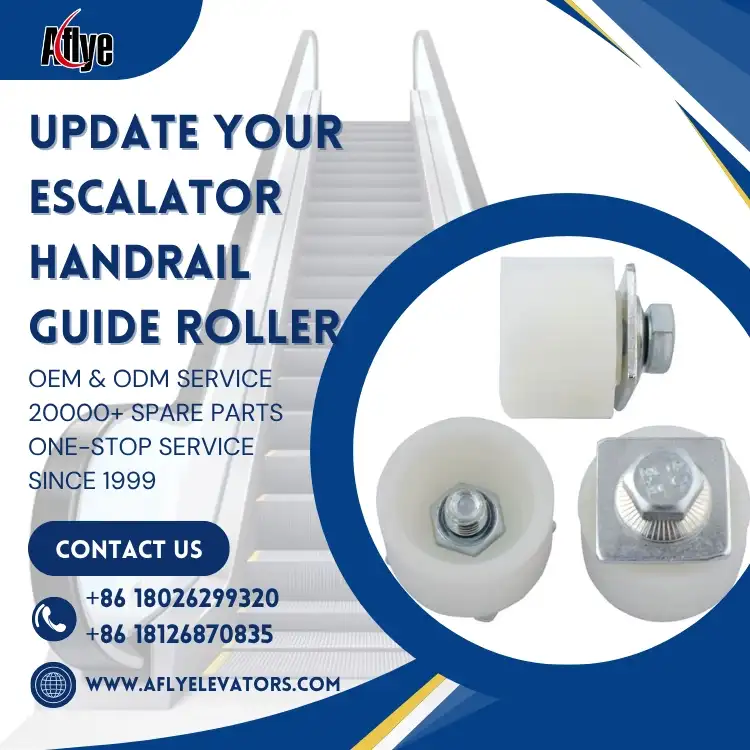
A-FLY supplies a wide range of escalator components, including escalator return rollers, handrail guide rollers, support rollers, pressure rollers, friction rollers, escalator bearings, and other escalator wear parts.
We also provide handrails, step rollers, step chains, comb plates, and other elevator and escalator spare parts.
Our services include model verification, dimensional matching, bulk purchasing, and OEM/ODM customization to support escalator maintenance, repair, and modernization projects.
Conclusion
Increased rotational resistance in escalator handrail return guide rollers is not necessarily caused by roller wear alone. Bearing aging, installation misalignment, and foreign matter contamination can also be major contributing factors.
Regular inspection of the handrail return guide system helps reduce abnormal friction, prevent premature wear, and improve overall escalator operating stability.