
Why Is the Escalator Braking Distance Abnormal?
During escalator operation, the escalator brake is a critical safety device that ensures safe stopping of the equipment. When an escalator experiences power failure, emergency stop activation, or safety protection action, the escalator braking system must stop the equipment quickly and steadily within the specified distance.
If the braking distance becomes significantly longer or the braking impact becomes excessive, it can not only affect operating quality but also increase the risk of passenger falls and equipment damage. Therefore, abnormal braking distance is an important inspection item during escalator maintenance.
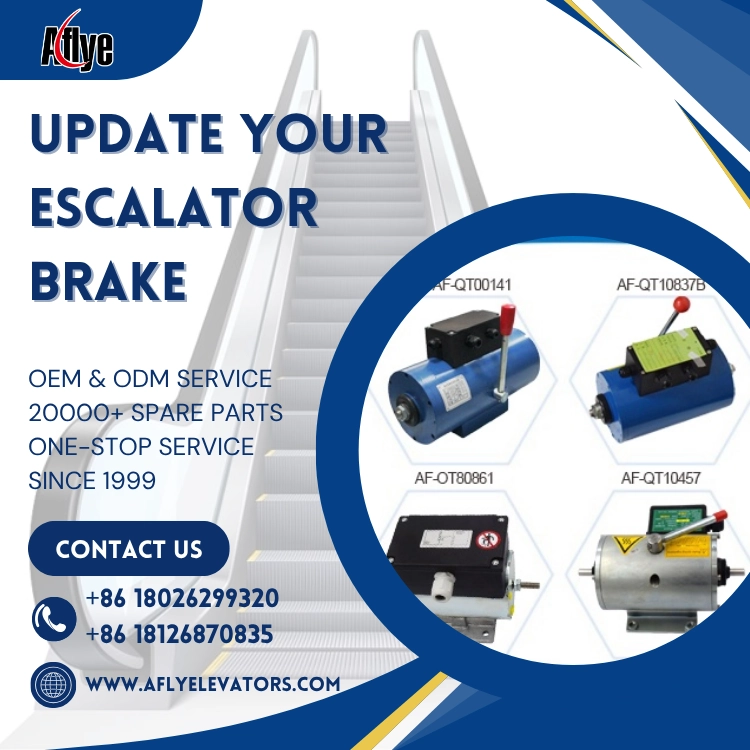
1. Escalator Brake Friction Pad Wear
The brake completes the stopping process through the friction force between the friction pad and the brake disc. After long-term operation, the friction pad gradually wears, reducing the effective contact area and braking force.
Common symptoms include:
Longer stopping distance;
Slower braking response;
Abnormal noise during braking;
Abnormally high brake temperature.
Solution:Regularly check the thickness and wear condition of the friction pad. Replace the relevant escalator brake components when the wear reaches the manufacturer's specified limit.
2. Brake Spring Fatigue Causes Insufficient Braking Force
The brake spring provides the clamping force required for braking. After repeated operation over a long period, the spring may experience fatigue, deformation, or reduced elasticity.
This may result in:
Insufficient braking force;
Increased braking distance;
Slight escalator movement after stopping;
Reduced braking stability.
During maintenance, technicians should check the spring free length and clamping force. If necessary, replace the complete spring assembly.
3. Brake Disc Wear or Surface Contamination
If the brake disc becomes worn, scratched, or contaminated with oil, the friction coefficient will decrease.
Typical problems include:
Brake slipping;
Unstable braking force;
Vibration during braking;
Inconsistent braking distance.
Therefore, the brake disc surface should be kept clean, and technicians should check for uneven wear or thermal deformation.
4. Electromagnetic Release Mechanism Failure
Modern escalator brakes usually use an electromagnetic release mechanism. When the coil ages, the voltage is insufficient, or the release mechanism does not operate smoothly, the following problems may occur:
Brake not fully released;
Delayed braking action;
Increased impact during stopping;
Abnormal braking distance.
It is recommended to check:
Coil resistance;
Supply voltage;
Mechanical movement of the release mechanism.
5. Tensioning and Drive System Abnormalities
The escalator braking system is closely connected with the drive system. If the main drive chain, step chain, or tensioning device has problems, braking performance may also be affected.
During maintenance, technicians should check:
Main drive chain wear;
Step chain tension;
Tensioning device condition;
Drive bearing operation;
Brake installation position.
Only when the entire transmission system operates normally can the braking distance meet safety requirements.
Escalator Brake Purchasing Recommendations
When purchasing an escalator brake and related escalator safety components, confirm the following parameters:
Brake model;
Braking torque;
Working voltage;
Installation dimensions;
Brake disc specifications;
Compatible escalator brand and model.
It is recommended to confirm the specifications according to the original model number, nameplate information, or technical drawings to avoid affecting braking performance due to incorrect specifications.
A-FLY Elevator & Escalator Parts Supply Capability
As a professional elevator and escalator parts supplier, A-FLY provides global maintenance companies, engineering contractors, and spare parts distributors with:
Main drive chains;
And a full range of elevator and escalator spare parts.
A-FLY supports OEM/ODM customization, sample matching, drawing confirmation, and fast delivery, providing professional solutions for different brands and models to support escalator maintenance and modernization projects with one-stop procurement services.
Conclusion
Abnormal escalator braking distance is usually caused by the combined effects of the escalator brake, braking system, transmission mechanism, and related safety components.
Maintenance technicians should conduct a comprehensive inspection of friction pads, springs, brake discs, electromagnetic release mechanisms, and the drive system. By replacing high-quality escalator parts in time, the escalator can maintain reliable and safe braking performance throughout long-term operation.