
Why Should Cracks in Elevator Steel Belt Coating Not Be Ignored?
In an elevator steel belt traction system, the coating of the elevator steel belt not only protects the internal steel cords but also plays an important role in friction transmission between the belt and the traction sheave.
When cracks, peeling, or localized damage appear on the belt surface, they may indicate material aging or abnormal mechanical stress. These conditions should be inspected promptly rather than treated as cosmetic issues.
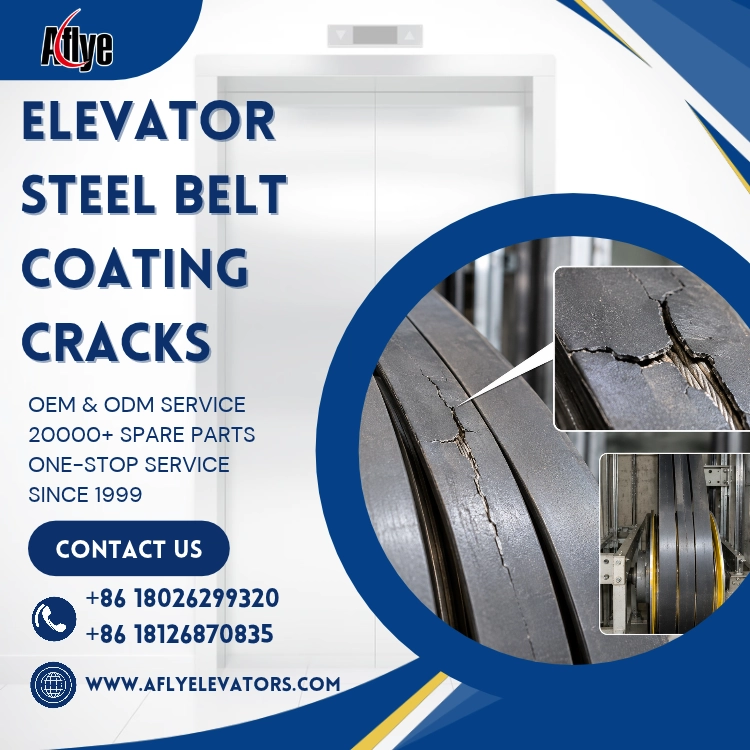
1. Why Does Elevator Steel Belt Coating Crack?
Common causes include:
Material fatigue caused by repeated bending over long-term operation;
Abnormalities on the steel belt sheave surface or grooves, increasing localized friction;
Uneven elevator steel belt tension, causing concentrated stress;
High temperatures, oil contamination, or other environmental conditions affecting coating performance;
Belt misalignment, causing continuous abnormal friction along the belt edges.
If cracks repeatedly appear in the same area, the corresponding traction sheave, deflector sheave, and belt running path should also be carefully inspected.
2. What Problems Can Cracked Elevator Steel Belt Coating Cause?
The coating of an elevator traction belt helps isolate the internal steel cords from the external environment and provides mechanical protection.
As cracks gradually expand, they may cause:
Further peeling or separation of the coating;
Changes in friction between the steel belt and traction sheave;
Easier penetration of moisture and contaminants;
Reduced protection of the internal steel cords;
Accelerated elevator steel belt wear.
Therefore, cracks in the belt coating should not be considered merely an appearance problem.
3. What Should Be Done When Cracks Are Found?
During elevator maintenance, technicians should inspect the location, length, depth, and distribution of the cracks, while also checking the belt edges, belt tension, alignment, and sheave condition.
If only minor surface marks are present, their condition should be evaluated according to the inspection criteria specified by the belt manufacturer.
However, if there are obvious cracks, coating separation, exposed steel cords, or abnormal belt deformation, surface repair alone should not be relied upon. The need for elevator steel belt replacement should be evaluated according to the original equipment specifications and applicable maintenance requirements.
At the same time, technicians should identify and correct problems such as uneven sheave wear, incorrect belt tension, or belt misalignment to prevent premature damage to the replacement belt.
4. Elevator Steel Belt Purchasing Tips
When purchasing an elevator traction belt, the following specifications should be carefully confirmed:
Steel belt model;
Belt width;
Belt thickness;
Required length;
Internal steel cord structure;
Coating material;
Compatible traction sheave specifications.
Different elevator steel belts should not be considered interchangeable based on appearance alone.
It is recommended to provide the original steel belt model, elevator technical specifications, and product photos to improve matching accuracy and reduce the risk of purchasing an incompatible replacement.
5. A-FLY Elevator & Escalator Parts Supply Capability
A-FLY supplies a wide range of elevator traction system and wear parts, including:
Other commonly replaced elevator parts.
These products are suitable for elevator maintenance, repair, and modernization projects.
For different project requirements, A-FLY supports model confirmation, specification matching, sample confirmation, and OEM/ODM services. We also supply a wide range of escalator wear parts, providing customers with one-stop elevator and escalator spare parts purchasing support.
Conclusion
Cracks in an elevator steel belt coating may be an early indication of coating material aging, abnormal friction, belt misalignment, or uneven mechanical stress.
Timely inspection of the belt coating, internal steel cords, traction sheaves, deflector sheaves, and belt tension can help identify potential traction system problems before the damage becomes more severe.