
Why Should Wear on the Elevator Safety Gear Wedge Working Surface Never Be Ignored?
The elevator safety gear is an essential elevator safety component. When triggered by the overspeed governor, the safety gear uses its wedges to grip the elevator guide rails, bringing the car to a stop according to its designed specifications. If the safety gear wedge working surface develops significant wear, grooves, or deformation, its contact conditions and force distribution may change. Therefore, it is not enough to simply check whether the safety gear can still operate.
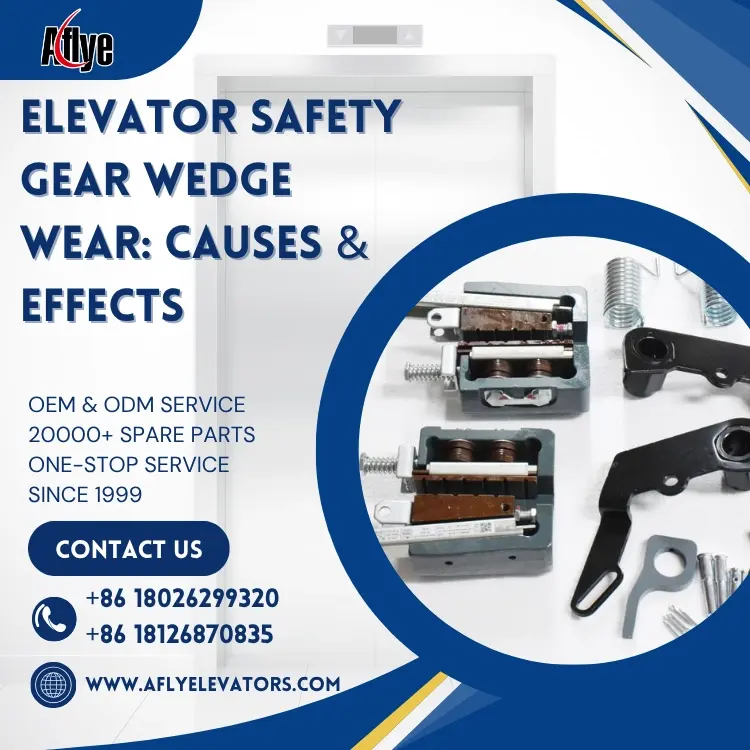
1. Why Do Elevator Safety Gear Wedges Wear Out?
Under normal conditions, elevator safety gears are not activated frequently. However, each actual gripping operation subjects the wedge working surfaces to considerable contact pressure and friction.
If the safety gear has previously been activated, has not been fully reset, or has abnormal clearance between the wedges and guide rails, localized friction may occur. Burrs, rust, and surface damage on the elevator guide rails can also accelerate safety gear wear.
In addition, misalignment in the linkage mechanism may cause uneven force distribution between the left and right wedges, resulting in noticeable uneven wear.
2. Why Does Working Surface Wear Affect Braking Performance?
Elevator safety gear braking does not simply rely on "gripping the guide rails." The wedge geometry, working surface condition, clamping travel, and contact conditions with the guide rails all affect the actual braking force.
When the wedges become excessively worn, their effective contact conditions may change, potentially causing:
Unsynchronized clamping between the left and right sides
Uneven force distribution
Abnormal braking performance
Additional damage to the guide rail working surfaces
Such wear may also affect the reliability of subsequent safety gear operations.
3. What Should Be Done When Safety Gear Wear Is Detected?
During elevator maintenance, carefully inspect the wedge working surfaces for uneven wear, grooves, cracks, deformation, or abnormal corrosion.
The inspection should also cover:
The safety gear lifting mechanism
Linkage rods and connecting components
Installation clearances
Guide rail surface conditions
If wear exceeds the manufacturer's allowable limits, the wedges should not be arbitrarily ground or modified for continued use. The relevant elevator safety gear components should be replaced according to the original equipment specifications.
All replacement, adjustment, and testing procedures must be performed by qualified professionals in accordance with the manufacturer's requirements and applicable safety standards.
4. What Specifications Should Be Confirmed When Purchasing Safety Gear Wedges?
When purchasing elevator safety gear wedges, it is recommended to provide the original elevator safety gear model, wedge dimensions, and product photos.
The following specifications should also be confirmed:
Elevator rated load
Operating speed
Guide rail specifications
Safety gear type
Wedge dimensions and structure
Installation configuration
Even if two safety gears look similar, their wedge angles, dimensions, and friction working surfaces may differ. Therefore, selecting replacement parts based on appearance alone is not recommended.
5. A-FLY Elevator Safety Components Supply
A-FLY supplies a wide range of elevator safety components, including elevator safety gears, safety gear wedges, overspeed governors, tension devices, buffers, and rope grippers.
We also provide elevator guide rails, wire ropes, and other elevator and escalator spare parts.
For maintenance and old elevator modernization projects, we support model verification, dimensional matching, sample confirmation, bulk purchasing, and OEM/ODM services.
Conclusion
Wear on the elevator safety gear wedge working surface should never be treated as ordinary mechanical wear.
Once significant uneven wear, grooves, or deformation are detected, the safety gear, linkage mechanism, and guide rails should all be inspected. Evaluating the entire braking system helps identify the underlying cause and prevents problems from recurring due to replacing only a single component.