
Frequent Escalator Handrail Slippage? Hardened Friction Wheel Surfaces May Be Reducing Driving Force
During escalator operation, the handrail relies on the drive system to maintain stable traction. The escalator handrail friction wheel transfers power through frictional contact with the handrail. When the friction wheel surface gradually hardens, even if there is no obvious visible damage, its driving force may decrease, resulting in unstable handrail speed or even slippage.
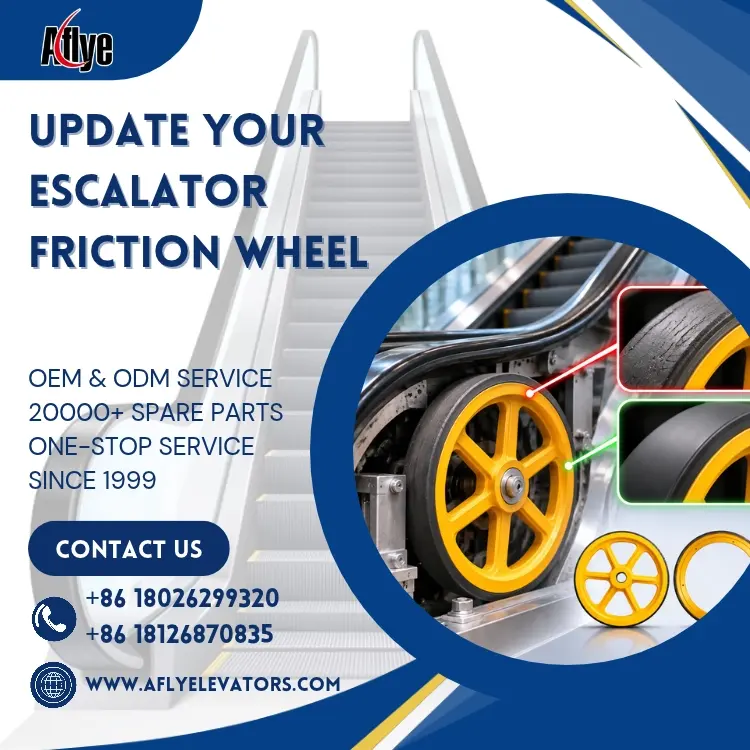
1. Why Does the Escalator Friction Wheel Surface Become Hardened?
Escalator friction wheels are typically exposed to continuous compression, friction, and repeated mechanical loads. Over time, the wheel surface material may gradually lose its original elasticity due to aging, temperature changes, and prolonged mechanical friction.
In addition, excessive handrail tension, improper pressure roller adjustment, surface contamination, and high operating temperatures may accelerate friction wheel aging.
2. Why Does Surface Hardening Reduce Driving Force?
Under normal conditions, the friction wheel surface has a certain degree of elasticity, allowing it to maintain stable contact with the handrail and generate sufficient friction.
When the wheel surface hardens, its ability to conform to the handrail surface decreases, reducing the effective friction force. When the available driving force is insufficient to overcome handrail running resistance, escalator handrail slippage may occur.
Common symptoms include:
Fluctuating handrail speed
Brief slippage during startup
Handrail vibration during operation
Abnormal noise around the contact area between the friction wheel and handrail
3. How Should Handrail Slippage Be Addressed?
Do not simply adjust the handrail tension when troubleshooting. The friction wheel should also be inspected for surface hardening, cracks, and uneven wear. Check the pressure rollers, guide rollers, support rollers, and the overall handrail running path as well.
If the escalator friction wheel has become significantly hardened or lost its elasticity, simply increasing the contact pressure may place additional loads on the handrail and bearings. Replace the friction wheel according to equipment requirements, then recheck handrail tension and drive system performance.
4. What Specifications Should You Confirm When Purchasing Handrail Friction Wheels?
When purchasing escalator friction wheels, confirm the following specifications:
Outside diameter
Wheel width
Shaft hole dimensions
Bearing model
Wheel surface material
Mounting structure
Compatible handrail specifications
For older escalator repair projects, it is recommended to provide photos and dimensions of the original friction wheel, along with the escalator model, to avoid mismatches in wheel diameter, mounting holes, or material hardness.
5. A-FLY Escalator Handrail System Parts Supply
A-FLY supplies escalator friction wheels, handrails, guide rollers, support rollers, pressure rollers, tensioning devices, and other escalator handrail system components to meet various escalator maintenance and modernization requirements.
We also supply escalator steps, step rollers, chains, comb plates, and other elevator and escalator spare parts. OEM/ODM customization, model matching, dimensional verification, and bulk purchasing are available.
Conclusion
Escalator handrail slippage is not necessarily caused by insufficient tension alone. Reduced friction performance due to a hardened friction wheel surface can also be an important reason for insufficient driving force.
Inspecting the friction wheel, handrail, and entire drive system together makes it easier to identify the actual cause and prevent recurring handrail slippage.