
Why Do Elevator Steel Belts Become Misaligned and Develop Edge Wear?
In a steel belt traction elevator, the elevator steel belt must maintain a stable running path along the steel belt sheaves. If the belt continuously shifts to one side and develops fraying, wear, or localized edge damage, it usually indicates a problem with the sheaves, belt tension, or installation condition.
Continued operation under these conditions may cause further damage and affect the overall elevator traction system.
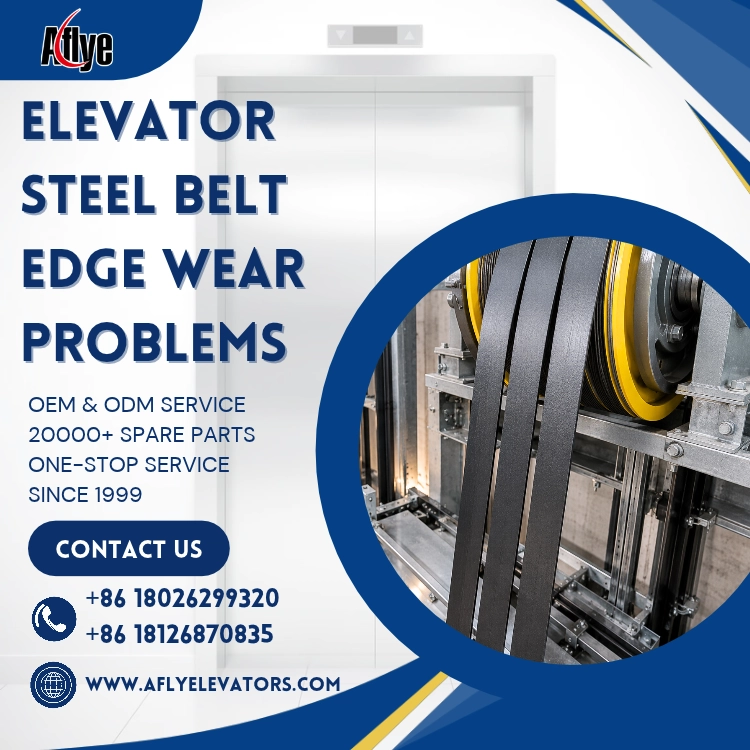
1. Why Does an Elevator Steel Belt Become Misaligned?
1. Incorrect Steel Belt Sheave Installation
If an elevator steel belt sheave is tilted, misaligned, or has an abnormal groove profile, the belt may be subjected to continuous lateral force during operation.
Over time, this can cause the steel belt to gradually move toward one side.
2. Uneven Tension Between Multiple Steel Belts
In a multi-belt traction system, significant differences in elevator steel belt tension can result in uneven load distribution.
This may cause the belts to follow different running paths and increase the risk of belt misalignment.
3. Steel Belt Sheave Surface Wear
After long-term operation, uneven groove wear, surface damage, or foreign material on the steel belt sheave can affect the normal guidance of the belt.
This may gradually cause the steel belt to shift away from its correct running position.
4. Incorrect Steel Belt Installation
If the steel belt is twisted, installed at an angle, or incorrectly positioned at its fixing points, it may not be able to maintain its natural running path.
Improper installation can therefore lead to continuous belt tracking problems.
5. Abnormal Guide Components
Changes in the position or alignment of the traction sheave, deflector sheave, or related guide sheaves can also cause elevator steel belt misalignment.
2. Why Does Belt Misalignment Cause Edge Wear?
During normal operation, the load should be distributed mainly across the effective working surface of the steel belt.
When the belt continuously shifts toward one side, its edge may rub against the sheave flange or other components, resulting in elevator steel belt edge wear.
Common symptoms include:
Fraying or damage along the steel belt edges;
Visible friction marks on the belt surface;
Side-to-side movement of the belt during operation;
Different levels of wear between multiple steel belts;
Abnormal friction noise from the traction area.
These symptoms should not be ignored, especially if the edge damage continues to increase.
3. How to Solve Elevator Steel Belt Misalignment
During elevator maintenance, technicians should inspect:
Steel belt running alignment;
Tension of each steel belt;
Steel belt sheave wear;
Sheave and shaft alignment;
Traction and deflector sheave condition.
If the problem is caused only by uneven belt tension, the tension should be readjusted according to the equipment requirements.
If the steel belt sheave has developed significant uneven wear, the affected components should be repaired or replaced as required.
For steel belts with severe edge damage, the need for steel belt replacement should be evaluated according to the manufacturer's inspection and replacement criteria. Continuing to operate a severely damaged belt should be avoided.
4. Elevator Steel Belt Parts Purchasing Tips
When purchasing an elevator steel belt, the following specifications should be carefully confirmed:
Belt width;
Belt thickness;
Belt length;
Belt construction and specifications;
Applicable load requirements;
Compatible steel belt sheave model.
The steel belt and steel belt sheave must be correctly matched. Replacement products should not be selected based only on appearance.
For older elevator repair projects, it is recommended to provide the original steel belt model, steel belt sheave dimensions, elevator technical specifications, and photos of the original parts to improve matching accuracy.
5. A-FLY Elevator & Escalator Parts Supply Capability
A-FLY supplies a wide range of elevator steel belt and traction system parts, including:
Other related steel belt components.
These products are suitable for elevator maintenance, repair, and modernization projects.
A-FLY also supports model confirmation, dimensional matching, sample confirmation, and OEM/ODM services. In addition, we supply a wide range of elevator and escalator wear parts, providing engineering contractors, maintenance companies, and spare parts distributors with one-stop elevator and escalator spare parts purchasing support.
Conclusion
Elevator steel belt misalignment is usually not caused by the belt alone. It is closely related to belt tension, sheave wear, installation position, and the alignment of the traction system.
When abnormal edge wear is detected, the entire belt running path should be inspected promptly. Identifying the actual cause can help prevent repeated damage caused by replacing the steel belt without correcting the underlying traction system problem.