
Why Does Elevator Door Rope Pulley Wear Cause Abnormal Door Operation?
In an elevator door operator system, the elevator Door Rope Pulley is an important transmission component that connects the driving force of the door operator with the movement of the door panels. It is also commonly known as an elevator door wire rope pulley. By transferring power through the wire rope, it enables the car door and landing doors to open and close according to the designed movement path.
Because the Door Rope Pulley is continuously exposed to rotational friction, wire rope tension, and frequent start-stop impacts, it is considered a common wear component in the elevator door system. When the rope sheave experiences wear, groove deformation, or bearing problems, power transmission efficiency will be affected, eventually causing various elevator door failures.
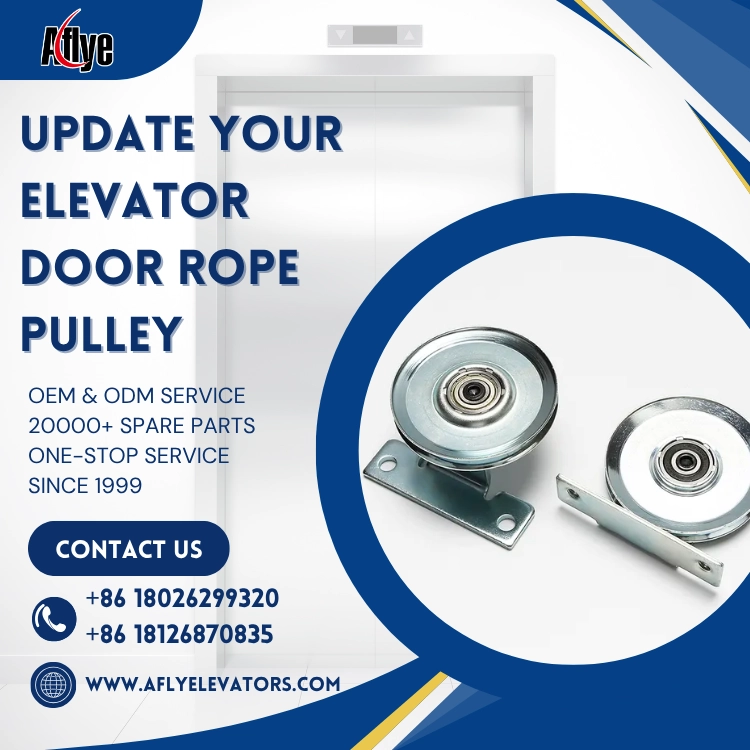
1. Elevator Door Rope Pulley Wear Reduces Transmission Efficiency
Under normal conditions, the wire rope and rope sheave groove maintain stable contact, transmitting movement to the door system through friction.
After long-term operation, the rope sheave may experience:
Rope groove wear;
Increased groove width;
Uneven surface wear;
Changes in rope sheave diameter.
When the rope sheave can no longer maintain sufficient friction, it may cause:
Slower door opening speed;
Unstable closing speed;
Door movement interruption;
Increased door operator load.
Solution:Inspect the wear condition of the Elevator Door Rope Pulley and check the groove condition. Replace the Door Rope Pulley in time if necessary.
2. Rope Sheave Wear Causes Abnormal Door Operating Noise
Many elevators may develop noises such as squeaking, friction sounds, or periodic abnormal sounds during operation. These problems may be related to the condition of the Door Rope Pulley.
Common causes include:
Rope sheave surface wear;
Insufficient bearing lubrication;
Eccentric rotation of the rope sheave;
Abnormal friction between the wire rope and groove wall.
These issues not only reduce passenger comfort but also accelerate wear of the wire rope and other elevator door components.
3. Incorrect Rope Sheave Dimensions Affect Door Movement Accuracy
Elevator door systems require high transmission accuracy. If the effective diameter of the rope sheave changes due to long-term wear, the travel distance of the door panels may be affected.
Possible problems include:
Door not closing completely;
Door lock unable to engage properly;
Repeated door opening and closing;
Door system fault alarms.
Therefore, during elevator maintenance, technicians should not only inspect the appearance of the rope sheave but also check dimensional changes and operating conditions.
4. Bearing Failure Causes Unstable Door Operator Operation
Some elevator Door Rope Pulleys contain internal bearing structures. After long-term operation, the bearings may experience:
Bearing wear;
Increased rotation resistance;
Rope sheave sticking;
Increased operating noise.
When the rope sheave cannot rotate smoothly, the door operator motor needs to output more power, which may cause overload of the door operator system.
5. Elevator Door Rope Pulley Maintenance Inspection Methods
During routine maintenance, technicians should focus on checking:
Rope sheave surface wear;
Contact condition between wire rope and groove;
Whether the rope sheave rotates smoothly;
Presence of abnormal noise;
Whether door opening and closing speed is normal;
Whether door operator load is abnormal.
If severe rope sheave wear is found, it should be replaced promptly to prevent further impact on the entire elevator door system.
6. Elevator Door Rope Pulley Purchasing Recommendations
When purchasing an elevator Door Rope Pulley, the following specifications should be confirmed:
Rope sheave diameter;
Number of grooves;
Groove dimensions;
Shaft hole specifications;
Material type;
Compatible door operator model.
Different elevator door systems may use different rope sheave structures. It is recommended to provide original part photos, dimensions, or samples for accurate matching to avoid installation problems caused by incorrect models.
A-FLY Elevator & Escalator Parts Supply Capability
As a professional elevator and escalator parts supplier, A-FLY provides global maintenance companies, engineering contractors, and spare parts distributors with:
Elevator door wire rope pulleys;
And a full range of elevator and escalator spare parts.
A-FLY supports OEM/ODM customization, sample confirmation, drawing matching, and fast delivery. Based on different elevator door operator systems, A-FLY provides accurate matching solutions to help customers reduce procurement risks and improve elevator maintenance efficiency.
Conclusion
Although the elevator Door Rope Pulley is a small transmission component, it plays an important role in ensuring stable operation of the elevator door system.
Wear of the rope sheave can lead to reduced power transmission efficiency, abnormal door opening and closing, and increased operating noise.
Through regular inspection, timely replacement of aging components, and cooperation with a reliable elevator parts supplier, elevator operating safety, reliability, and passenger comfort can be effectively improved.