
Why Can Elevator Door Lock Contacts Prevent an Elevator from Running?
In an elevator operating system, elevator door lock contacts are one of the most important electrical safety components. They detect whether the landing doors and car doors are securely closed and send feedback signals to the elevator safety circuit. Only when all door lock contacts are properly closed will the elevator control system allow the elevator to operate.
Therefore, when an elevator door lock fault occurs, the elevator may fail to start, repeatedly open and close the doors, or stop unexpectedly even if the mechanical system is working normally. During daily elevator maintenance, door lock contacts should be treated as key elevator safety components requiring regular inspection.
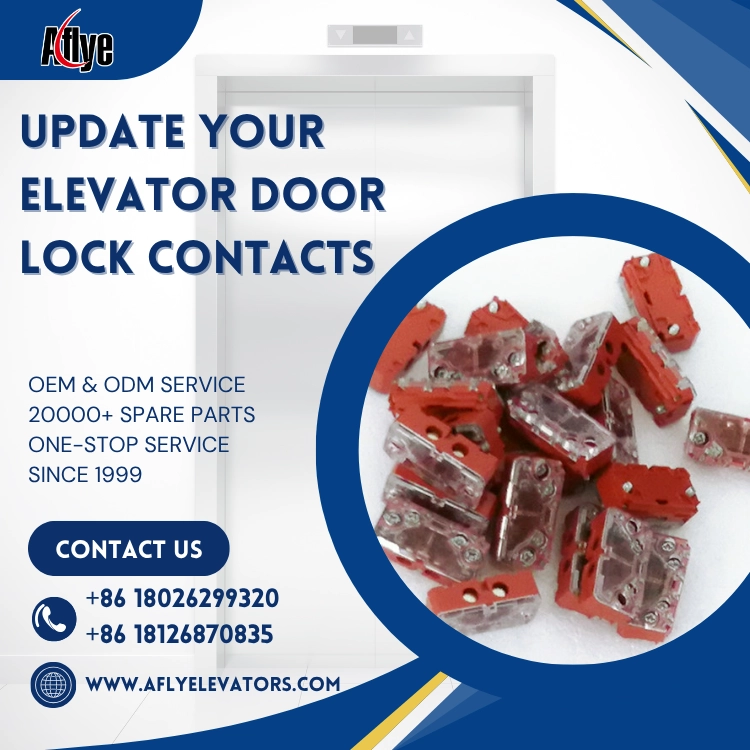
1. Door Lock Contacts Fail to Close, Causing Safety Circuit Interruption
Elevator safety design requires all landing door locks and car door locks to form a complete safety detection circuit. If any elevator door lock contact fails to close properly, the control system will determine that the elevator door is not fully closed and prevent operation.
Common symptoms include:
Elevator stops at a floor and cannot start;
Door lock fault remains after the doors are closed;
Control cabinet displays a safety circuit fault;
Elevator repeatedly reopens and closes the doors.
Solution:Check the closing condition of the door lock contacts, contact pressure, and wiring connections. After locating the fault, adjust or replace the related components.
2. Contact Wear or Oxidation Causes Unstable Signals
Elevator door lock contacts operate frequently and are exposed to mechanical impact and environmental conditions over long periods.
Common problems include:
Contact surface oxidation;
Increased contact resistance;
Contact burning;
Spring fatigue.
These issues may result in:
Occasional failure to start;
Door lock alarms during operation;
Intermittent faults;
Difficulty in troubleshooting.
For elevators with long service periods, regular inspection of door lock contacts is recommended to prevent minor issues from developing into elevator downtime.
3. Mechanical Misalignment of the Door System Affects Contact Operation
Many elevator door lock problems are not caused by damaged contacts themselves, but by mechanical issues within the door system.
Common causes include:
Worn elevator door hanger rollers;
Incorrect door vane position;
Incomplete engagement of landing door locks;
Worn door shoes.
These problems can prevent the door lock contacts from operating completely, causing the safety circuit to remain open.
Therefore, when troubleshooting door lock failures, the entire elevator door system should be inspected together.
4. Wiring Problems Cause Signal Loss
Elevator door lock contacts are connected to the control system through electrical wiring. After long-term operation, wiring problems may occur, such as:
Loose terminal connections;
Aging cables;
Poor connector contact;
Short circuits or open circuits.
These faults usually appear as intermittent alarms and require electrical testing tools for accurate diagnosis.
Maintenance advice:
Check door lock circuit voltage, wiring continuity, and control cabinet input signals to avoid incorrectly identifying the problem as a damaged door lock component.
5. Elevator Door Lock Contact Maintenance Inspection Methods
During routine elevator maintenance, technicians should check:
Whether door lock contacts operate smoothly;
Whether contact closing pressure is normal;
Whether contact surfaces show burning or damage;
Whether door lock mechanical engagement is accurate;
Whether safety circuit signals remain stable.
For elevators with high usage frequency, a regular inspection schedule should be established to detect contact aging risks in advance.
6. Elevator Door Lock Contact Purchasing Recommendations
When purchasing elevator door lock contacts, the following specifications should be confirmed:
Contact structure type;
Operating voltage;
Installation dimensions;
Wiring method;
Number of contacts;
Compatible door lock model;
Elevator brand and model.
Different door lock systems may use different contact structures. It is recommended to provide original part photos, model numbers, or dimensions for professional matching to avoid compatibility problems after installation.
A-FLY Elevator & Escalator Parts Supply Capability
As a professional elevator and escalator parts supplier, A-FLY provides global maintenance companies, engineering contractors, and parts distributors with:
Door shoes;
And complete elevator safety components.
A-FLY supports OEM/ODM customization, sample confirmation, drawing matching, and fast delivery. Based on different elevator brands and models, A-FLY can provide professional elevator door system solutions to help customers reduce procurement risks and improve maintenance efficiency.
Conclusion
Although elevator door lock contacts are small components, they directly determine whether the elevator safety circuit can operate properly.
When an elevator experiences problems such as failure to run, door lock alarms, or safety circuit faults, technicians should first inspect the door lock contacts and related door system components.
Through proper maintenance procedures, timely replacement of reliable elevator parts, and professional supplier support, elevator safety and long-term stable operation can be effectively ensured.