
Why Does an Elevator Button Return Slowly or Get Stuck After Being Pressed?
In daily elevator operation, elevator push buttons are important components that allow passengers to interact with the elevator control system. If a button does not return normally after being pressed, returns slowly, or becomes completely stuck, it can affect the passenger experience and may also cause abnormal elevator button signals, making troubleshooting more difficult for maintenance technicians.
So, what causes an elevator button to return slowly or become stuck? How can these problems be solved, and what should be considered when purchasing elevator buttons?
1. Common Causes of Slow-Returning or Stuck Elevator Buttons
1. Wear of the Button’s Mechanical Structure
Elevator buttons are pressed frequently during daily operation. Over time, internal springs, guide structures, and button support components may gradually wear out. When spring force decreases or mechanical clearances change, the elevator button may return more slowly after being pressed.
In high-traffic locations such as shopping malls, hotels, and hospitals, frequent use can accelerate mechanical fatigue.
2. Dust or Foreign Matter Inside the Button
Dust, oil, and other contaminants can accumulate inside an elevator car. If the button has insufficient protection, foreign matter may enter through small gaps and increase pressing resistance, causing the elevator button to stick.
3. Incorrect Button Installation Dimensions
If the button housing dimensions, mounting hole size, or panel fit are incorrect, the button may be subjected to lateral pressure after installation, preventing smooth movement.
Therefore, when purchasing elevator buttons, it is important to confirm the button dimensions, mounting method, operating voltage, and connector specifications to avoid installation problems caused by incorrect matching.
4. Aging of Internal Contact Components
Some elevator buttons contain not only mechanical pressing structures but also electrical contacts and LED backlight components. After long-term use, worn contacts or deformed internal components may affect button movement and prevent the elevator control system from receiving signals correctly.
2. What Problems Can a Stuck Elevator Button Cause?
1. Poor Passenger Experience
If a button does not return quickly after being pressed, passengers may assume that it has failed and press it repeatedly.
2. Abnormal Signal Feedback
If the internal contacts cannot reset properly, the button may continuously send an input signal or fail to provide feedback, affecting the normal control logic of the elevator.
3. Increased Elevator Maintenance Costs
Frequent button failures increase troubleshooting and maintenance time. If damaged buttons are not replaced promptly, they may also affect the stable operation of related control components.
3. Solutions for Elevator Button Failures
When an elevator button returns slowly or becomes stuck, check the following:
Whether there is dust or foreign matter around the button;
Whether the button is correctly aligned and installed;
Whether the pressing and return action is smooth;
Whether the internal spring or contacts are worn;
Whether the LED and signal wiring are functioning properly.
If the problem is caused only by minor contamination, cleaning and adjustment may solve it. However, if the internal mechanical structure is already worn, replacing the elevator push button is recommended.
For older elevator modernization projects, upgrading the entire button system can also improve durability and operating comfort.
4. What Should You Consider When Purchasing Elevator Buttons?
When selecting an elevator button, appearance is only one factor. Several technical parameters must also be confirmed.
First, the button must be compatible with the existing elevator control system, including its operating voltage, connector type, and signal type.
Second, attention should be paid to button service life, including the number of pressing cycles, spring structure, and contact wear resistance.
Different elevator projects may also require different button functions, such as:
Standard illuminated elevator buttons;
Braille elevator buttons;
Explosion-proof elevator buttons;
Custom-character elevator buttons.
Choosing the correct elevator button for the application environment can help reduce future maintenance frequency.
5. A-FLY Elevator & Escalator Parts Supply Capability
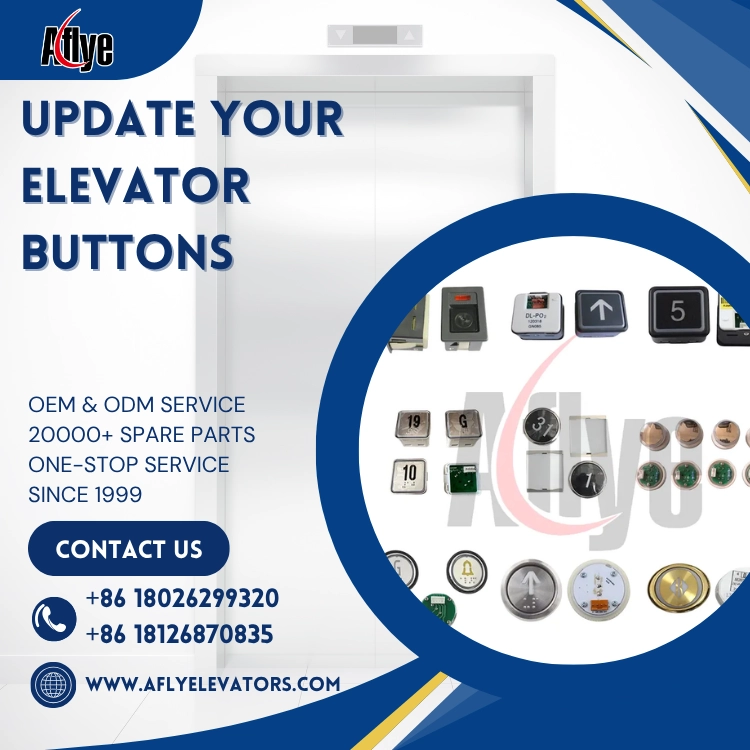
A-FLY specializes in supplying elevator and escalator spare parts worldwide, including elevator push buttons, COP buttons, hall call buttons, LED buttons, Braille buttons, explosion-proof buttons, and various elevator and escalator wear parts.
With extensive industry experience, A-FLY supports custom button dimensions, characters, voltages, and OEM/ODM services, meeting the requirements of elevator repair, replacement, and modernization projects.
A-FLY also provides one-stop solutions covering elevator door system parts, control system components, display system parts, escalator chains, escalator rollers, and other elevator and escalator spare parts, providing reliable product support for customers worldwide.
Conclusion
A slow-returning or stuck elevator button may seem like a minor problem, but it can indicate mechanical wear, incorrect installation, contamination, or damaged internal components. Proper troubleshooting, timely replacement, and selecting correctly matched elevator buttons can effectively improve elevator reliability and passenger experience.