
Why Do Elevator Button LED Lights Fail Frequently?
In modern elevator systems, elevator button LED lights are not only used to indicate button status but also play an important role in improving passenger experience and displaying floor registration. Compared with traditional bulbs, LEDs offer advantages such as longer service life, lower energy consumption, and stable brightness, making them widely used in various elevator button systems.
However, during actual elevator maintenance, some elevators may experience problems such as button lights frequently going off, flickering, or failing within a short period of time. In many cases, the failure is not caused by the LED itself, but is related to the elevator button backlight structure, button voltage, circuit design, and installation environment.
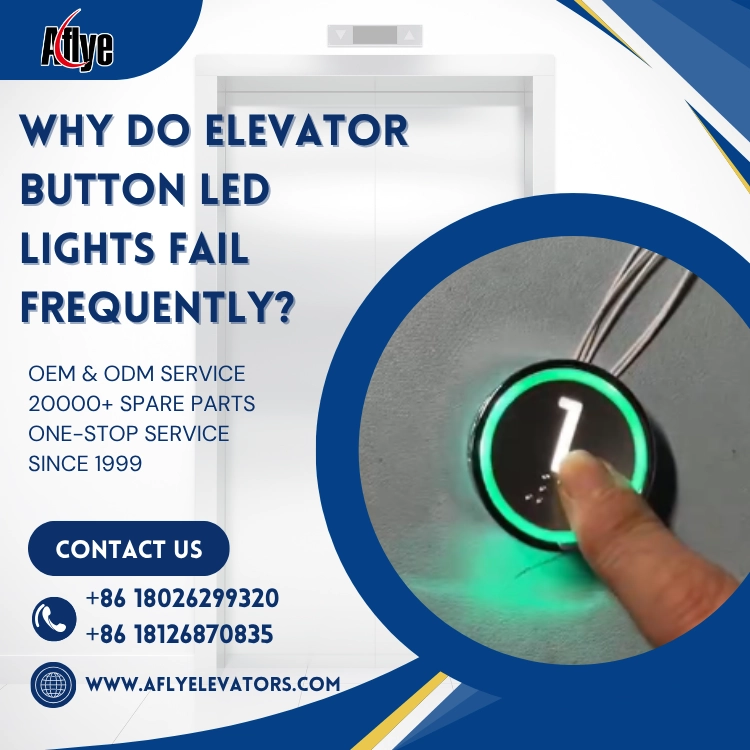
1. Abnormal Elevator Button Voltage Causes LED Damage
The stability of elevator button voltage is one of the key factors affecting LED service life. Common problems include:
Input voltage exceeding the rated range of the button;
Unstable output from the power supply module;
Instantaneous voltage surges;
Reverse connection of positive and negative terminals.
When LEDs operate under excessive voltage for a long time, the internal chip temperature increases, which can cause:
Reduced LED brightness;
Uneven lighting;
Frequent LED burnout;
Significantly shortened service life.
Solution:Before installation, confirm the working voltage of the elevator button, such as 12V or 24V, and check whether the power output is stable to prevent damage caused by voltage mismatch.
2. Button Backlight Circuit Design Affects Service Life
Elevator buttons usually contain LED chips, resistors, circuit boards, and other components. If the button backlight design is not suitable, such as:
Incorrect current-limiting resistor parameters;
Insufficient heat dissipation design;
Lack of circuit protection;
the LED may operate under continuous overload conditions.
Typical symptoms include:
Newly installed buttons failing within a short time;
Continuous failures of the same batch of buttons;
Gradual reduction in backlight brightness.
Therefore, choosing a reliable elevator button backlight solution is essential for long-term stable operation.
3. Poor Button Quality Causes Rapid LED Aging
Different manufacturers use different qualities of LED chips, circuit boards, and electronic components. Low-quality elevator buttons may have issues such as:
Insufficient LED chip lifespan;
Unstable soldering process;
Poor moisture resistance;
Inconsistent component quality.
These problems may cause:
Individual LED lights not working;
Complete loss of button backlight;
Abnormal indicator performance.
4. Installation Environment Affects LED Lifespan
Elevator buttons operate in high-frequency usage environments, and external conditions can also affect LED stability. For example:
Excessive cabin temperature;
High humidity;
Dust entering the button;
Frequent mechanical impacts.
Especially in hospitals, shopping malls, and public transportation facilities, buttons are used more frequently, making durability an important consideration.
5. How to Identify the Cause of Elevator Button LED Failure?
During troubleshooting, maintenance technicians can follow these steps:
Check whether the elevator button voltage meets requirements;
Test whether the button input wiring is stable;
Inspect the button backlight circuit and LED condition;
Determine whether the entire button assembly needs replacement.
If multiple buttons experience LED failures at the same time, the power supply system should be checked first instead of replacing individual buttons.
6. Elevator Button Purchasing Recommendations
When purchasing elevator button LED lights and button assemblies, confirm the following parameters:
Working voltage (12V/24V, etc.);
LED backlight color;
Button size;
Installation method;
Interface type;
Braille availability;
Pressing cycle life;
Protection rating.
Different elevator models may use different button specifications. It is recommended to provide original button photos, dimensions, or model information for professional matching to avoid repeated purchases caused by incorrect parameters.
A-FLY Elevator & Escalator Parts Supply Capability
As a professional elevator and escalator parts supplier, A-FLY provides global maintenance companies, engineering contractors, and parts distributors with elevator buttons, elevator button LED lights, button backlight assemblies, button boards, display panels, door operator parts, and a full range of elevator and escalator spare parts.
A-FLY supports OEM/ODM customization and can provide elevator buttons with different sizes, characters, Braille options, backlight colors, and voltage specifications according to customer requirements. We also provide sample confirmation, drawing matching, and fast delivery services to help customers reduce procurement risks.
Conclusion
Frequent failure of elevator button LED lights is usually related to abnormal voltage, backlight circuit design, product quality, and installation environment. During maintenance, technicians should not only replace the LED light but also analyze the power supply, wiring, button structure, and system compatibility.
Choosing a reliable elevator parts supplier and using qualified elevator button products can effectively improve elevator operation stability and extend service life.