
What Safety Problems Can Be Caused by Limit Switch Failure?
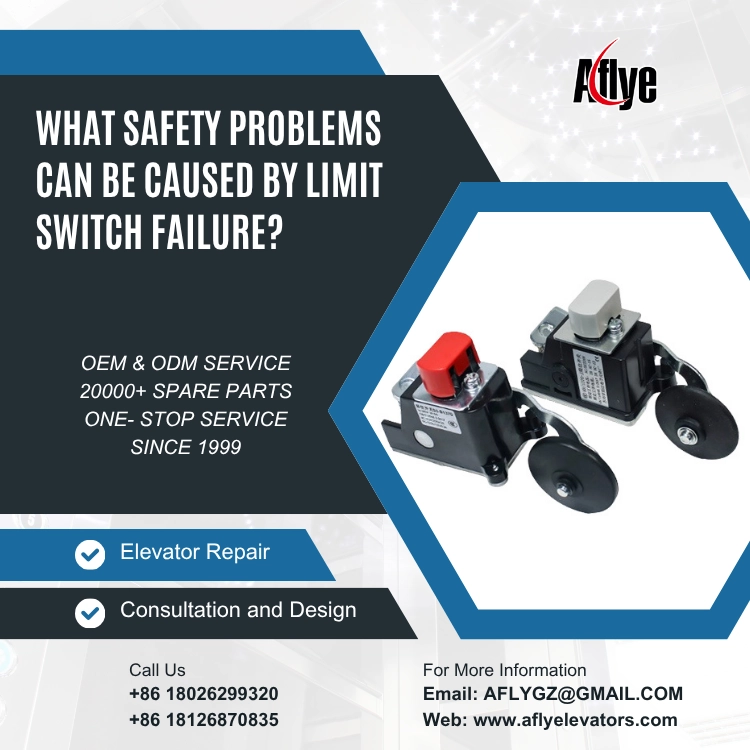
In elevator and escalator control systems, limit switches are one of the key safety protection devices. Their main function is to limit the operating range of the equipment and prevent overtravel or abnormal movement.
Once a limit switch fails, the equipment may lose critical protection functions, creating significant safety risks.
As a professional elevator & escalator parts supplier, A-FLY has found through maintenance practice that limit switch problems are often hidden, but their consequences should never be underestimated.
1. Risk of Equipment Overtravel
The core function of a limit switch is to restrict the operating range.
If it fails, the elevator or escalator may continue operating beyond its designated limit, causing overtravel conditions.
For elevators, this abnormality may affect leveling accuracy and, in severe cases, cause abnormal car positioning, affecting normal passenger entry and exit.
2. Increased Risk of Overrun or Bottom Impact
In elevator systems, limit switches often serve as the final layer of position protection.
If the switch fails and other protection devices do not respond in time, the risk of the elevator car overrunning the top or hitting the bottom may increase.
Although such incidents are relatively rare, they are serious safety hazards that require close attention.
3. Equipment Loss of Control or Protection Failure
Limit switches are used not only for position control but also as part of the safety circuit.
If the contacts fail, signals become abnormal, or wiring becomes loose, the system may not correctly identify equipment status, resulting in delayed or failed protective actions.
In some situations, this may also cause false triggering or sudden shutdowns.
4. Increased Load on Other Elevator & Escalator Spare Parts
After a limit switch failure, the equipment may operate abnormally, placing additional stress on the drive system, braking system, and other elevator spare parts.
Long-term operation under abnormal conditions can accelerate wear on related elevator & escalator spare parts and increase future maintenance costs.
5. Frequent Faults and Shutdowns
Limit switch abnormalities may also cause:
Frequent fault codes
False protection triggering
Operational interruptions
This can affect normal equipment usage.
In high-traffic locations such as shopping malls and subway stations, these problems directly impact operational efficiency and user experience.
Common Causes of Failure
Limit switch failure is usually related to:
Contact wear
Internal aging
Installation misalignment
Loose wiring
Environmental factors
For example, dust buildup, moisture corrosion, and long-term vibration can all reduce switch reliability.
These issues are more common in aging equipment or poorly maintained projects.
Maintenance Recommendations
During routine maintenance, technicians should regularly inspect:
Limit switch sensitivity
Installation position
Wiring condition
Contact wear or oxidation
For elevator & escalator spare parts that have been used for a long time or show unstable performance, timely replacement is recommended to ensure reliable and effective safety protection.
Conclusion
The risks caused by limit switch failure are not limited to abnormal operation — they are directly related to overall equipment safety.
Strengthening inspection and maintenance while choosing reliable elevator spare parts and professional elevator & escalator parts suppliers is essential for ensuring safe equipment operation.
A-FLY provides various limit switches and related elevator & escalator spare parts to help customers achieve more stable and safer operational management.