
What Are the Warning Signs Before an Escalator Brake Fails?
During escalator operation, the escalator brake is a critical component that ensures the escalator stops safely and is one of the core parts of the escalator safety system. Once the brake performance begins to deteriorate, it may cause unstable stopping, slipping, sudden impacts, or safety shutdowns. In severe cases, it can compromise passenger safety. Therefore, maintenance personnel should identify early warning signs through routine inspections and prepare for timely fault diagnosis and component replacement.
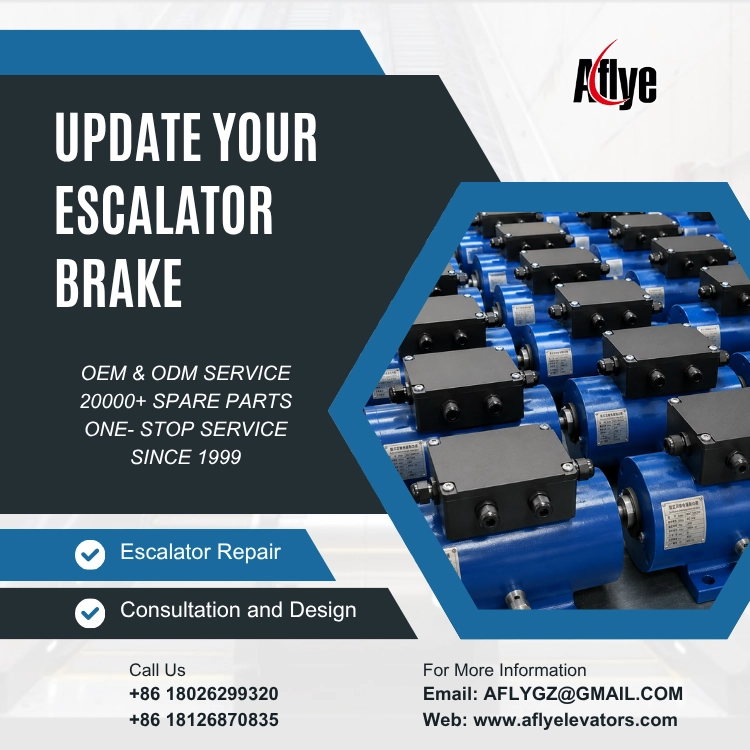
1. Longer Braking Distance When the Escalator Stops
Under normal conditions, an escalator should stop smoothly and reliably. If the escalator continues to move noticeably after shutdown or the stopping distance becomes longer than before, it may indicate worn brake linings, insufficient braking force, or weakened brake spring pressure.
Solution
Maintenance personnel should inspect the brake clearance, brake lining thickness, and brake spring condition. If the brake linings are severely worn, replace the escalator brake or related elevator and escalator spare parts promptly to prevent further deterioration of braking performance.
2. Abnormal Noise or Impact During Braking
A faulty escalator brake may produce sharp friction noises, metallic impacts, or noticeable jolts when the escalator stops. These symptoms are commonly caused by uneven brake lining wear, damaged brake disc surfaces, improper brake clearance, or loose mechanical components.
Inspection Recommendation
Inspect the brake disc for scratches, oil contamination, or deformation, and verify that all brake mounting bolts are securely tightened. If abnormal noises persist, repairs should be carried out as soon as possible to maintain the reliability of the escalator safety system.
3. Excessive Brake Temperature
If the escalator brake remains partially engaged during operation or the brake clearance is incorrectly adjusted, excessive heat may build up. Overheating accelerates brake lining wear, reduces braking performance, and may even damage nearby electrical components.
Maintenance Method
Check whether the brake is fully released during operation, and verify that the brake coil, power supply voltage, and control signals are functioning correctly. If the brake becomes excessively hot or emits a burning smell, stop the escalator immediately for inspection.
4. Frequent Fault Alarms or Failure to Start
When the escalator control system detects abnormal brake release, unstable brake feedback signals, or safety circuit faults, it may trigger fault alarms, prevent startup, or immediately activate protection after startup.
These symptoms are among the most important warning signs of impending escalator brake failure.
Solution
Maintenance personnel should analyze the fault codes and inspect the brake coil, microswitch, wiring terminals, and control circuits to determine whether the issue is electrical or mechanical.
5. Escalator Brake Procurement Recommendations
When purchasing an escalator brake, be sure to confirm:
Compatible brand
Model number
Braking torque
Voltage specification
Mounting hole dimensions
Brake disc size
Operating environment
Do not select a brake based solely on appearance, as incompatible components may result in installation issues, insufficient braking force, or abnormal control signals.
As a professional elevator and escalator spare parts supplier, A-FLY provides escalator brakes, brake discs, brake linings, control boards, step chains, handrails, comb plates, and a comprehensive range of elevator and escalator spare parts for maintenance companies, engineering contractors, and distributors worldwide.
A-FLY supports multi-model compatibility, bulk supply, OEM/ODM customization, and fast delivery, helping customers improve escalator maintenance efficiency and reduce downtime.
Conclusion
Escalator brake failure rarely occurs without warning. A longer stopping distance, abnormal noises, impact during braking, overheating, and frequent fault shutdowns are all important early warning signs.
Maintenance personnel should pay close attention to routine inspections of the escalator safety system and replace reliable elevator and escalator spare parts promptly to ensure long-term safe and stable escalator operation.