
Typical Symptoms of Poor Contact in Elevator Door Lock Contacts
In elevator safety systems, the door lock device is one of the most critical components for ensuring passenger safety. The door lock contacts, as a key electrical part of this system, can directly affect elevator operation if poor contact occurs—potentially leading to shutdowns or safety faults. Therefore, identifying the typical symptoms of poor door lock contact is essential for maintenance engineers.
As a professional elevator and escalator parts supplier, A-FLY has summarized common symptoms and solutions based on extensive global maintenance experience, helping customers resolve elevator faults more efficiently.
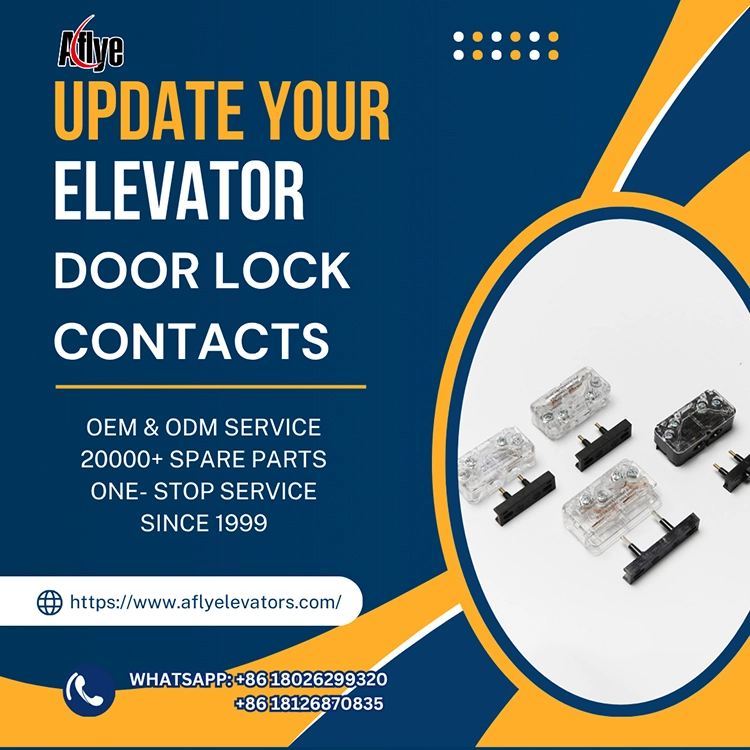
1. Frequent “Door Lock Not Closed” Alarms
One of the most common symptoms of poor contact is that the control system cannot detect the door lock closed signal.
Even when both the car door and landing door are fully closed, the system may display alarms such as:
“Door lock circuit not closed”
Similar safety loop errors
In this case, the elevator cannot start, significantly affecting operational efficiency. The root cause is usually oxidized, burned, or weakened contacts that prevent stable signal transmission.
2. Sudden Elevator Shutdown During Operation
In some cases, the elevator may suddenly stop during operation, accompanied by door lock circuit alarms.
This is often due to unstable contact, where vibration or movement causes intermittent disconnection. For example:
Oxidation or dust on contact surfaces
Increased contact resistance
If not resolved promptly, this issue may lead to repeated shutdowns and increased maintenance difficulty.
3. Abnormal Door Operation or Failure to Start
Poor contact may also disrupt normal door operation logic, such as:
Doors are closed but the elevator cannot start
Doors repeatedly open and close without stabilizing
Button commands show delayed or no response
These issues occur because the control system cannot accurately detect the door lock status.
4. Intermittent Faults That Are Hard to Reproduce
Unlike completely failed components, poor contact issues are often intermittent. The elevator may operate normally at times but fail under high usage or environmental changes.
This is typically caused by:
Contact aging
Spring fatigue
Insufficient contact pressure
Because the issue is not constant, it can be difficult to diagnose and requires careful inspection.
5. Contact Overheating or Burning
When contact is poor, electrical resistance increases at the contact point, generating heat.
Over time, this may result in:
Burn marks or discoloration
Contact surface damage or melting
This not only worsens the contact issue but also reduces the reliability of the entire door lock system. In such cases, related elevator components should be replaced immediately.
6. Common Causes of Poor Contact
Poor door lock contact is usually caused by:
Oxidation or contamination of contact surfaces
Mechanical wear or spring fatigue reducing contact pressure
Misalignment or installation errors
In humid or dusty environments, these issues occur more frequently and require more regular inspection.
7. Solutions and Replacement Recommendations
To address poor contact issues, the following steps are recommended:
Clean the contact surfaces to remove oxidation and contaminants
Check for mechanical misalignment or looseness in the door lock mechanism
Adjust components if necessary
Replace the door lock assembly if contacts are severely worn or burned
When selecting replacement parts, prioritize products with stable quality and strong compatibility. As a professional supplier, A-FLY offers a wide range of elevator door locks, contact components, and related parts suitable for various elevator systems.
Conclusion
Although poor door lock contact may seem like a minor issue, it can lead to major failures.
By identifying symptoms early, conducting systematic troubleshooting, and replacing key components with high-quality parts from a reliable supplier like A-FLY, maintenance teams can significantly reduce downtime and improve elevator safety.
Choosing a trusted partner like A-FLY ensures more efficient and reliable elevator maintenance, helping maintain long-term stable operation.