
What Risks Can Be Caused by Escalator Emergency Stop Switch Failure?
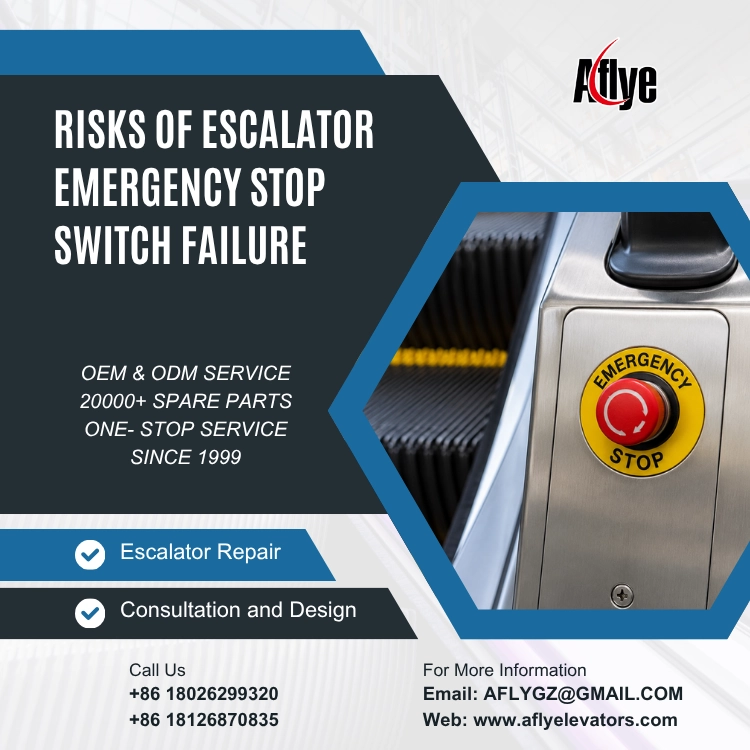
In an escalator safety system, the emergency stop switch is one of the most direct and critical manual intervention devices.
When an emergency occurs, passengers or staff can press the emergency stop switch to immediately stop the escalator, helping prevent an incident from escalating.
However, if the emergency stop switch fails, the risks involved are often underestimated.
As a professional elevator & escalator parts supplier, A-FLY has found through maintenance experience that although emergency stop switch issues may seem minor, they are directly related to the overall safety management of escalators.
1. Inability to Stop the Escalator Immediately in Emergencies
The primary function of an emergency stop switch is to quickly stop the escalator during an emergency.
If the switch fails, the escalator may not stop promptly when abnormal situations occur, such as:
Passenger entrapment
Falls on the escalator
Foreign objects becoming trapped in the system
As a result, accidents may become more severe.
2. Increased Safety Risks for Passengers
In public locations such as shopping malls, subway stations, and airports, escalators operate frequently and carry large numbers of passengers.
If the emergency stop switch cannot function properly, passengers lose an important safety measure during emergencies, increasing the risk of panic and personal injury.
3. Loss of a Critical Safety Protection Function
The emergency stop switch is an important part of the escalator safety circuit.
Its failure not only affects manual emergency operation but may also reduce the effectiveness of the entire safety protection system.
In some situations, even if other elevator & escalator spare parts are functioning normally, the overall safety protection capability of the system can be significantly weakened.
4. Potential Liability and Compliance Risks
A malfunctioning emergency stop switch may prevent the escalator from meeting required safety standards and regulations.
If an accident occurs, this may not only complicate emergency handling but also create liability and management risks for building owners and operators.
Therefore, the reliability of the emergency stop switch is extremely important.
5. Increased Load on Other Elevator & Escalator Spare Parts
When the emergency stop function fails, the escalator may continue operating under abnormal conditions.
This can place additional stress on components such as:
The drive system
The braking system
Other critical escalator spare parts
Over time, this may lead to secondary failures and increased maintenance costs.
Common Causes of Emergency Stop Switch Failure
Emergency stop switch failures are commonly caused by:
Contact wear
Internal component aging
Loose wiring connections
Installation misalignment
In addition, factors such as:
Dust accumulation
Moisture exposure
Frequent operation
can also shorten the service life of the switch.
Without regular inspections, these issues can be difficult to detect in time.
Maintenance Recommendations
During routine maintenance, technicians should regularly test the emergency stop switch to ensure that it is responsive and reliable.
Maintenance should include:
Checking contact conditions
Inspecting wiring connections
Ensuring there is no looseness or oxidation
Aged or unstable elevator & escalator spare parts should be replaced promptly to ensure proper operation during emergencies.
Conclusion
The risks associated with escalator emergency stop switch failure extend beyond abnormal equipment operation—they directly affect passenger safety and emergency response capability.
Regular inspections and the use of high-quality escalator spare parts are essential measures for ensuring safe escalator operation.
As a professional elevator & escalator parts supplier, A-FLY offers a wide range of safety switches and related elevator & escalator spare parts solutions, helping customers achieve safer and more efficient operation management.