
What Operating Problems Can Be Caused by Escalator Newel Chain Wear or Elongation?
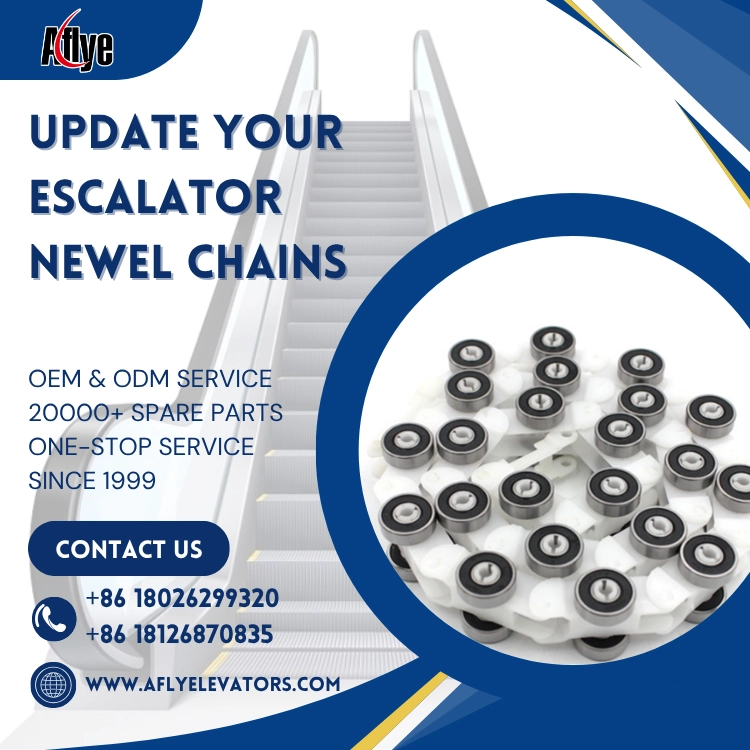
The escalator newel chain is an important transmission component in the upper and lower turnaround sections of an escalator. Working together with sprockets and the tensioning mechanism, it guides related components through a stable circulating movement. Its condition directly affects the synchronization of the escalator step system and the overall escalator drive system.
When a chain is described as “stretched,” the chain plates themselves have usually not physically elongated. Instead, long-term wear of the pins, bushings, and rollers gradually increases the distance between chain link centers. Once the escalator chain pitch exceeds the allowable tolerance, the original engagement with the sprocket is disrupted, causing increasingly serious operating problems.
1. Poor Sprocket Engagement Causes Periodic Impact
Under normal conditions, the newel chain should engage accurately with the sprocket teeth. When the chain becomes worn and elongated, the rollers no longer enter the tooth grooves at the correct position, which may result in poor engagement, tooth climbing, and impact.
Common symptoms include:
Clicking noises in the upper or lower turnaround sections;
Periodic changes in operating noise;
Increased chain and sprocket vibration;
Chain skipping in severe cases.
Continuous impact can also accelerate sprocket tooth wear, turning a single chain problem into a larger transmission system failure.
2. Unstable Step Turnaround Affects Operating Synchronization
A loose newel chain or inconsistent chain pitch can cause fluctuations in the movement path within the turnaround section. As a result, the steps may not enter or leave the turnaround area smoothly.
Possible symptoms include slight step vibration, impact during turnaround, uneven operating rhythm, and changes in local clearances.
If these problems occur together with abnormalities in the step chain, guide rails, or rollers, the overall stability of the escalator step system may be further affected.
3. Increased Transmission Resistance Raises Motor Load
When the newel chain joints become stiff, rollers seize, or chain tension becomes abnormal, transmission resistance increases.
The drive system then needs to produce more torque, which may result in:
Increased motor current;
Higher gearbox load;
Greater impact during starting and stopping.
Long-term operation under these conditions not only increases energy consumption but may also shorten the service life of sprockets, bearings, and other drive system components.
4. Main Causes of newel chain Wear or Elongation
Common causes include:
Insufficient lubrication or deteriorated lubricant;
Dust and foreign objects entering the chain joints;
Long-term high-load operation;
Incorrect chain tension adjustment;
Uneven sprocket wear;
Incorrect sprocket or shaft alignment.
If the chains on both sides show different levels of wear, technicians should also inspect sprocket alignment, shaft condition, and the tensioning mechanism. This helps prevent uneven wear from recurring shortly after chain replacement.
5. Escalator Maintenance Solutions
During escalator maintenance, technicians should inspect:
newel chain pitch;
Overall chain elongation;
Roller rotation condition;
Pin wear;
Sprocket tooth profile.
If stiff links, excessive looseness, severe corrosion, or excessive pitch deviation are found, it is recommended to replace the complete matched chain rather than repairing only individual links.
After replacement, chain tension and synchronization between both sides should be readjusted. A low-speed test run should then be performed to confirm that there is no impact, tooth climbing, chain skipping, or abnormal noise in the turnaround section.
6. Escalator newel chain Purchasing Recommendations
When purchasing an escalator newel chain, it is important to confirm:
Chain pitch;
Number of chain links;
Roller diameter;
Pin dimensions;
Connection method;
Total chain length;
Matching sprocket specifications.
It is recommended to provide photos of the original part, nameplate information, dimensional drawings, or samples for accurate matching. Chains with similar pitches may still have different structures, which can lead to installation problems.
Buyers should also consider material strength, heat-treatment quality, pin-to-bushing fit accuracy, and whether the supplier can provide matched chains and sprockets as a complete solution.
A-FLY Elevator & Escalator Parts Supply Capability
A-FLY supplies escalator newel chains, escalator chains, step chains, tension chains, sprockets, step rollers, and other elevator and escalator parts to maintenance companies, engineering contractors, and spare parts distributors worldwide.
We support sample matching, drawing confirmation, OEM/ODM customization, and bulk supply. A-FLY can provide suitable spare parts solutions for escalator maintenance, modernization, and spare parts inventory projects.
Conclusion
Wear or elongation of the escalator newel chain can disrupt sprocket engagement and turnaround synchronization, leading to noise, vibration, chain skipping, and increased transmission load.
Regularly checking chain pitch, lubrication, and tension, while using accurately sized and reliable escalator parts, can effectively reduce failure and downtime risks.