
Why Does Elevator Guide Shoe Liner Wear Cause Car Shaking and Abnormal Running Noise?
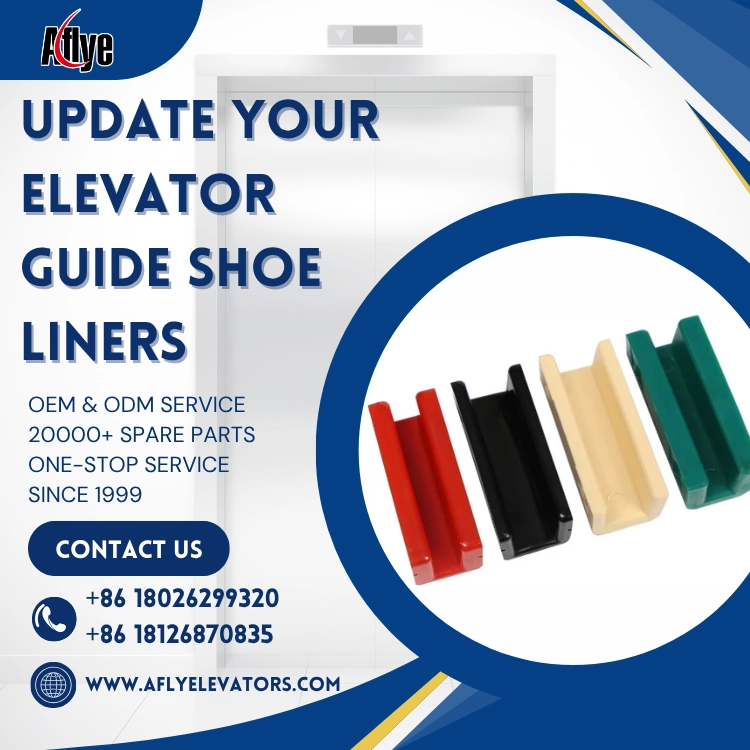
The elevator guide shoe liner is a high-frequency wear component in the elevator car guiding system. It is installed inside the elevator guide shoe and maintains sliding contact with the elevator guide rail.
Its main function is to restrict lateral movement of the elevator car, absorb local impacts, and reduce direct friction between metal components.
When the elevator shoe liner becomes worn, deformed, or hardened, the clearance between the guide shoe and guide rail increases. As a result, the elevator car loses stable guidance during operation, causing elevator car shaking, vibration, and abnormal running noise.
1. Guide Shoe Liner Wear Increases Guide Clearance
Under normal conditions, the guide shoe liner should maintain a proper working clearance with the guide rail surface.
After long-term operation, continuous friction gradually reduces the thickness of the shoe liner, causing the elevator car to move laterally during acceleration, deceleration, or when passing guide rail joints.
Common symptoms include:
Left and right shaking of the elevator car;
Noticeable vibration during starting and braking;
Reduced riding comfort at high speed;
Increased vibration when passing certain floors.
In severe cases, excessive liner wear may cause direct contact between the metal parts of the guide shoe and the guide rail, increasing impact and operating noise.
2. Hardened or Damaged Shoe Liners Cause Abnormal Running Noise
Some shoe liners may lose their original wear resistance and cushioning ability after long-term exposure to:
Oil contamination;
Dust;
Temperature changes;
Continuous compression.
If cracks, missing corners, or partial peeling occur, the contact between the guide shoe and guide rail may produce:
Friction sounds;
Impact noises;
Periodic scraping sounds.
In this situation, simply cleaning the guide rail cannot solve the problem. The condition of the shoe liner surface, fixing condition, and guide shoe installation position should be checked, and replacement should be carried out when necessary.
3. Guide Rail Problems Can Accelerate Shoe Liner Wear
Elevator running noise is not always caused only by poor shoe liner quality.Problems with the guide rail, such as:
Misalignment at guide rail joints;
Verticality deviation;
Surface burrs;
Abnormal lubrication conditions;
can cause uneven lateral forces on the shoe liner, resulting in uneven or one-sided wear.
Therefore, when replacing elevator shoe liners, maintenance technicians should also inspect:
Guide rail alignment;
Elevator car balance;
Guide shoe fixing bolts.
This helps prevent newly installed components from failing again in a short period.
4. Maintenance and Troubleshooting Solutions
It is recommended to troubleshoot according to the sequence:
Shoe liner → Guide shoe → Guide rail → Elevator car balance
Maintenance steps include:
Measure the remaining thickness and clearance of the shoe liner;
Check for uneven wear, cracks, or material hardening;
Confirm guide shoe installation position and fastening condition;
Inspect guide rail joints, vertical alignment, and surface condition;
Perform no-load and load test runs after replacement.
If different groups of shoe liners show significantly different wear levels, the elevator car center of gravity and the force balance of the guiding system should also be checked.
5. Elevator Shoe Liner Purchasing Recommendations
When purchasing elevator guide shoe liners, it is important to confirm:
Guide shoe model;
Shoe liner length, width, and thickness;
Groove structure;
Material type;
Guide rail specifications.
Even if different elevator guide shoes look similar, their actual installation dimensions and clearance requirements may vary.
It is recommended to provide:
Original component photos;
Actual measurement data;
Guide rail width;
Samples for verification.
Choosing products with good wear resistance, dimensional accuracy, and stable material performance can improve service life and reduce maintenance frequency.
A-FLY Elevator & Escalator Parts Supply Capability
As a professional elevator and escalator parts supplier, A-FLY provides:
Roller guide shoes;
Guide rollers;
Guide rail components;
And various other elevator and escalator parts.
A-FLY supports:
Sample matching;
Drawing confirmation;
OEM/ODM customization;
Bulk supply.
According to different elevator maintenance and modernization projects, A-FLY can provide customized component solutions to help customers improve maintenance efficiency and reduce equipment downtime.
Conclusion
Although the elevator guide shoe liner is a small wear component, its condition directly affects elevator riding comfort and operating stability.
Shoe liner wear not only reduces passenger comfort but may also accelerate damage to guide rails and guide shoes.
When elevator car shaking or abnormal running noise occurs, technicians should promptly inspect shoe liner clearance, guide rail condition, and guiding system installation accuracy.
Selecting properly matched and reliable elevator spare parts can effectively prevent failures from developing further and ensure long-term safe and smooth elevator operation.