
Plastic Door Hanger Rollers vs. PU Door Hanger Rollers
In an elevator door system, door hanger rollers determine how smoothly the door panels travel along the guide rail.
When replacing door hanger rollers, many maintenance technicians struggle with a common question: what is the real difference between plastic door hanger rollers and PU door hanger rollers? Can they be used interchangeably?
Based on real operational results, the answer is no.
As a long-term global elevator & escalator spare parts supplier, A-FLY has found through numerous door operator maintenance cases that plastic and PU door hanger rollers are designed for completely different operating conditions. Choosing the wrong material is often the root cause of door noise, jamming, and shortened service life.
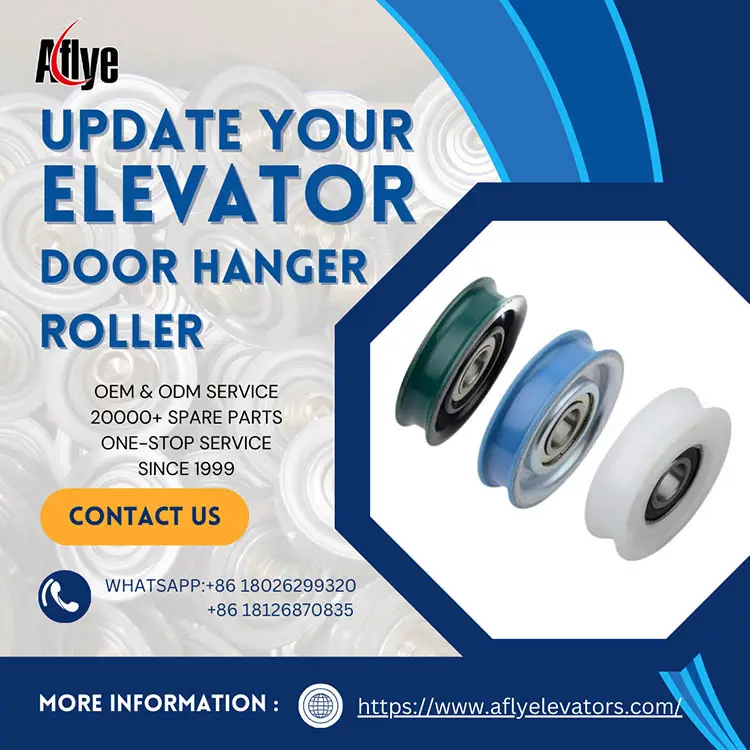
1. A Clear Conclusion First: Different Materials Mean Different Operating Logic
The material of a door hanger roller directly affects several key factors:
Friction characteristics with the guide rail
Impact resistance and vibration absorption
Long-term wear behavior
Load distribution on the door operator
Therefore, plastic and PU door hanger rollers are not a “low-end vs. high-end” choice, but two different solutions for different working conditions.
2. Typical Characteristics of Plastic Door Hanger Rollers
Plastic door hanger rollers usually have the following features:
Relatively hard material with minimal deformation
Low rolling resistance in the early stage
Lower cost
Suitable for light doors and low-frequency operation
In elevators with lighter door panels and lower usage frequency, plastic door hanger rollers can meet basic operating requirements.
However, during long-term operation, plastic rollers are more likely to develop:
Slippage after surface polishing
Gradually increasing noise
Limited impact resistance
3. Where Do PU Door Hanger Rollers Excel?
PU (polyurethane) door hanger rollers are widely used in elevator door systems because their material properties are more “door-operator friendly”:
Better elasticity, absorbing operational vibration
Higher conformity with guide rails
Quieter rolling performance
Less wear on the guide rail
In environments with high door-opening frequency, heavier door panels, or strict noise requirements, PU door hanger rollers can significantly improve overall operating experience.
4. Noise Difference: The Most Intuitive Indicator
In the same door operator system:
Plastic door hanger rollers are more likely to develop dry noise or squealing after a period of use
PU door hanger rollers, thanks to their cushioning properties, show much slower noise increase
This is why PU door hanger rollers are preferred in hotels, office buildings, hospitals, and other noise-sensitive projects.
5. The Higher the Usage Frequency, the Greater the Difference
In high-frequency scenarios such as shopping malls or residential buildings during peak hours:
Plastic door hanger rollers are more prone to uneven wear due to fatigue
PU door hanger rollers distribute impact forces more effectively
As a result, plastic rollers require more frequent replacement, while PU rollers offer a significantly longer service life.
6. Not Every Scenario “Must Use PU”
It is important to note that PU door hanger rollers are not the only choice in every situation. Plastic door hanger rollers remain reasonable when:
Door panels are lightweight
Usage frequency is low
Cost control is a priority
Environmental conditions are relatively stable
The key is not “which option is more expensive,” but whether the roller matches the actual operating conditions.
7. Improper Mixing Often Leads to Problems
Common mistakes in real maintenance work include:
Replacing rollers on only one side with a different material
Mixing new and old materials
Ignoring changes in door panel weight
These practices can cause asynchronous door movement and uneven load on the door operator, triggering a chain of related failures.
8. How to Choose the Right Door Hanger Roller Material
When selecting door hanger rollers, it is recommended to consider:
Door panel weight
Average daily opening and closing cycles
Noise requirements
Current condition of the door operator
Only by evaluating the system as a whole can door hanger rollers perform as intended.
9. A-FLY’s Multi-Scenario Door Hanger Roller Solutions
As a professional elevator & escalator spare parts supplier, A-FLY provides plastic door hanger rollers, PU door hanger rollers, and related elevator door operator components in multiple specifications.
A-FLY also assists customers with material selection based on different application scenarios, helping avoid repeated maintenance caused by improper roller choice.
Conclusion
There is no absolute answer to whether plastic or PU door hanger rollers are “better”—the only real question is whether they are used in the right place.
In elevator door system maintenance and upgrades, choosing the correct roller material is often far more effective than repeatedly adjusting the door operator.
By selecting suitable elevator & escalator components and working with an experienced supplier like A-FLY, you can ensure that elevator door systems remain quiet, smooth, and reliable over the long term.