
Why Does Moving Walk Handrail Friction Wheel Wear Cause Handrail Slippage?
During moving walk operation, the moving walk handrail friction wheel is an important transmission component in the handrail drive system. It transfers driving force through friction between the wheel surface and the handrail.
When the friction wheel becomes worn, aged, or its surface condition deteriorates, friction is reduced, which may cause moving walk handrail slippage, unstable handrail speed, and other operating problems.
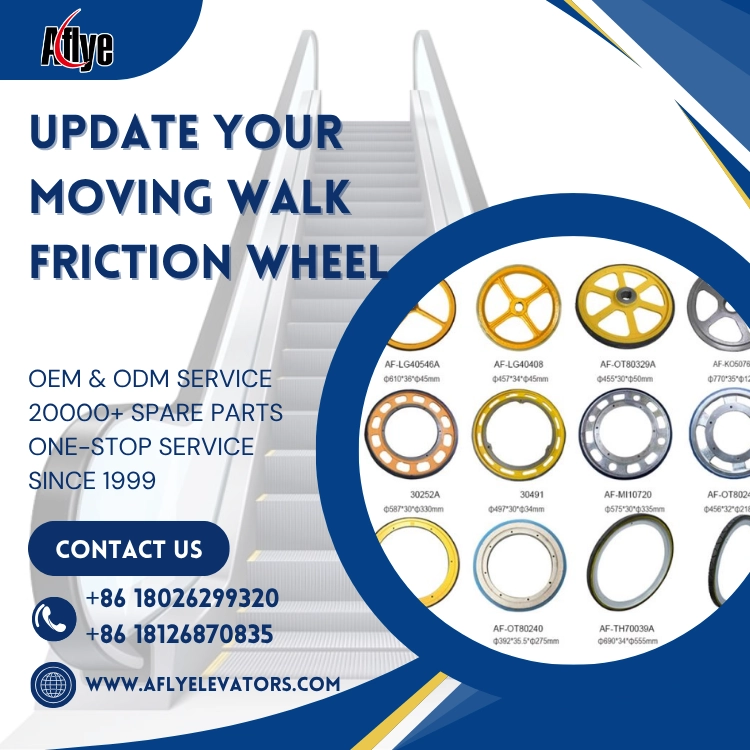
1. Why Does a Handrail Drive Friction Wheel Wear?
1. Long-Term Friction Causes Surface Wear
As the handrail operates continuously, the friction wheel is exposed to constant pressure and friction.
Over time, the wheel surface may become:
Worn or flattened;
Hardened;
Unevenly worn.
These conditions reduce the effective contact area and friction between the wheel and handrail, affecting power transmission.
2. Abnormal Handrail Tension
If the moving walk handrail is too loose, the contact pressure between the handrail and friction wheel decreases.
If the handrail is too tight, the load on the friction wheel increases.
Both conditions can accelerate friction wheel wear and affect the stability of the handrail drive system.
3. Aging Friction Wheel Material
Long-term exposure to high temperatures, humidity, or frequent operation may cause the friction wheel material to deteriorate.
The wheel surface may harden or crack, reducing its friction coefficient and ability to transmit driving force effectively.
2. Why Does Friction Wheel Wear Cause Handrail Slippage?
Under normal conditions, the handrail drive wheel must maintain sufficient friction to transfer driving force reliably to the handrail.
When the friction wheel diameter changes due to wear, the wheel surface becomes damaged, or the friction coefficient decreases, the available traction force is reduced.
When the load increases or handrail resistance changes, this may result in:
Intermittent handrail slippage;
Reduced handrail speed;
Handrail vibration or jerking;
Handrail speed becoming unsynchronized with the pallets;
Abnormal friction noise from the drive area.
In severe cases, handrail slippage may also increase the load on other components in the moving walk handrail drive system.
3. How to Solve Moving Walk Handrail Slippage
During moving walk maintenance, technicians should inspect:
Friction wheel surface condition;
Friction wheel installation;
Handrail tension;
Handrail drive mechanism operation.
If the friction wheel shows obvious wear, cracking, or surface hardening, timely friction wheel replacement is recommended.
The handrail should also be checked for aging, deformation, or abnormal running resistance. If necessary, these problems should be corrected at the same time to prevent premature wear of the new friction wheel.
4. Moving Walk Wear Parts Purchasing Tips
When purchasing a moving walk handrail friction wheel, the following specifications should be confirmed:
Equipment model;
Friction wheel outer diameter;
Wheel width;
Shaft diameter;
Wheel surface material;
Installation method.
Friction wheel specifications may vary between different moving walk models and systems.
Before purchasing, it is recommended to provide the original part model, clear photos, and measured dimensions to improve matching accuracy and reduce the risk of ordering incompatible parts.
5. A-FLY Elevator & Escalator Parts Supply Capability
A-FLY supplies a wide range of moving walk, escalator, and elevator spare parts, including:
Moving walk handrail friction wheels;
Handrail drive wheels;
Other commonly replaced moving walk parts.
These products are suitable for moving walk maintenance, repair, and modernization projects.
A-FLY supports model confirmation, dimensional matching, sample confirmation, and OEM/ODM customization services, providing maintenance companies, engineering contractors, and spare parts distributors with one-stop elevator, escalator, and moving walk spare parts purchasing solutions.
Conclusion
Moving walk handrail friction wheel wear directly reduces power transmission efficiency and is one of the common causes of handrail slippage and unstable speed.
Regular inspection of the friction wheel, handrail tension, and drive system, together with timely replacement of worn moving walk components, can help maintain smooth and stable handrail operation.