
Why Does Moving Walk Comb Plate Wear Cause Pallet Movement Problems?
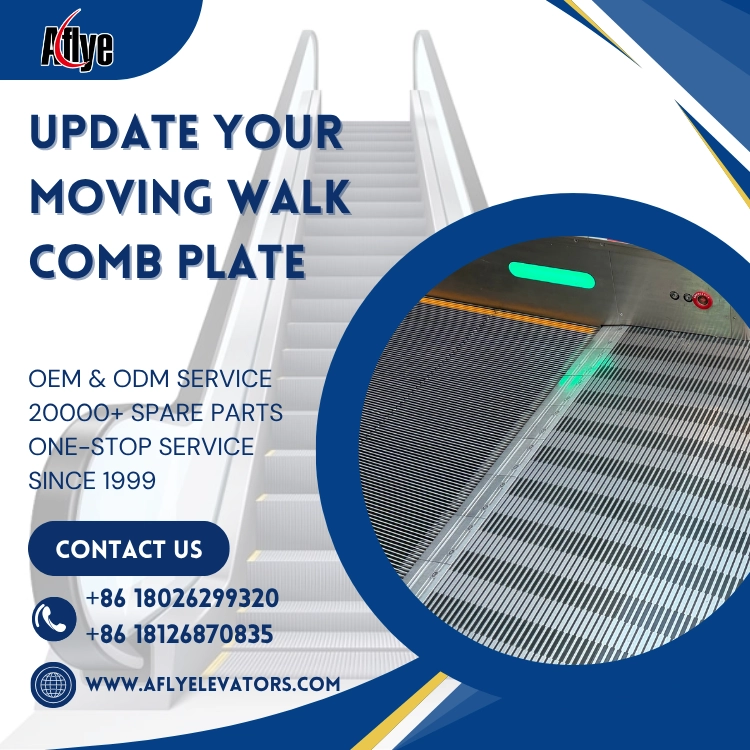
During the operation of a moving walk, the moving walk comb plate is located at the entrance and exit ends where the pallets enter or leave the landing area. It must engage correctly with the grooves of the moving walk pallets and is an important safety component.
When the comb plate becomes worn, deformed, or incorrectly positioned, the moving walk pallets may not pass through the comb area smoothly, increasing operating and safety risks.
1. Why Do Moving Walk Comb Plates Wear?
1. Long-Term Friction and Impact
Moving walk pallets operate continuously in a circulating system. As the pallets repeatedly pass through the comb plate area, the comb teeth are exposed to long-term friction and impact.
Over time, this may cause:
Worn comb tooth tips;
Thinning of the comb teeth;
Comb tooth deformation.
2. Abnormal Pallet Operation
If the moving walk pallets are deformed or misaligned, or if the pallet rollers become worn, the engagement between the pallets and comb plate may change.
This can increase friction and impact, accelerating comb plate wear.
3. Incorrect Installation Position
If the installation height, angle, or clearance of the comb plate does not meet the required specifications, the pallets may collide with the comb teeth when entering the comb area.
Repeated contact and impact can further accelerate moving walk comb plate wear.
2. What Problems Can Worn Comb Plates Cause?
When the comb teeth become severely worn or deformed, the moving walk pallets may experience:
Difficulty entering or leaving the landing area smoothly;
Collision, sticking, or abnormal noise;
Increased impact during pallet movement;
Improper engagement between the comb plate and pallets.
In severe cases, a damaged comb plate may create a potential risk to passengers' feet. Therefore, the moving walk comb plate should not be treated simply as an ordinary wear part—it is also an important safety component.
3. How to Solve Moving Walk Comb Plate Wear Problems
During moving walk maintenance, technicians should inspect:
Comb tooth condition;
Comb plate installation position;
Engagement between the comb plate and pallets;
Pallet condition;
Pallet rollers;
Guide rails.
Minor installation deviations can usually be corrected through proper adjustment.
However, if the comb plate shows obvious wear, broken teeth, deformation, or other damage, timely moving walk comb plate replacement is recommended.
After replacement, the movement of the pallets through the comb area should be checked again to ensure smooth and correct engagement.
4. Moving Walk Parts Purchasing Tips
When purchasing moving walk spare parts, the following comb plate specifications should be carefully confirmed:
Comb plate length;
Comb plate width;
Tooth pitch;
Mounting hole positions;
Material;
Moving walk model.
Comb plate structures may vary between different moving walk models and systems. Therefore, replacement parts should not be selected based only on appearance.
Providing photos of the original part, model information, and measured dimensions can help ensure that the replacement component matches the equipment correctly.
5. A-FLY Elevator & Escalator Parts Supply Capability
A-FLY supplies a wide range of elevator, escalator, and moving walk spare parts, including:
Escalator and moving walk chains;
Other elevator and escalator spare parts.
These products are suitable for equipment maintenance, repair, and modernization projects.
For different models and project requirements, A-FLY supports model confirmation, dimensional matching, sample confirmation, and OEM/ODM customization services, providing customers with one-stop elevator, escalator, and moving walk spare parts purchasing solutions.
Conclusion
Moving walk comb plate wear can directly affect the smooth passage of pallets through the landing area and may increase operating and safety risks.
Regular inspection of the engagement between the comb plate and pallets, together with timely replacement of worn or damaged moving walk parts, is an important measure for maintaining stable equipment operation and passenger safety.