
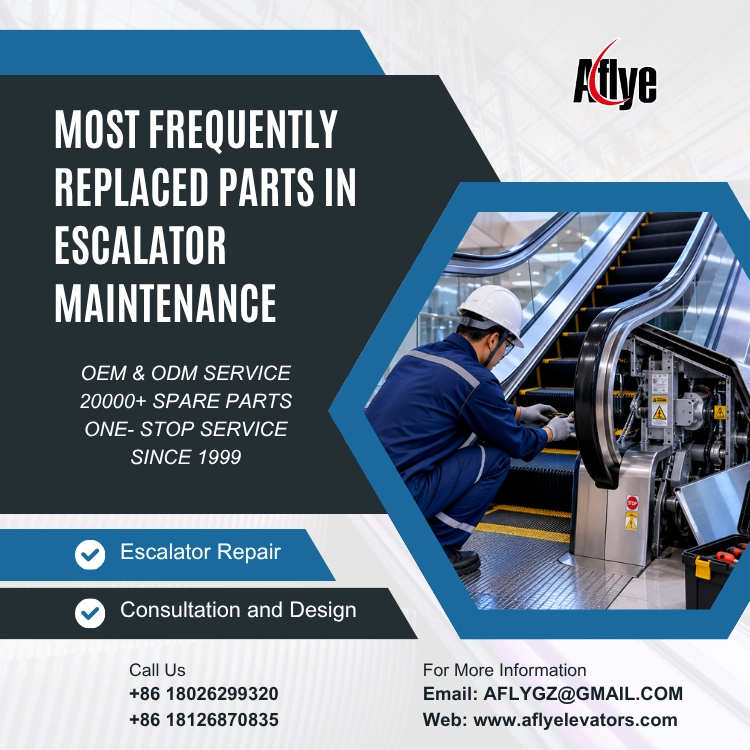
Most Frequently Replaced Parts in Escalator Maintenance
During the long-term operation of escalators, continuous heavy usage and constant loads cause certain key components to gradually wear out or age, requiring regular replacement.
For maintenance companies, understanding common wear parts in advance and maintaining proper spare parts inventory can significantly improve maintenance efficiency and reduce downtime.
As a professional elevator & escalator parts supplier, A-FLY has summarized the following high-frequency replacement parts based on extensive project experience.
1. Escalator Step Rollers
Step rollers are essential components that support the movement of escalator steps.
Since they continuously bear loads and friction, they are prone to:
Wear and tear
Bearing damage
Abnormal noise
Once the rollers become faulty, escalator operation may become unstable and even generate vibration.
2. Step Chains and Drive Chains
Escalator chains are critical transmission components.
After long-term operation, they may experience:
Elongation
Loosening
Wear
Poor chain condition directly affects transmission efficiency and operational stability, making chains one of the most important components to inspect and replace during maintenance.
3. Friction Wheels
Escalator friction wheels play a vital role in power transmission.
When slipping, hardening, or surface wear occurs, they may cause:
Unstable operation
Increased noise
Transmission failure
As a result, friction wheels are replaced more frequently in high-traffic environments.
4. Escalator Brakes and Related Components
The braking system is a key part of escalator safety protection.
Escalator brakes and brake linings gradually wear out or lose performance over time.
Failure to replace worn brake components in time may affect braking efficiency and compromise equipment safety.
5. Handrails and Guide Components
Escalator handrails are continuously exposed to friction and environmental conditions, making them susceptible to:
Aging
Cracking
Misalignment
At the same time, worn guide components can affect handrail stability and smooth operation.
These escalator spare parts also require regular replacement.
6. Safety Switches and Sensors
These include:
Emergency stop switches
Other safety contacts
Although relatively small in size, these components are critical to escalator safety.
After long-term use, they may develop poor contact or fail completely, affecting the reliability of the safety circuit.
7. Lighting and Auxiliary Components
Auxiliary components such as:
Escalator LED light strips
Indicator lights
can age or become damaged in humid or high-temperature environments.
Although they do not directly affect core escalator operation, they impact overall appearance, passenger experience, and system presentation.
Maintenance Recommendations
In routine maintenance, inspection and replacement schedules should be established according to equipment usage frequency and operating environment.
For critical elevator & escalator spare parts, it is recommended to prioritize products with:
Stable quality
High compatibility
Reliable performance
This helps reduce repeat repairs and minimize downtime risks.
Maintaining a reasonable spare parts inventory is also recommended to improve maintenance response efficiency.
Conclusion
Understanding the most frequently replaced parts in escalator maintenance helps maintenance teams optimize spare parts management and improve service efficiency.As a professional elevator & escalator parts supplier, A-FLY provides a comprehensive range of escalator spare parts and one-stop procurement solutions, helping customers achieve more stable, efficient, and cost-effective operation management.