
Monarch Elevator Debugger Faults & Replacement Solutions
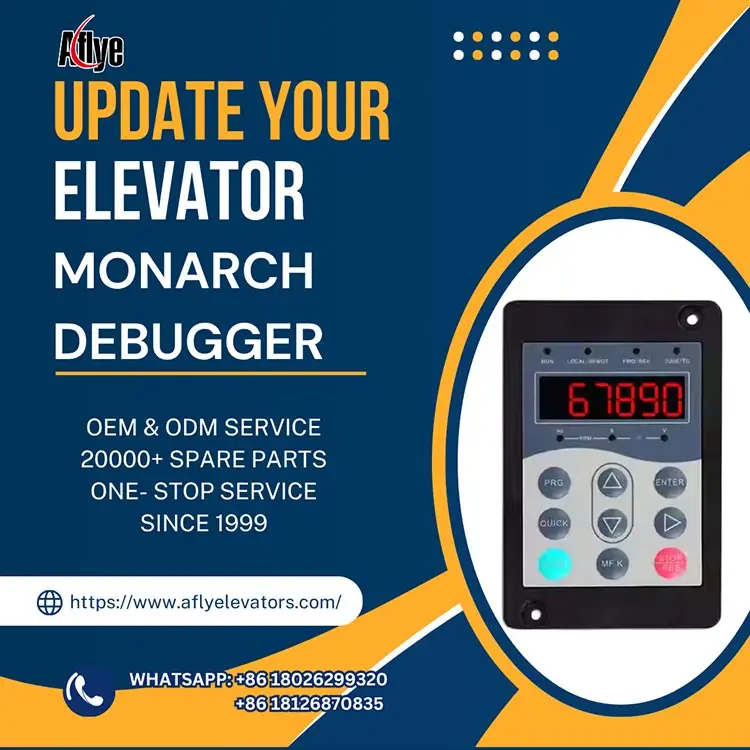
In elevator systems, the Monarch elevator debugger plays a vital role in signal display, parameter adjustment, and fault indication. Whether located in the control cabinet, inside the elevator car, or on landing operation panels, the debugger serves as the core interface for maintenance personnel to monitor system status.
In practical maintenance projects, elevator shutdowns or alarms are often first reflected through abnormal displays on the debugger. As a professional supplier serving the global market, A-FLY has found that most debugger failures are not caused by core program issues, but by aging peripheral components or interface problems.
1. No Display or Black Screen
A black screen is a common issue with elevator debuggers. Possible causes include:
Abnormal output from the power supply module
Loose or poorly connected ribbon cables
Damaged backlight circuit
Aging internal electronic components
During troubleshooting, priority should be given to checking power stability and interface connections. If the power supply is normal but there is still no display, replacing the debugger with a compatible model is usually required.
2. Unresponsive or Slow Buttons
If the debugger buttons fail to respond or respond slowly, possible causes include:
Oxidized button contacts
Aging membrane switches
Moisture affecting internal circuit boards
Abnormal signal transmission
These issues are more common in high-humidity or high-frequency usage environments. Replacing a reliable operation panel or button module is often the most effective solution.
3. Frequent Alarm Code Display
When the Monarch debugger frequently shows alarm codes, the issue is often not with the panel itself but with other system components, such as:
Abnormal encoder signals
Unstable door lock circuits
Brake feedback issues
Poor heat dissipation of the inverter
In many cases, the debugger is simply a “display window” for faults, while the actual problem lies in other elevator or escalator components.
4. Garbled or Flickering Display
If the panel shows distorted characters, flickering, or incomplete information, possible causes include:
Loose communication interfaces
Data transmission interference
Aging internal chips
At this stage, it is important to check communication cables and grounding conditions, eliminate interference sources, and then determine whether panel replacement is necessary.
5. Potential Impact of Debugger Failures
Although the debugger does not directly control elevator operation, its malfunction can lead to:
Difficulty in accurately diagnosing faults
Increased risk of incorrect operation
Reduced debugging efficiency
Longer maintenance time
In high-frequency operation environments, a stable debugger system is essential.
6. Correct Approach to Spare Parts Replacement
When handling Monarch debugger faults, the following troubleshooting logic is recommended:
Check power supply and interface connections first
Inspect the condition of peripheral elevator components
Verify communication and signal wiring integrity
Only then consider replacing the debugger unit
This outside-to-inside approach helps reduce misdiagnosis and unnecessary replacement costs.
7. Comprehensive Control System Support from A-FLY
As a professional elevator and escalator spare parts supplier, A-FLY provides:
Elevator debuggers and operation interface components
Main control boards and drive system parts
Door lock and safety circuit components
Encoders and signal-related spare parts
These solutions help maintenance teams quickly locate faults and complete efficient replacements.
Conclusion
Failures in Monarch elevator debuggers are often just surface symptoms, while underlying issues may involve signal transmission, power supply, or mechanical systems.
Through systematic troubleshooting, proper replacement of key components, and cooperation with an experienced supplier like A-FLY, it is possible to restore stable elevator operation and significantly reduce long-term maintenance costs.
In elevator maintenance and modernization projects, accurate diagnosis and reliable component selection are key to improving efficiency and safety.