
Issues Caused by Elevator Leveling Magnetic Sensor Failure
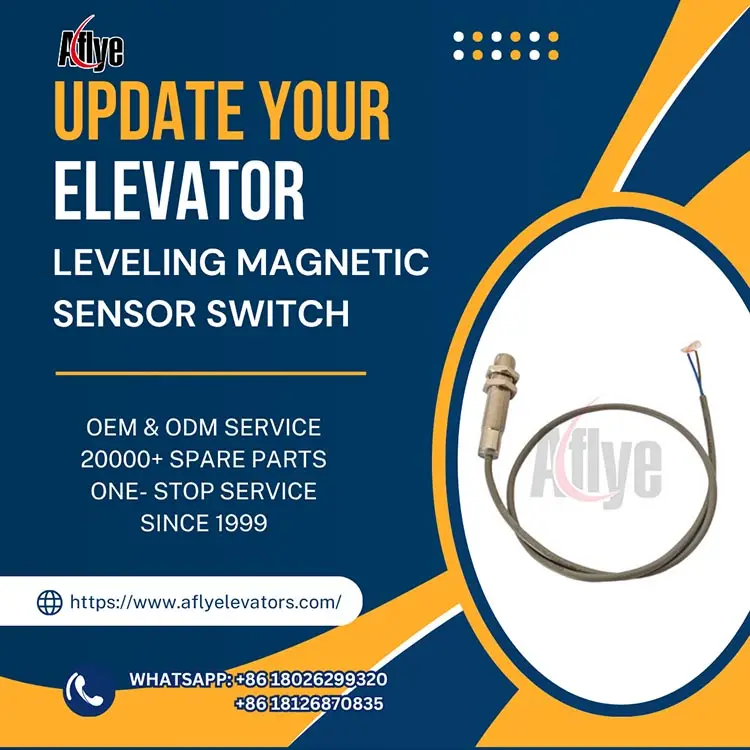
In modern elevator control systems, the leveling magnetic sensor switch is a critical position detection device. It detects magnetic signals installed in the hoistway and feeds back the car position to the control system, enabling the elevator to stop precisely at each floor. Once this sensor fails or its signal becomes abnormal, the elevator’s operation will be noticeably affected.
In practical maintenance work, such issues are quite common. As a professional supplier serving the global market, A-FLY has found that many problems such as inaccurate leveling, stopping deviations, and abnormal operation are often caused by failures of the leveling magnetic sensor switch or related components.
1. Inaccurate Elevator Leveling
The primary function of the magnetic sensor switch is to provide leveling signals. When it fails, the control system cannot accurately determine the car position, resulting in:
The car stopping above floor level
The car stopping below floor level
Noticeable leveling deviation
This not only affects passenger comfort but may also create safety risks, especially for the elderly, children, or people with limited mobility.
2. Repeated Micro-Adjustment After Arrival
When the sensor signal is unstable, the control system may repeatedly attempt to correct the car position. This is typically observed as:
Slight upward or downward movement after arrival
Repeated adjustments before door opening
Extended stopping time at the floor
Although this “creeping” behavior may seem minor, it increases operating time and adds load to the drive system and other elevator components.
3. Reduced Operational Efficiency
Inaccurate leveling signals affect the deceleration and positioning process. If the system cannot correctly identify the floor position:
The elevator may decelerate too early
Or stop too late
This reduces overall operational efficiency, especially in high-rise buildings or high-traffic environments.
4. System Alarms or Shutdown
In some control systems, if the magnetic sensor signal is lost or abnormal, safety protection mechanisms are triggered. Common symptoms include:
The elevator cannot start normally
The system displays leveling signal errors
Fault codes appear and the elevator stops
In such cases, maintenance personnel should inspect the magnetic sensor switch and related components.
5. Common Causes of Magnetic Sensor Failure
In real maintenance scenarios, failures are usually caused by:
Component aging
Long-term operation in the hoistway environment can lead to degradation of electronic components.
Misalignment of hoistway magnets
Loose or shifted magnets prevent accurate signal detection.
Poor wiring connections
Loose, damp, or aging cables can disrupt signal transmission.
Additionally, dust, oil contamination, and humidity may also affect sensor performance.
6. How to Determine if the Sensor Is Faulty
Maintenance engineers can check the following during routine inspections:
Whether the elevator levels accurately
Indicator light status of the magnetic sensor
Position of hoistway magnets
Stability of wiring connections
If abnormalities are detected, related elevator components should be replaced promptly.
7. Importance of High-Quality Elevator Components
Although the leveling magnetic sensor switch is a small component, it plays a decisive role in positioning accuracy. High-quality sensors provide:
More stable signal detection
Longer service life
Reduced leveling errors
Therefore, choosing reliable elevator and escalator spare parts is essential during maintenance and upgrades.
8. Professional Solutions from A-FLY
As a professional supplier, A-FLY offers a wide range of elevator control system components, including:
Leveling magnetic sensor switches
Other elevator and escalator spare parts
These products are compatible with various control systems and help maintenance teams quickly diagnose and resolve issues.
Conclusion
Although the elevator leveling magnetic sensor switch is a small component, it is essential for accurate floor leveling.
By regularly inspecting the leveling system, replacing key components in time, and working with a reliable supplier like A-FLY, it is possible to reduce leveling errors, improve operational stability, and ensure passenger safety.