
How to Determine Whether an Elevator Light Curtain Needs Replacement: A Maintenance Inspection Guide
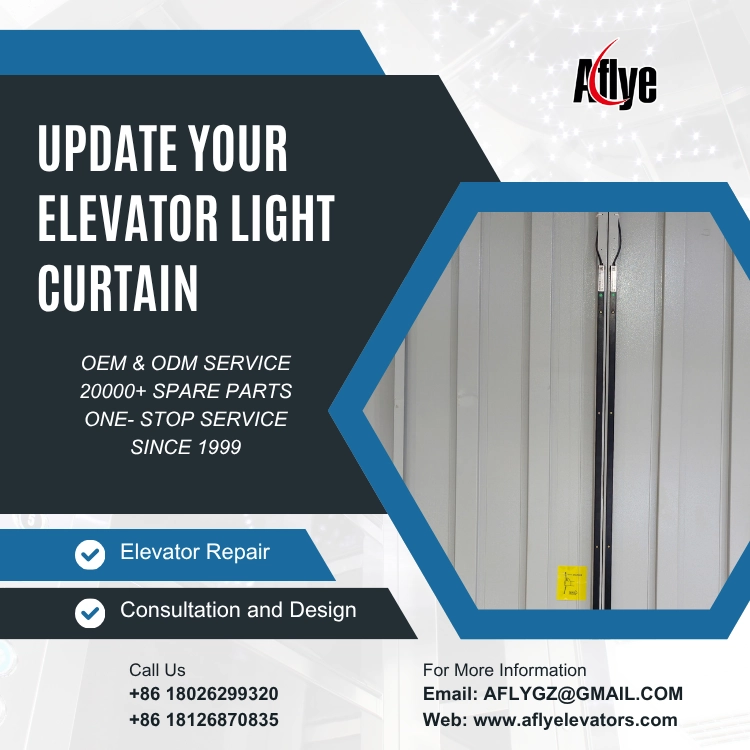
In an elevator door system, the elevator light curtain is one of the most important elevator safety components. It uses infrared beams to detect passengers or obstacles in the doorway area, preventing the elevator doors from closing on people or objects. If the light curtain malfunctions, it may cause the doors to open or close incorrectly, repeatedly cycle open and closed, or even compromise passenger safety.
For this reason, maintenance personnel should regularly inspect the condition of the light curtain and determine whether it requires repair or replacement.
1. Repeated Door Opening and Closing May Indicate False Light Curtain Activation
When elevator doors repeatedly reopen even though no passenger or obstacle is present, the light curtain may be sending false signals to the control system.
Common causes include:
Excessive dust on the light curtain surface
Misalignment between the transmitter and receiver
Poor wiring connections
Aging internal components
Solution
First, clean the light curtain surface thoroughly and check whether its installation position has shifted. If false triggering continues after cleaning and adjustment, replacing the elevator light curtain is recommended to prevent ongoing operational issues and reduced elevator efficiency.
2. No Response When Someone Passes Through the Doorway
If a passenger or object enters the doorway area and the elevator doors continue closing, the light curtain's detection function may have failed.
This is a high-risk issue that may be caused by:
Damaged infrared transmitters
Abnormal receiving signals
Unstable power supply
Faulty control wiring
Inspection Method
Maintenance technicians can perform an obstruction test by placing an object through different beam positions and checking whether the light curtain responds correctly.
At the same time, verify whether the control board receives the corresponding signal.
If multiple beam interruptions produce no response, the faulty light curtain should be taken out of service and replaced immediately.
3. Abnormal Indicator Lights or Unstable Signals
Under normal conditions, the indicator lights on an elevator light curtain should remain stable.
The following symptoms may indicate problems:
Indicator lights not illuminated
Abnormal flashing
Intermittent operation
Unstable signal transmission
These issues often point to problems with the power supply, communication circuits, or internal electronic components.
Recommended Action
Check:
Power supply voltage
Wiring terminals
Connectors and plugs
Cable condition
If the wiring is normal but the signal remains unstable, replacing the light curtain assembly is usually the most effective solution.
4. Aging, Physical Damage, or Water Ingress
After years of operation, elevator light curtains may develop:
Cracked housings
Worn optical surfaces
Moisture or water intrusion
Reduced detection sensitivity
These problems occur more frequently in environments with:
High humidity
Heavy dust accumulation
Frequent elevator usage
Once housing damage or internal moisture is detected, continued use is not recommended, as these conditions can significantly reduce detection accuracy and compromise doorway safety.
5. Elevator Light Curtain Purchasing Recommendations
When purchasing an elevator light curtain, buyers should carefully verify:
Installation dimensions
Number of infrared beams
Interface type
Operating voltage
Compatible elevator brands
Intended operating environment
A high-quality elevator light curtain should provide:
High detection sensitivity
Strong anti-interference capability
Easy installation
Stable long-term performance
As a professional elevator and escalator spare parts supplier, A-FLY provides a wide range of:
Elevator door system components
Control boards
Related elevator and escalator spare parts
A-FLY supports multi-brand compatibility, bulk supply, OEM/ODM customization, and fast delivery, helping maintenance companies, engineering contractors, and spare parts wholesalers complete repairs quickly and minimize elevator downtime.
Conclusion
Determining whether an elevator light curtain needs replacement involves more than checking whether the indicator light is still on. Maintenance personnel should evaluate:
Detection sensitivity
Signal stability
Installation condition
Wiring connections
Physical aging and external damage
If the elevator light curtain frequently generates false signals, fails to detect obstacles, or produces unstable signals, it should be replaced promptly with a reliable elevator safety component to ensure safe and dependable elevator operation.