
How Different Escalator Roller Materials Affect Service Life
In an escalator system, step rollers are key components that support the steps and allow them to move smoothly along the guide rails. They directly bear passenger loads and operational friction, making them one of the core factors that determine ride smoothness and durability. Many maintenance issues—such as abnormal noise, vibration, or uneven step movement—are often related to the condition of step rollers.
In practice, rollers made from different materials vary significantly in wear resistance, impact resistance, and service life. As a professional elevator & escalator parts supplier, A-FLY has found through extensive project experience that selecting the right roller material can significantly extend equipment lifespan and reduce maintenance costs.
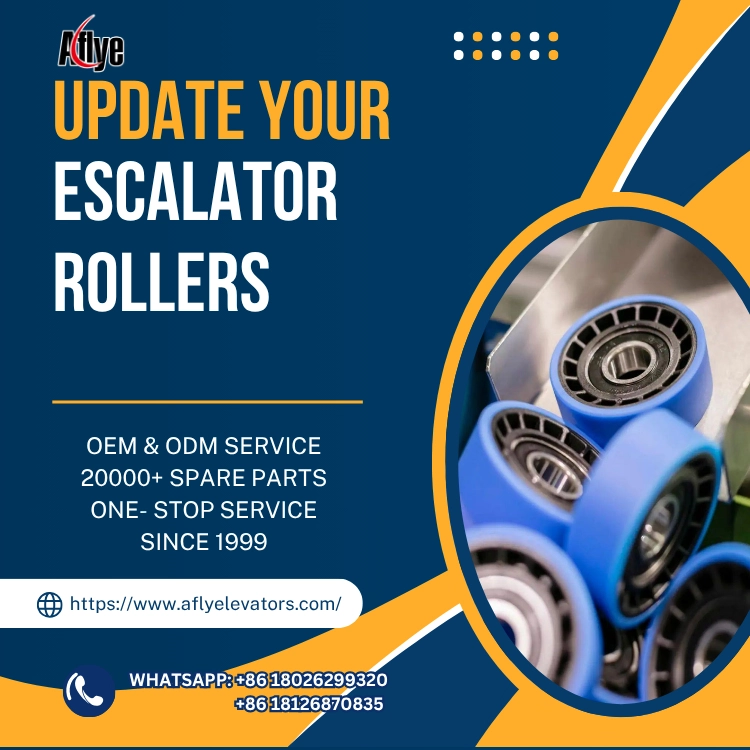
1. Common Types of Escalator Roller Materials
The most common materials used for escalator rollers include:
Polyurethane (PU)
Nylon
Rubber composite
Each material has distinct performance characteristics, which determine its application scenarios and lifespan.
2. Characteristics of Polyurethane (PU) Rollers
Polyurethane is one of the most widely used materials for step rollers due to its balanced performance. Its advantages include:
High wear resistance
Good elasticity and shock absorption
Low operating noise
Because PU offers a good balance between friction and cushioning, it is widely used in high-traffic environments such as shopping malls and public transportation systems.
However, under long-term high-temperature or heavy-load conditions, PU may age or harden, which can reduce its service life.
3. Characteristics of Nylon Rollers
Nylon rollers are known for their high mechanical strength and wear resistance, making them suitable for certain industrial environments. Their advantages include:
High hardness and strong load-bearing capacity
Good wear resistance
Stable structural performance
However, nylon has relatively low elasticity, which limits its shock absorption capability and may lead to increased noise. In addition, under poor lubrication or unfavorable rail conditions, nylon rollers may accelerate guide rail wear.
4. Rubber Composite Rollers
Rubber composite rollers are typically used in applications requiring high shock absorption and low noise. Their characteristics include:
Excellent cushioning performance
Smooth operation
Low noise levels
However, rubber materials generally have lower wear resistance. In high-load or high-frequency environments, their service life is usually shorter than PU or nylon rollers.
5. Key Factors Affecting Service Life
The lifespan of step rollers made from different materials mainly depends on:
Wear resistance: determines how quickly the roller surface degrades
Elasticity and shock absorption: affects load distribution on bearings and structures
Temperature resistance: impacts long-term stability
Aging resistance: determines overall service life
For example, in high-frequency applications, selecting a material with poor wear resistance will lead to faster wear and shorter lifespan.
6. Impact of Operating Environment on Material Selection
The service life of step rollers depends not only on material but also on operating conditions. For example:
In shopping malls or subway stations, PU rollers with high wear resistance are recommended
In industrial environments, high-strength nylon rollers may be more suitable
In noise-sensitive areas, rubber composite rollers are a better choice
Choosing the right material for escalator components can significantly improve overall performance.
7. Problems Caused by Improper Material Selection
If the wrong roller material is used, it may lead to:
Rapid wear and frequent replacement
Increased operating noise
Noticeable step vibration
Accelerated guide rail wear
These issues not only affect performance but also increase maintenance costs.
8. How to Extend Step Roller Service Life
To improve the lifespan of step rollers, it is recommended to:
Regularly inspect roller surface wear
Maintain proper lubrication of guide rails
Avoid overload operation
Replace aging escalator components in time
Proper maintenance can effectively extend the life of rollers and related elevator parts.
9. Importance of High-Quality Step Rollers
High-quality step rollers offer advantages in material selection, manufacturing precision, and structural design, resulting in more stable performance.
As a professional supplier, A-FLY provides step rollers in various materials along with related elevator & escalator spare parts, suitable for different escalator models and applications. With strong wear resistance and stable operation, these products help reduce failure rates and improve system reliability.
Conclusion
The choice of step roller material directly affects its service life and overall escalator performance.
By selecting appropriate escalator components based on the operating environment and working with a reliable supplier like A-FLY, it is possible to enhance equipment performance and reduce maintenance costs.
For maintenance teams, choosing the right material is the first step toward extending equipment lifespan.