
Why Does Escalator Handrail Support Roller Wear Increase Running Resistance?
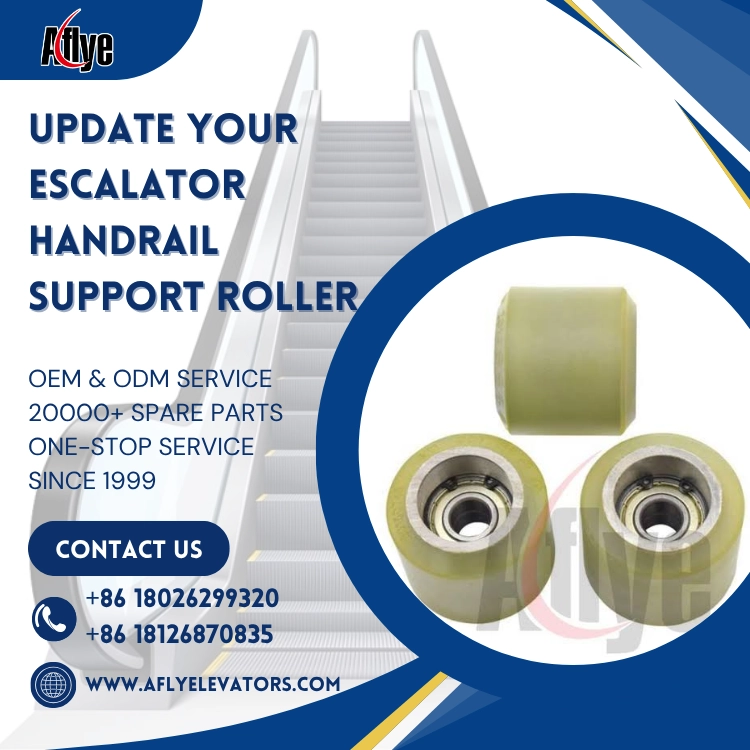
In an escalator handrail system, the handrail relies on multiple escalator handrail support rollers and guide components to maintain smooth and stable movement. These support rollers mainly provide support and guidance while helping reduce friction.
When an escalator support roller becomes worn, its bearing begins to seize, or the roller surface becomes deformed, the running resistance of the handrail can increase significantly. This may also cause abnormal escalator noise, unstable handrail speed, and other operating problems.
1. Why Do Escalator Handrail Support Rollers Wear?
1. Long-Term Friction on the Roller Surface
The handrail remains in continuous contact with the handrail rollers during operation. After long-term use, the roller surface may become flattened, develop grooves, or experience material aging.
As wear increases, normal rolling contact may gradually turn into sliding friction, increasing resistance.
2. Bearing Wear or Seizure
If the support roller bearing loses lubrication, becomes contaminated with dust, or develops internal wear, its rotational resistance will increase.
In severe cases, the roller may no longer rotate freely, requiring greater driving force to move the escalator handrail.
3. Incorrect Installation Position
Misaligned roller centers, loose mounting components, or inconsistent roller heights may create excessive localized pressure on the handrail.
This can cause uneven roller wear and increase handrail running resistance.
4. Incorrect Handrail Tension
Excessive handrail tension increases the load on the support rollers, while insufficient tension may cause an unstable running path.
Both conditions can accelerate escalator handrail support roller wear.
2. What Operating Problems Can Worn Support Rollers Cause?
The most direct effect of worn support rollers is increased friction and running resistance. This may further cause:
Reduced escalator handrail speed;
Localized handrail slipping or vibration;
Friction noise or abnormal rolling noise;
Abnormal wear along the handrail edges;
Increased load on the drive wheel and friction wheel.
If these problems are ignored for a long time, they may also shorten the service life of the handrail and other related escalator parts.
3. How Should This Problem Be Handled During Escalator Maintenance?
When increased handrail resistance or abnormal noise is detected, maintenance technicians should inspect:
Support roller surface condition;
Bearing rotation;
Roller installation position;
Handrail tension.
If the problem is caused only by incorrect installation, the roller assembly can be readjusted.
However, if the roller shows severe uneven wear, cracking, or bearing seizure, timely escalator support roller replacement is recommended.
The friction wheel, guide rollers, and escalator handrail should also be inspected at the same time to prevent the same problem from recurring.
4. Escalator Handrail Support Roller Purchasing Tips
When purchasing escalator handrail support rollers, several specifications should be carefully confirmed:
Roller diameter;
Roller width;
Shaft diameter;
Bearing specifications;
Mounting dimensions;
Roller material.
Rollers that look similar are not necessarily interchangeable. Even small dimensional differences may change the running path of the escalator handrail.
For older escalator maintenance projects, it is recommended to provide photos of the original part, measured dimensions, or physical samples for matching. This can significantly improve purchasing accuracy and reduce compatibility problems.
5. A-FLY Elevator & Escalator Parts Supply Capability
A-FLY supplies a wide range of elevator and escalator spare parts, including:
Escalator handrail support rollers;
Escalator chains and other wear parts.
For escalator maintenance, repair, and modernization projects, A-FLY supports model confirmation, sample matching, dimensional customization, and OEM/ODM services.
We provide one-stop elevator and escalator spare parts purchasing solutions for maintenance companies, engineering contractors, and spare parts distributors.
Conclusion
Although the escalator handrail support roller is a relatively small component, it directly affects the running resistance and stability of the handrail system.
Regular escalator maintenance and timely detection of roller wear, bearing seizure, or installation misalignment can help reduce abnormal operating noise and extend the service life of the escalator handrail and related components.