
Why Does Escalator Handrail Guide Wheel Wear Cause Handrail Misalignment?
During long-term escalator operation, escalator handrail misalignment is a relatively common problem. Many maintenance projects focus only on the handrail itself while overlooking the escalator handrail guide wheels, which provide essential guidance and support.
In fact, worn guide wheels can directly affect the running path of the handrail, causing lateral movement, increased friction, and abnormal operating noise. If the problem is left untreated, it may also accelerate handrail wear and increase maintenance costs.
1. What Is the Function of an Escalator Handrail Guide Wheel?
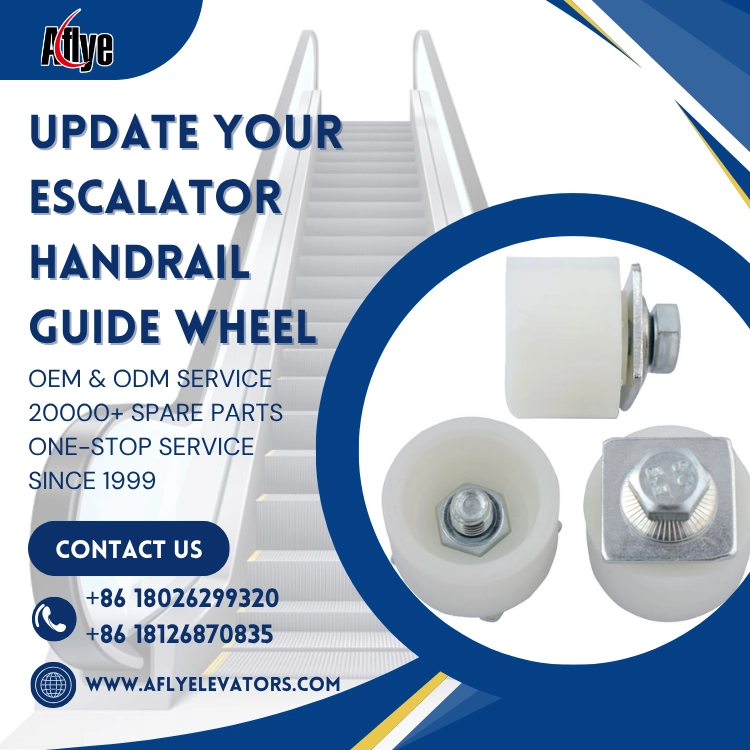
The escalator handrail guide wheel is installed inside the escalator handrail system. Its main function is to guide the handrail along the designed path and maintain stable coordination between the handrail and the drive system.
Under normal conditions, the guide wheels need to maintain good roundness, smooth rotation, and accurate installation positioning so that the handrail can circulate smoothly.
When guide wheels become worn, deformed, or develop bearing problems, the operating condition of the handrail gradually changes.
2. Why Does Guide Wheel Wear Cause Escalator Handrail Misalignment?
1. Worn Guide Wheel Diameter Causes Positioning Deviation
Escalator handrail guide wheels remain in continuous contact with the handrail during operation and are subject to constant friction. As the wheel surface wears, its guiding dimensions change, making it difficult for the handrail to maintain its original center position.
As a result, the escalator handrail may move toward one side, and severe misalignment can cause wear along the handrail edge.
2. Damaged Guide Wheel Bearings Cause Uneven Running Resistance
The bearing inside the guide wheel is a common escalator wear part. After long-term operation, the bearing may suffer from insufficient lubrication, increased clearance, or sticking.
When some guide wheels cannot rotate smoothly, the resistance applied to the handrail becomes uneven, which can cause changes in running speed and handrail alignment.
3. Incorrect Guide Wheel Installation Position
Improper adjustment during escalator maintenance, or changes in mounting position caused by long-term vibration, may prevent multiple guide wheels from maintaining consistent guiding performance.
As the handrail is subjected to lateral forces during operation, it can gradually move out of its proper running position.
3. What Problems Can Escalator Handrail Misalignment Cause?
First, handrail misalignment increases friction between the handrail and the side panels or guide components, resulting in edge wear.
Second, excessive friction can increase escalator operating noise and shorten the service life of the handrail.
In severe cases, significant handrail misalignment may cause unstable operation and negatively affect passenger comfort. Therefore, the relevant escalator spare parts should be inspected promptly.
4. Solutions for Escalator Handrail Guide Wheel Problems
When troubleshooting escalator handrail misalignment, the following areas should be inspected:
Check whether the handrail guide wheels have wear, cracks, or deformation;
Check whether the guide wheel bearings are sticking or producing abnormal noise;
Confirm that the guide wheels rotate smoothly;
Check the handrail tension;
Inspect the guide rail position;
Check the condition of the handrail drive system.
If the guide wheels show significant wear or the bearings are damaged, they should be replaced promptly to prevent further damage to the handrail and other escalator components.
5. Escalator Handrail Guide Wheel Purchasing Tips
When purchasing escalator handrail guide wheels, it is important to confirm the product dimensions, mounting structure, and compatible escalator model.Key factors include:
Whether the guide wheel diameter and mounting dimensions match;
Bearing quality and rotational stability;
Wear resistance of the wheel material;
Long-term operating reliability.
For older escalator modernization projects, it is not recommended to replace only the handrail. The guide wheels, friction wheels, handrail drive components, and other related escalator parts should also be inspected to ensure stable operation of the entire handrail system.
6. A-FLY Elevator & Escalator Parts Supply Capability
A-FLY specializes in supplying elevator and escalator spare parts worldwide, including escalator handrail guide wheels, escalator handrails, escalator friction wheels, escalator step rollers, escalator chains, and escalator safety components.
For escalator maintenance, modernization projects, and spare parts procurement, A-FLY supports model confirmation, dimensional matching, and OEM/ODM customization, providing reliable elevator and escalator parts solutions.
A-FLY also supplies elevator door system components, control system parts, operating components, and safety parts, helping customers improve procurement efficiency and reduce equipment maintenance costs.
Conclusion
Although the escalator handrail guide wheel is a relatively small component, it plays an important role in maintaining stable handrail operation. Regularly inspecting guide wheel wear and replacing aging components in time can effectively reduce problems such as handrail misalignment, abnormal wear, and operating noise.
Choosing high-quality escalator spare parts is an important measure for ensuring safe escalator operation and extending equipment service life.