
Why Does Elevator Guide Shoe Liner Wear Cause Elevator Vibration?
During elevator operation, the elevator guide shoe liner works together with the guide rail to guide and stabilize the elevator car. As operating time increases, the liner is continuously exposed to friction. Once it becomes worn, the clearance between the guide shoe and guide rail may increase, resulting in noticeable elevator vibration and shaking during operation.
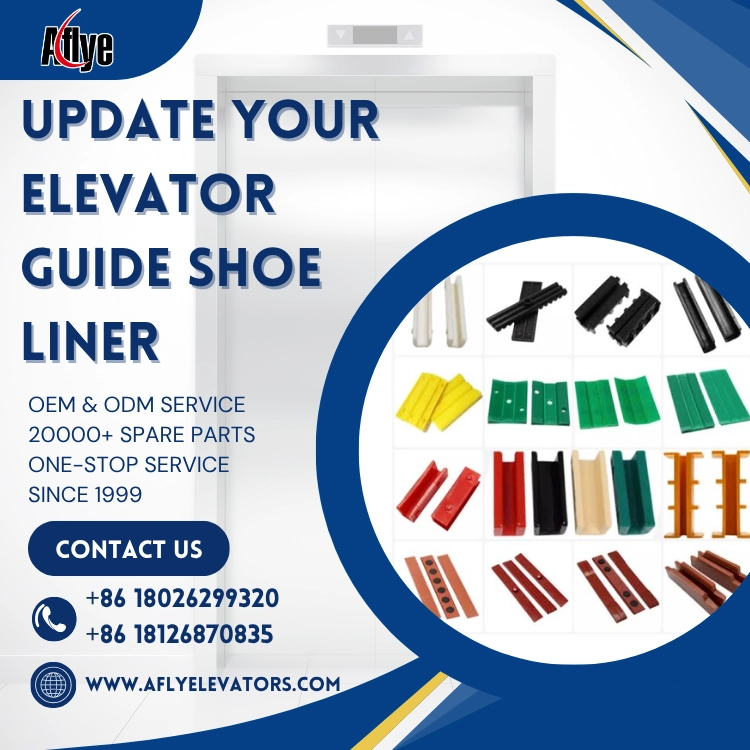
1. Why Do Elevator Guide Shoe Liners Wear?
1. Long-Term Friction and Wear
As the elevator car travels up and down repeatedly, the guide shoe liner remains in continuous contact with the guide rail. Over time, the liner may develop:
Worn or flattened surfaces;
Cracks;
Localized or uneven wear.
As the wear becomes more severe, the guide shoe may no longer maintain proper contact with the guide rail.
2. Abnormal Guide Rail Clearance or Condition
If the elevator guide rails are incorrectly installed, their joints are uneven, or the rail surfaces are worn, uneven pressure may be applied to the guide shoe liners.
This can accelerate elevator guide shoe wear and affect the stability of elevator car movement.
3. Improper Lubrication or Installation
Insufficient lubrication, incorrect liner positioning, or improper mounting can increase running resistance and accelerate guide shoe liner wear.
Therefore, lubrication and installation conditions should also be checked during routine elevator maintenance.
2. Why Do Worn Guide Shoe Liners Cause Elevator Car Vibration?
Under normal conditions, the elevator guide shoe liner and guide rail maintain the correct operating clearance.
When the liner becomes severely worn, the clearance between the guide shoe and guide rail may increase. As a result, the guide shoe can no longer guide the elevator car steadily.
When the car passes guide rail joints, deformed rail sections, or changes its direction of travel, lateral movement and vibration may occur.
Common symptoms include:
Elevator car shaking during upward or downward travel;
More noticeable vibration at higher speeds;
Impact or jolting when passing guide rail joints;
Friction noise or abnormal operating noise.
If the problem is ignored for a long time, it may also accelerate wear on the guide rails and other elevator components.
3. How to Solve Elevator Guide Shoe Liner Problems
During elevator maintenance, technicians should inspect:
Guide shoe liner wear;
Guide shoe installation condition;
Guide rail surfaces;
Guide rail joints.
If the liner is significantly worn, deformed, or cracked, timely elevator guide shoe liner replacement is recommended.
After replacement, the clearance between the guide shoe and guide rail should be checked and readjusted to ensure smooth and stable elevator car operation.
If the elevator continues to vibrate after replacing the liners, technicians should further inspect the guide rail alignment, rail joints, verticality, and other guiding components. This helps identify the root cause instead of simply replacing parts without solving the underlying problem.
4. Elevator Guide Shoe Liner Purchasing Tips
When purchasing elevator spare parts, the following information should be confirmed:
Guide shoe model;
Guide shoe liner dimensions;
Material type;
Installation method;
Guide rail specifications.
Guide shoe liner structures and dimensions may vary between different elevator models and systems.
Before purchasing, providing photos of the original part, model information, or measured dimensions can help improve matching accuracy and reduce the risk of purchasing incompatible parts.
5. A-FLY Elevator & Escalator Parts Supply Capability
A-FLY supplies a wide range of elevator and escalator spare parts, including:
Other elevator and escalator spare parts.
For elevator maintenance, repair, and modernization projects, A-FLY supports model confirmation, dimensional matching, sample confirmation, and OEM/ODM customization services.
We provide customers with one-stop elevator and escalator spare parts purchasing solutions for different elevator models and project requirements.
Conclusion
Elevator guide shoe liner wear is one of the common causes of elevator car vibration and unstable operation.
Regular inspection of guide shoe liners, guide rail clearance, and guide shoe condition, together with timely replacement of worn components, can effectively improve elevator ride comfort and reduce the risk of abnormal wear on other elevator parts.