
Why Does Elevator Governor Tension Pulley Wear Affect Governor Operation?
In an elevator safety protection system, the elevator governor tension pulley helps maintain proper tension on the governor rope, allowing the overspeed governor to accurately monitor elevator car movement and speed.
When the tension pulley becomes worn, stuck, or rotates abnormally, the tension of the governor rope may change, potentially affecting the reliable operation of the elevator overspeed governor.
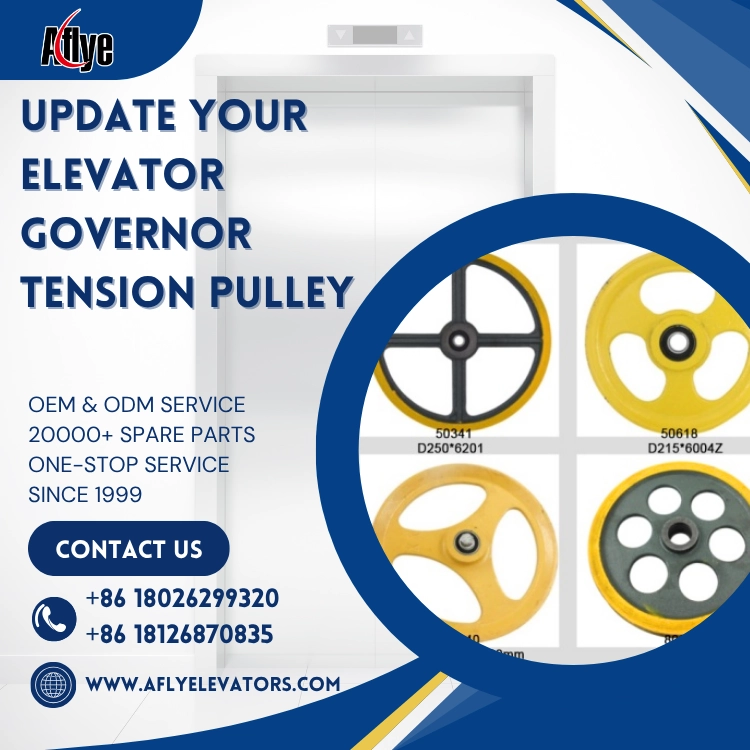
1. Why Does an Elevator Governor Tension Pulley Wear?
1. Wear Caused by Long-Term Operation
The tension pulley remains in continuous contact with the governor wire rope during elevator operation. Over time, both the pulley groove and bearings may gradually wear.
If the pulley groove becomes deeper, uneven, or deformed, the running path of the governor rope may change, affecting smooth operation.
2. Bearing Aging or Seizure
Insufficient lubrication, dust contamination, or long-term use may cause the tension pulley bearing to deteriorate.
This can result in:
Increased rotational resistance;
Unsmooth pulley rotation;
Abnormal noise;
Bearing seizure or pulley sticking.
3. Abnormal Tensioning Device Condition
If the governor tensioning device is misaligned, provides insufficient tension, or has damaged mechanical components, the tension pulley may experience uneven loading.
This can accelerate pulley and bearing wear and affect the stability of the governor rope.
2. Why Does Tension Pulley Wear Affect Governor Operation?
Under normal conditions, the governor wire rope must maintain stable tension and move consistently with the elevator car.
When the tension pulley becomes severely worn, it may cause:
Governor rope slack;
Rope vibration or jumping;
Increased running resistance;
Unstable rope movement.
These conditions may prevent the governor from receiving consistent mechanical feedback from the moving elevator car.
In severe cases, this may result in abnormal governor operation, unintended activation, delayed response, or unreliable triggering, increasing the risk of governor system faults.
Therefore, although the tension pulley is a relatively small mechanical component, its condition directly affects the reliability of the elevator safety system.
3. How to Solve Governor Tension Pulley Wear Problems
During elevator maintenance, technicians should carefully inspect:
Tension pulley groove condition;
Pulley bearings;
Pulley rotation;
Governor rope tension;
Installation position of the tensioning device.
If the tension pulley shows severe wear, deformation, sticking, or bearing damage, timely elevator governor tension pulley replacement is recommended.
After replacement, the operating condition of the governor rope and related elevator safety components should also be checked to ensure reliable governor operation.
4. Elevator Safety Component Purchasing Tips
When purchasing an elevator governor tension pulley, the following specifications should be confirmed:
Overspeed governor model;
Pulley diameter;
Pulley groove dimensions;
Shaft diameter;
Installation method;
Compatible governor rope specifications.
Governor tensioning device structures may vary between different elevator models and systems.
Before purchasing, it is recommended to provide photos of the original part, model information, and measured dimensions to improve matching accuracy and reduce the risk of purchasing incompatible elevator parts.
5. A-FLY Elevator & Escalator Parts Supply Capability
A-FLY supplies a wide range of elevator and escalator spare parts, including:
Elevator governor tension pulleys;
Elevator safety gears;
Other elevator safety components.
A-FLY also supplies escalator steps, step chains, rollers, handrails, and other commonly used elevator and escalator spare parts.
For elevator maintenance, repair, and modernization projects, A-FLY supports model confirmation, dimensional matching, sample confirmation, and OEM/ODM customization services, providing customers with one-stop elevator and escalator spare parts purchasing solutions.
Conclusion
Elevator governor tension pulley wear can affect the stable movement and tension of the governor rope, which may further reduce the reliability of overspeed governor operation.
Regular inspection of the tension pulley, governor rope, and tensioning device, together with timely replacement of worn components, is an important part of elevator maintenance and helps ensure reliable operation of the elevator safety protection system.