
Why Does Escalator Friction Wheel Wear Cause Handrail Belt Slipping?
In an escalator drive system, the escalator friction wheel is an important transmission component that drives the escalator handrail belt. It transfers power to the handrail belt through friction between the wheel surface and the handrail, ensuring that the handrail speed remains synchronized with the escalator steps.
Because the friction wheel is continuously exposed to friction, pressure changes, and environmental conditions, it is considered a typical escalator wear part. When the friction wheel becomes worn, hardened, or damaged on the surface, its power transmission efficiency gradually decreases, eventually causing handrail belt slipping, abnormal speed, and potential safety risks.
Therefore, the condition of the friction wheel should be a key inspection item during routine escalator maintenance.
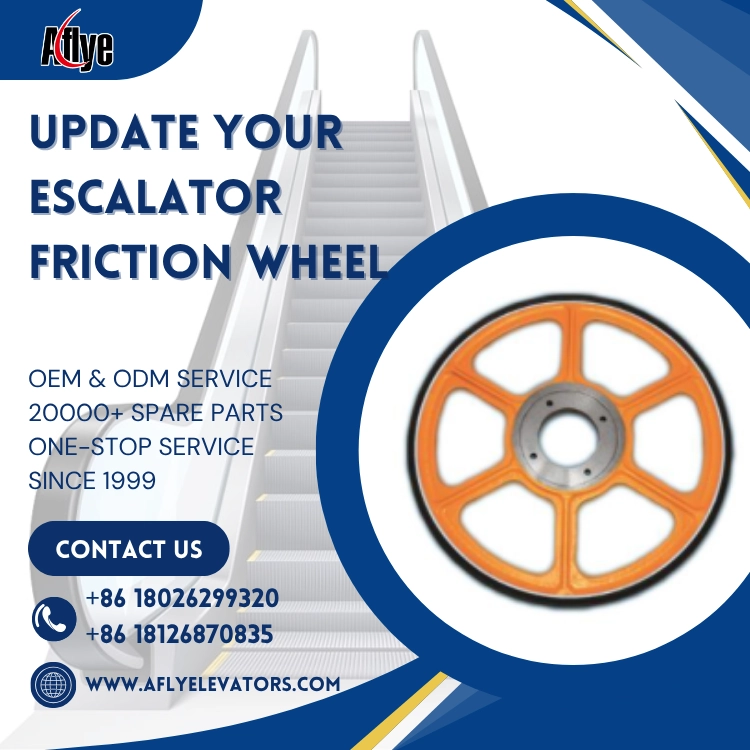
1. Friction Wheel Surface Wear Reduces Friction Force
Escalator friction wheels are usually made from elastic materials that provide sufficient friction to drive the handrail belt. After long-term operation, the friction wheel surface may experience:
Rubber layer wear;
Surface hardening;
Cracking and aging;
Reduced thickness.
When the friction coefficient between the friction wheel and handrail belt decreases, driving force cannot be transmitted effectively, resulting in:
Reduced handrail belt speed;
Slipping during startup;
Handrail belt speed mismatch with escalator steps;
More obvious failures under heavy loads.
Solution:Inspect the surface condition and wear level of the friction wheel. If the wear exceeds the allowable limit, replace the friction wheel in time.
2. Friction Wheel Size Changes Affect Handrail Belt Speed
In addition to surface wear, changes in the outer diameter of the friction wheel can also affect handrail belt operation.
After long-term wear, the friction wheel may experience:
Reduced effective diameter;
Lower contact pressure;
Reduced output linear speed.
Even if the drive system is operating normally, the escalator handrail belt may still run slower than expected.
Long-term operation under this condition may cause:
Abnormal handrail belt tension;
Increased edge wear;
Higher load on the drive system.
3. Insufficient Tension Increases Handrail Belt Slipping
The handrail belt does not rely only on the friction wheel for operation; proper tension is also required.
When handrail belt tension is insufficient, even a friction wheel in good condition may experience:
Insufficient friction force;
Reduced contact area between the handrail belt and wheel surface;
Intermittent slipping during operation.
Therefore, when troubleshooting handrail belt slipping issues, technicians should also inspect:
Handrail belt tensioning device;
Pressure roller assembly;
Guide rollers;
Wear condition of the handrail belt itself.
4. Oil and Foreign Contamination Reduce Transmission Efficiency
Escalators operate in complex environments, and the friction wheel surface may be affected by:
Dust;
Oil contamination;
Cleaning agent residue;
Foreign materials.
These contaminants reduce the friction between the friction wheel and handrail belt, causing sudden slipping or speed fluctuations.
During maintenance, the drive area should be kept clean, and the friction wheel surface should be checked for abnormal contamination.
5. Escalator Friction Wheel Maintenance Inspection Methods
During escalator maintenance, technicians should focus on checking:
Friction wheel surface wear;
Whether the rubber material has hardened;
Whether the wheel diameter has changed;
Whether handrail belt speed remains synchronized;
Whether abnormal noise exists;
Whether the tensioning system operates normally.
If severe friction wheel wear is found, it should be replaced promptly to prevent further damage to the handrail belt and other transmission components.
6. Escalator Friction Wheel Purchasing Recommendations
When purchasing an escalator friction wheel, the following specifications should be confirmed:
Outer diameter size;
Width specification;
Material type;
Hardness level;
Shaft hole dimensions;
Compatible escalator model;
Compatibility with the handrail belt drive structure.
Different escalator models may use different friction wheel designs. It is recommended to provide original part photos, dimensions, or model information for accurate matching by a professional supplier.
A-FLY Elevator & Escalator Parts Supply Capability
As a professional elevator and escalator parts supplier, A-FLY provides global maintenance companies, engineering contractors, and spare parts distributors with a complete range of escalator wear parts, including:
Guide rollers;
Pressure rollers;
Tensioning devices;
And other escalator spare parts.
A-FLY supports OEM/ODM customization, sample confirmation, drawing matching, and fast delivery. Based on different escalator brands and models, A-FLY provides professional matching solutions to help customers reduce procurement risks and improve maintenance efficiency.
Conclusion
Wear of the escalator friction wheel is one of the important causes of handrail belt slipping. Since the friction wheel directly affects handrail belt power transmission, any wear, aging, or dimensional change may affect escalator operating safety.
Through regular inspection of friction wheel conditions, timely replacement of worn escalator components, and cooperation with a reliable elevator and escalator parts supplier, the long-term stable operation and safety of escalators can be effectively improved.