
Why Do Escalator Trim Strips Become Loose, Lift Up, or Make Noise? Common Causes and Replacement Tips
In an escalator, trim strips are mainly used to cover joints, secure decorative panels, and improve the overall appearance of the equipment.
Although escalator trim strips are relatively simple exterior components, long-term exposure to mechanical vibration, passenger impacts, and environmental changes may cause them to become loose, lift away from their mounting surfaces, or produce abnormal friction noise.
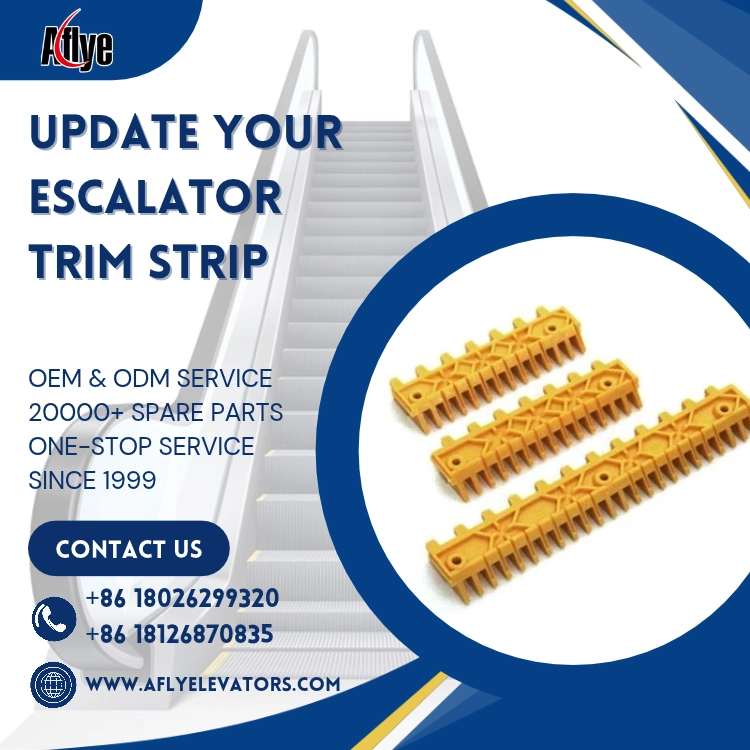
1. Why Do Escalator Trim Strips Become Loose?
1. Fasteners Loosen Due to Long-Term Vibration
Continuous mechanical vibration during escalator operation may gradually loosen screws, clips, or connectors, causing escalator decorative strips to become unstable.
2. Aging or Deformation of Trim Strips
After extended use, plastic, rubber, or metal escalator trim strips may experience hardening, shrinkage, or slight deformation.
As a result, they may no longer fit securely against their original mounting surfaces.
3. Incorrect Installation Dimensions
If a replacement trim strip has an incorrect length, cross-sectional profile, or mounting groove size, certain sections may lift away after installation.
This problem is particularly noticeable around joints and corners.
4. External Impacts
Repeated impacts from cleaning equipment, transported objects, or passenger luggage may cause escalator skirt panel trim strips to shift or damage their fixing structures.
2. Why Do Loose Escalator Trim Strips Cause Abnormal Noise?
When an escalator trim strip becomes loose, operating vibration may cause it to repeatedly strike or rub against adjacent components, such as skirt panels and cover plates.
This can produce regular clicking, rattling, or friction noise during escalator operation.
If the trim strip is significantly lifted or displaced, it may also come into abnormal contact with nearby moving components.
Therefore, when unusual noise is detected, the exact location and condition of the affected trim strip should be inspected promptly.
3. How to Fix Escalator Trim Strip Problems
During escalator maintenance, technicians should inspect:
Trim strip fasteners and fixing clips;
Mounting grooves;
Joints and connection points;
Adjacent skirt panels and cover plates;
Overall trim strip alignment.
If the problem is caused only by loose fasteners, the trim strip can be repositioned and securely fastened.
However, if the strip is cracked, severely deformed, has damaged clips, or can no longer be securely installed, escalator trim strip replacement is recommended.
After replacement, technicians should confirm that the trim strip is properly aligned, the joints fit correctly, and there is no abnormal interference with surrounding components.
4. Escalator Trim Strip Purchasing Tips
When purchasing escalator decorative trim strips, the following specifications should be carefully confirmed:
Installation position;
Cross-sectional profile;
Strip width;
Required length;
Material;
Color;
Fixing or mounting method.
For escalators with unclear model information, it is recommended to provide photos of the original trim strip cross-section, escalator model, and actual measured dimensions.
This can help improve matching accuracy and prevent problems such as installation difficulties, loose fitting, or premature detachment.
5. A-FLY Escalator Parts Supply Capability
A-FLY supplies a wide range of escalator decorative and exterior components, including:
Escalator skirt panel trim strips;
Other escalator exterior finishing parts.
We also supply various escalator spare parts and wear components, including:
These products are suitable for escalator repair, routine maintenance, and modernization projects.
A-FLY supports dimensional matching, sample confirmation, and OEM/ODM customization, providing engineering contractors, maintenance companies, and spare parts distributors with one-stop elevator and escalator spare parts purchasing solutions.
Conclusion
Loose, lifted, or noisy escalator trim strips are commonly caused by loosened fasteners, material aging, incorrect dimensions, or external impacts.
Timely inspection and replacement of damaged trim strips can not only improve the escalator's appearance but also reduce further problems caused by loose components and abnormal mechanical contact.