
Why Do Elevator Wire Ropes Develop Localized Broken Wires?
During elevator maintenance, if broken wires are concentrated in a short section of an elevator wire rope while other sections remain relatively normal, the problem should not simply be attributed to natural aging.
Localized wire breakage often indicates that the wire rope has been subjected to abnormal bending, friction, or load impacts in a particular area over an extended period. Therefore, the entire elevator traction system should also be inspected.
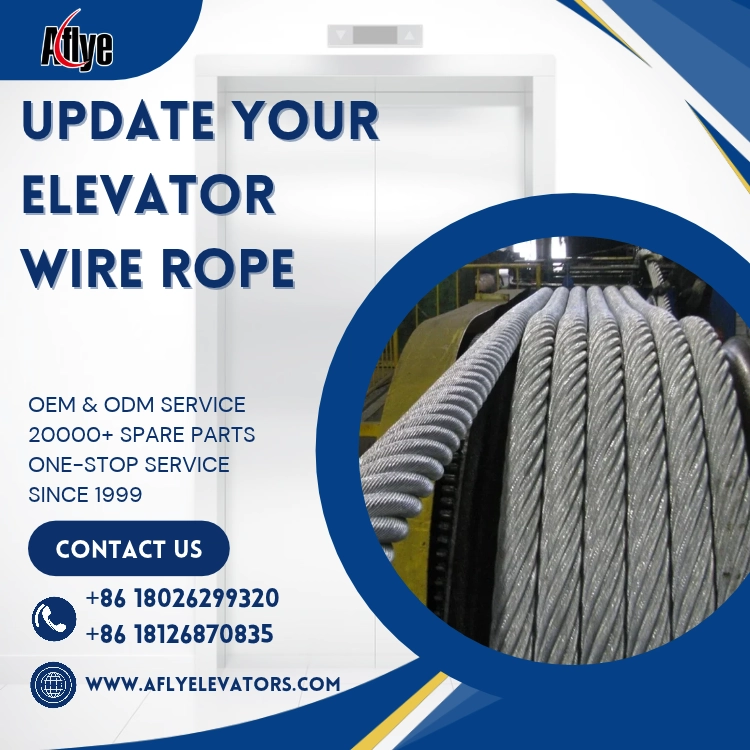
1. Why Do Elevator Wire Ropes Develop Localized Broken Wires?
1. Abnormal Traction Sheave Grooves
Worn grooves, incorrect groove profiles, or damaged groove surfaces can cause localized compression and friction on the elevator traction wire rope, accelerating fatigue of the outer wires.
2. Fatigue Caused by Repeated Bending
Elevator wire ropes continuously bend as they pass over traction sheaves and deflector sheaves.
If the sheave diameter, rope running path, or loading conditions are abnormal, localized bending fatigue may develop, eventually resulting in concentrated wire breakage.
3. Uneven Tension Between Multiple Wire Ropes
When some elevator wire ropes carry excessive tension, they may support a greater proportion of the load.
This can accelerate fatigue damage to both internal and external wires in certain sections of the rope.
4. Abnormal Friction or Mechanical Damage
Contact between the wire rope and sheave flanges, rope guards, or other mechanical components may create visible wear marks and broken wires in specific areas.
2. Why Is Replacing the Wire Rope Alone Not Enough?
If the actual cause of the damage is not corrected, even a newly installed elevator wire rope may develop similar wear or breakage in the same area.
During an elevator wire rope inspection, technicians should also check:
Traction sheave and deflector sheave grooves;
Tension balance between wire ropes;
Wire rope running alignment;
Lubrication and corrosion conditions;
Possible abnormal friction or contact points.
When broken wires are detected, their condition should be evaluated according to the applicable manufacturer's requirements, inspection criteria, and maintenance standards.
The decision to continue using a damaged wire rope should not be based on visual inspection alone.
3. How to Solve Localized Wire Rope Breakage
For minor abnormalities, the first step is to identify the cause of the broken wires and carry out appropriate inspections and monitoring in accordance with applicable safety requirements.
If the number, concentration, or severity of broken wires reaches the specified replacement criteria, the affected elevator wire ropes must be replaced promptly.
At the same time, problems such as uneven sheave groove wear, incorrect rope tension, or abnormal sheave alignment should be corrected to prevent repeated damage to the replacement ropes.
4. Elevator Wire Rope Purchasing Tips
When purchasing an elevator wire rope, the following specifications should be carefully confirmed:
Wire rope diameter;
Rope construction;
Rope core type;
Strength grade;
Required length;
Compatible traction sheave groove specifications.
Different wire rope constructions have different bending characteristics and operating requirements.
Therefore, replacement wire ropes should not be selected based on diameter alone. Compatibility with the original elevator traction system and applicable technical specifications must also be verified.
5. A-FLY Elevator & Escalator Parts Supply Capability
A-FLY supplies a wide range of elevator traction system and wear parts, including:
Elevator wire rope termination assemblies;
Other commonly replaced elevator components.
These products are suitable for elevator maintenance, repair, and old elevator modernization projects.
A-FLY supports model confirmation, specification matching, dimensional verification, and OEM/ODM services.
We also supply various escalator wear parts, providing engineering contractors, maintenance companies, and spare parts distributors with one-stop elevator and escalator spare parts purchasing solutions.
Conclusion
Localized broken wires in elevator wire ropes are often important warning signs of abnormal loading, bending fatigue, or traction sheave groove problems.
Rather than focusing only on the broken wires themselves, technicians should inspect the traction sheaves, rope tension, and running alignment to identify the root cause and reduce the risk of repeated wire rope damage.