
Elevator Button Pressing Force Keeps Changing? Return Spring Fatigue May Be the Cause
Elevator push buttons are subjected to a large number of repeated presses every day. After extended use, some buttons may feel softer or harder to press, return more slowly, or require a deeper press before they respond.
In addition to wear of the button cap and contacts, elevator button return spring fatigue is an often-overlooked mechanical cause.
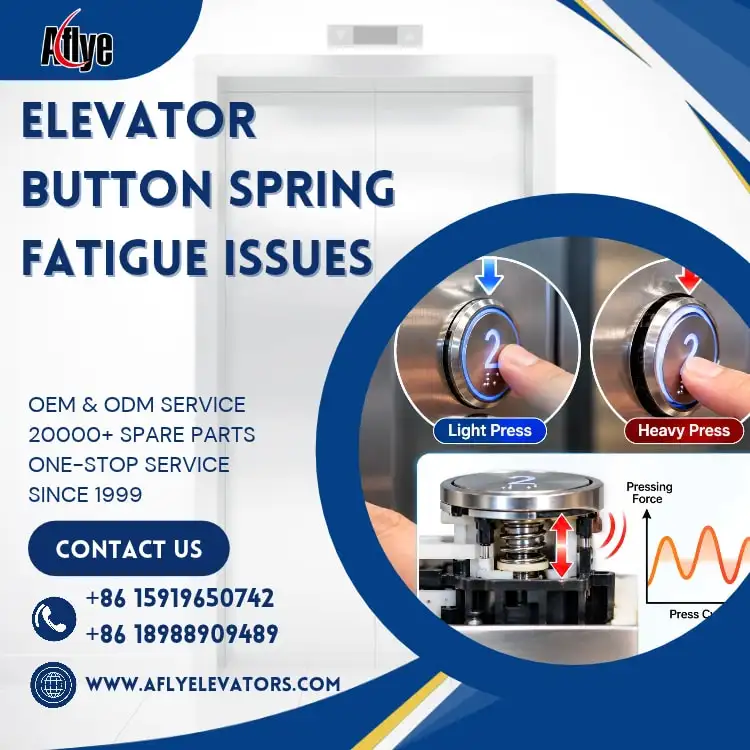
1. Why Does an Elevator Button Spring Become Fatigued?
1. Long-Term High-Frequency Compression
Each time the button is pressed, the internal return spring is compressed and then released.
After a large number of operating cycles, the spring may gradually lose elasticity, causing changes in the button's return force and pressing feel.
2. Spring Deformation or Misalignment
If the spring becomes tilted, displaced, or locally deformed, the force acting on the button may become uneven.
This can cause noticeable changes in the elevator button pressing force.
3. Wear of Internal Mechanical Components
The button cap, guide components, and spring work together during every press.
When these components become worn or develop excessive clearance, the actual working stroke of the spring may change, resulting in abnormal button movement or poor return performance.
2. What Are the Signs of Button Spring Fatigue?
Common symptoms include:
The button feels noticeably easier to press than buttons on other floors;
The button returns more slowly after being pressed;
The pressing stroke becomes longer or feels loose;
The button occasionally fails to return completely;
Repeated pressing is required for reliable activation;
The button cap becomes slightly tilted or sticks during movement.
If the spring return force continues to decrease, it may also prevent the internal button contacts from releasing properly.
3. How to Fix Abnormal Elevator Button Return
During elevator maintenance, technicians should inspect the button return spring, button cap, guide structure, and contact mechanism together.
The inspection should determine whether there is:
Spring deformation;
Reduced spring force;
Mechanical sticking;
Excessive internal wear or clearance.
If the problem is caused only by installation misalignment, the button can be readjusted according to its structure.
However, if the spring is significantly fatigued or deformed, or if several internal elevator button wear parts have aged at the same time, replacing the complete elevator button is usually a more reliable solution.
4. Elevator Button Purchasing Tips
When purchasing a replacement elevator push button, appearance alone is not enough to determine compatibility.
The following specifications should be confirmed:
Button diameter;
Panel cutout dimensions;
Operating voltage;
Button travel;
Connector or interface type;
LED illumination color;
Mounting method.
For old elevator modernization projects, it is also recommended to provide front and rear photos of the original button, panel dimensions, and wiring information.
This can help reduce problems such as excessive pressing resistance, poor button return, or incompatible electrical interfaces after installation.
5. A-FLY Elevator & Escalator Parts Supply Capability
A-FLY supplies a wide range of elevator buttons and related button components, including:
Elevator push buttons;
Elevator button caps;
Elevator button boards;
Illuminated elevator buttons;
Other commonly replaced elevator button parts.
These products are suitable for elevator maintenance, replacement, and old elevator modernization projects.
A-FLY supports OEM/ODM customization for button dimensions, characters, operating voltages, illumination colors, interfaces, and panel designs.
We also supply a wide range of elevator door system parts, control system components, safety components, and escalator wear parts, providing customers with one-stop elevator and escalator spare parts purchasing solutions.
Conclusion
A noticeable change in elevator button pressing force often indicates that the internal mechanical condition of the button has changed.
Timely inspection of the return spring and related moving components can help identify button aging at an early stage and reduce problems such as sticking, slow return, incomplete reset, and button contact failure.