
Why Does Escalator Step Sprocket Wear Cause Unstable Step Operation?
During long-term escalator operation, the step system relies on precise engagement between the escalator step sprocket and the escalator step chain to maintain smooth and stable circulation. Once the step sprocket becomes worn, its tooth profile changes, or the engagement clearance becomes abnormal, the steps may run unevenly, causing jerking, impact, increased noise, and other operating problems.
For high-traffic locations such as shopping malls, airports, and railway stations, timely inspection and replacement of worn escalator chain components are important for maintaining safe and reliable escalator operation.
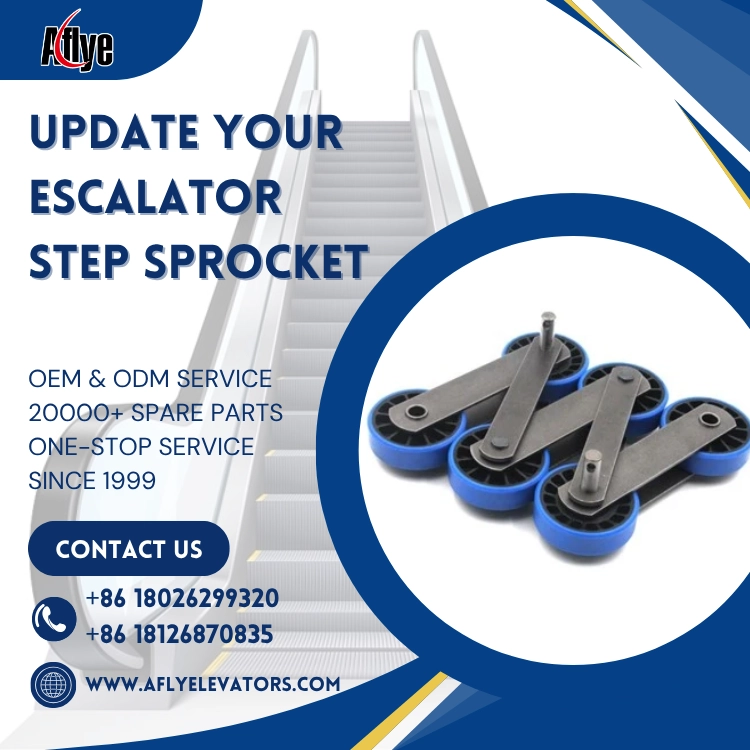
1. What Is the Function of an Escalator Step Sprocket?
The escalator step sprocket is a key component of the escalator transmission system. Its main function is to drive the escalator step chain so that the steps circulate along a fixed path.
Under normal conditions, the sprocket teeth engage smoothly with the step chain links, transmitting power evenly and ensuring stable step movement. When the sprocket becomes worn, this transmission accuracy is reduced, resulting in abnormal step operation.
2. Common Causes of Escalator Step Sprocket Wear
1. Tooth Wear Caused by Long-Term Operation
Escalators often operate continuously for long periods, and the step sprocket is constantly subjected to loads and impacts. Over time, the tooth tips and grooves gradually wear, increasing the engagement clearance between the sprocket and chain.
2. Escalator Step Chain Elongation
After long-term use, the escalator step chain may experience increased pitch due to wear of its pins, bushings, and other components. When the chain pitch changes while the sprocket retains its original dimensions, abnormal engagement occurs and sprocket wear accelerates.
3. Insufficient Lubrication or Contamination
Dust, metal particles, and insufficient lubrication can increase friction between the sprocket and chain. This accelerates tooth wear while also increasing operating resistance.
4. Installation or Adjustment Errors
Incorrect sprocket alignment or improper chain tension can cause uneven load distribution, resulting in abnormal or localized tooth wear.
3. What Operating Problems Can Escalator Sprocket Wear Cause?
Jerking or uneven step movement: When the sprocket teeth and grooves become worn, the chain can no longer maintain stable engagement. The steps may suddenly accelerate or decelerate, causing noticeable vibration.
Increased operating noise: Excessive clearance between a worn sprocket and the chain can produce impact and friction noises, reducing passenger comfort.
Unstable escalator speed: Reduced transmission efficiency can create uneven loading within the step system and affect overall operating stability.
Accelerated wear of other components: Abnormal sprocket operation increases the load on the escalator step chain, step rollers, and drive components, shortening the service life of other escalator parts.
4. Solutions During Escalator Maintenance
During routine escalator maintenance, the following points should be carefully inspected:
Check the sprocket teeth for wear, missing teeth, or deformation.
Measure the step chain pitch and confirm whether it remains within the allowable range.
Check whether the sprocket and chain engage smoothly.
Listen for abnormal noise and check for excessive vibration during operation.
If the sprocket is severely worn, it should be replaced with a correctly matched escalator step sprocket. The step chain should also be inspected at the same time. Replacing only one component may result in poor compatibility between new and worn parts.
5. Escalator Chain Parts Purchasing Tips
When purchasing escalator chain components, confirm the actual equipment specifications, including:
Sprocket diameter and number of teeth;
Step chain specifications and pitch;
Installation position and connection method;
Operating environment and load requirements.
For older escalator modernization projects, it is recommended to select replacement parts based on actual on-site measurements. Incorrect specifications may cause installation difficulties, increased operating noise, or reduced component life.
Choosing a professional escalator parts supplier can also help ensure more accurate model matching and technical support, improving maintenance efficiency.
6. A-FLY Elevator & Escalator Parts Supply Capability
A-FLY specializes in supplying elevator and escalator spare parts worldwide, including escalator step sprockets, escalator step chains, escalator chain components, escalator rollers, escalator drive chains, escalator transmission components, and a wide range of elevator and escalator wear parts.
With extensive experience in elevator and escalator spare parts supply, A-FLY supports model confirmation, sample matching, and OEM/ODM customization. We provide reliable spare parts solutions for escalator maintenance companies, engineering contractors, parts distributors, and modernization projects.
Conclusion
Although the escalator step sprocket is a relatively small component in the transmission system, its condition directly affects the stability of the entire step system. Detecting sprocket wear in time and selecting correctly matched escalator chain parts for maintenance and replacement can effectively reduce operating problems, improve escalator safety, and extend equipment service life.