
Escalator Step Roller Wear: Assessment & Parts Recommendations
During the long-term operation of escalators, step rollers are typical high-frequency wear components. They directly bear the weight of the steps and continuously roll along the guide rails. Once wear becomes severe, the overall stability, noise level, and even safety of the escalator can be affected. However, in many maintenance situations, step roller issues are often overlooked until obvious noise or vibration appears.
As a professional supplier serving the global elevator and escalator spare parts market, A-FLY has observed through numerous field cases that accurately assessing step roller wear and replacing them with wear-resistant components in time is one of the key measures to reduce escalator failure rates.
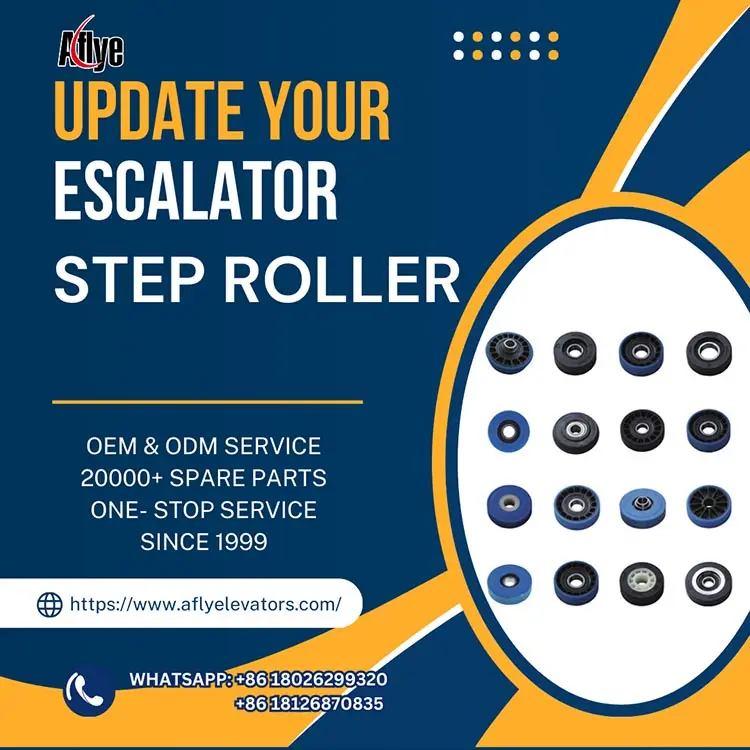
1. The Role of Step Rollers in Escalator Systems
Escalator step rollers are installed on both sides of each step and work with guide rails to ensure smooth movement. Their main functions include:
Supporting the weight of steps and passengers
Maintaining stable step movement along the guide rails
Reducing friction between steps and guide rails
Minimizing noise and vibration during escalator operation
Once the rollers become abnormal, step movement can quickly become unstable, and the issue may spread to affect the entire escalator system.
2. Common Methods to Identify Step Roller Wear
In practical maintenance work, the following aspects can help determine whether step rollers have entered a wear stage:
Changes in operating sound
Continuous rolling noise, periodic clicking sounds, or localized abnormal noises during operation often indicate wear on the roller surface or bearings.
Step movement condition
If steps show slight vibration or uneven movement—especially when carrying heavier loads—it may indicate reduced rolling precision.
Visual and manual inspection
During shutdown inspection, if the roller surface appears flattened, hardened, or cracked, or if it feels stiff when rotated by hand, replacement is generally required.
Local temperature rise
Abnormal heating during operation may occur when bearings are worn or lubrication fails. In such cases, the roller should not continue to be used.
3. Potential Risks Caused by Worn Step Rollers
If worn rollers continue operating for a long period, a chain of problems may occur:
Continuous increase in escalator operating noise
Abnormal contact between steps and guide rails, accelerating rail wear
Increased load on step chains and drive systems
Shortened service life of other escalator components
From a long-term maintenance perspective, ignoring step roller wear often results in higher repair costs later.
4. Why Choose Wear-Resistant Step Rollers?
Standard rollers may wear quickly under high-frequency and heavy-load conditions. Wear-resistant step rollers are designed with improved materials and structures for long-term operation:
Roller materials with higher wear resistance
More reliable sealed bearing structures
Improved rolling stability to reduce uneven wear
These rollers are particularly suitable for high-traffic environments such as shopping malls, metro stations, and airports. In addition to wear resistance, it is recommended to use waterproof and dustproof bearings, along with designs such as phenolic cover rollers with aluminum cores or reinforced frame-type rollers for better durability.
5. Key Considerations When Replacing Step Rollers
When replacing escalator step rollers, the following details should be noted:
Replace rollers in sets whenever possible to avoid mixing new and worn rollers
Ensure the roller dimensions match the guide rail system
Inspect the condition of the guide rails at the same time
Observe operating noise and step stability after replacement
Proper replacement procedures help prevent recurring problems.
6. Wear-Resistant Step Roller Solutions from A-FLY
As a professional elevator and escalator spare parts supplier, A-FLY provides multiple specifications of escalator step rollers and related escalator spare parts. These products have been verified in real projects for wear resistance, bearing stability, and dimensional consistency, making them suitable for various operating environments and usage intensities while helping customers extend maintenance intervals.
Conclusion
Wear of escalator step rollers is not merely a normal phenomenon, but rather a direct reflection of the overall operating condition of the escalator.
By scientifically assessing wear levels, replacing rollers with wear-resistant escalator components in time, and working with a reliable supplier like A-FLY, operators can significantly improve operational safety while reducing long-term maintenance costs.
In escalator maintenance and modernization projects, properly managing step rollers is often the key step to keeping the entire escalator running smoothly and quietly.