
Why Does an Escalator Step Roller Develop Uneven Wear on One Side?
The escalator step roller supports the step as it moves continuously along the guide track. Under normal conditions, the load should be distributed relatively evenly across the roller surface.
If one side of the roller shows continuous or excessive wear, the problem may not simply be related to roller quality. It can also be caused by the guide track, roller bearing, step installation, or abnormal step running path. Continued uneven wear may eventually lead to escalator vibration and abnormal operating noise.
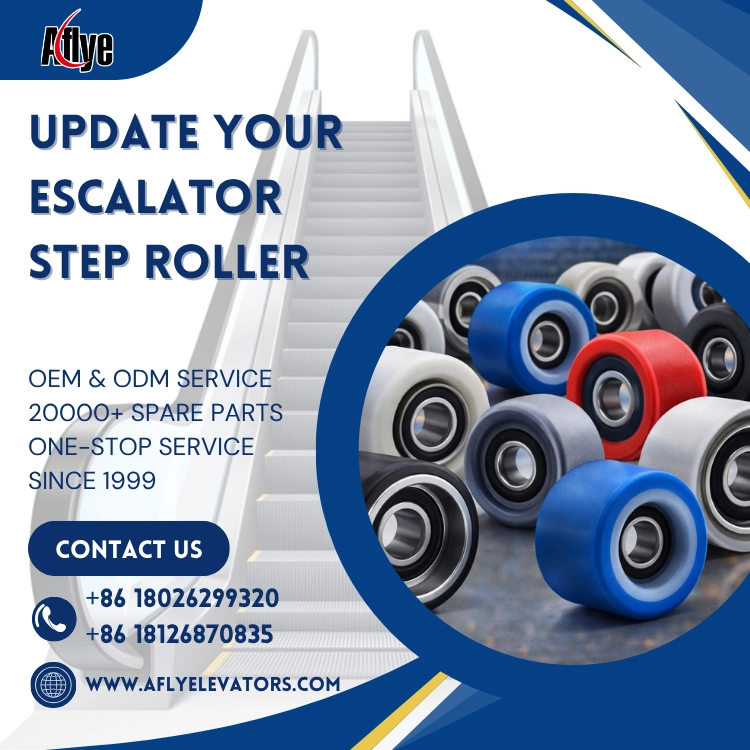
1. Common Causes of Uneven Escalator Step Roller Wear
1. Escalator Guide Track Misalignment
If the escalator guide track has uneven joints, incorrect positioning, or local deformation, the step roller may continuously carry more load on one side of its surface.
Over time, this can create noticeable one-sided wear.
2. Incorrect Step Roller Installation
Improper installation of the roller shaft, washers, or fixing components may prevent the escalator step roller from maintaining the correct contact angle with the guide track.
This can cause uneven load distribution across the roller surface.
3. Increased Bearing Clearance
When the step roller bearing becomes worn, the roller may develop radial or axial movement.
This can concentrate the load on one side of the roller surface and accelerate uneven wear.
4. Abnormal Step Running Path
Uneven step chain elongation, changes in the step shaft position, or deformation of related components may alter the running position of the escalator step.
As a result, the roller may become unevenly loaded and develop one-sided wear.
2. What Problems Can One-Sided Roller Wear Cause?
As uneven wear becomes more severe, the roller surface may gradually develop an angled profile or localized depression.
This prevents the roller from maintaining stable contact with the guide track and may cause:
Periodic vibration during escalator operation;
Abnormal noise between the roller and guide track;
Slight step shaking or vertical movement;
Accelerated wear of the bearing and guide track;
Newly replaced step rollers developing uneven wear again within a short period.
If multiple rollers show similar wear at the same position, the guide track alignment and step running path should be carefully inspected rather than simply replacing the rollers.
3. How Should This Problem Be Handled During Escalator Maintenance?
During escalator maintenance, technicians should inspect the following components together:
Step roller surface condition;
Bearing clearance;
Roller shaft and fixing condition;
Escalator guide track;
Step running alignment.
Rollers with significant uneven wear, cracks, or an out-of-round condition should be replaced promptly.
However, if the uneven wear is caused by incorrect guide track positioning or step installation, replacing the roller alone will not completely solve the problem. The related mechanical components must also be readjusted or repaired.
4. Escalator Step Roller Purchasing Tips
When purchasing an escalator step roller, the following specifications should be carefully confirmed:
Roller diameter;
Roller width;
Bearing model;
Shaft or center hole dimensions;
Roller surface material;
Mounting structure.
For escalators with unclear model information, it is recommended to provide photos of the original roller, equipment model, and measured dimensions to avoid mismatches in size, material, or hardness.
5. A-FLY Elevator & Escalator Parts Supply Capability
A-FLY supplies a wide range of escalator wear parts and spare parts, including:
Other commonly replaced escalator components.
These products are suitable for escalator repair, maintenance, and modernization projects.
A-FLY supports model confirmation, dimensional matching, sample confirmation, and OEM/ODM services, providing engineering contractors, maintenance companies, and spare parts distributors with one-stop elevator and escalator spare parts purchasing solutions.
Conclusion
One-sided wear of an escalator step roller is often caused by a combination of roller condition, bearing clearance, guide track alignment, and the step running path.
When uneven wear is detected, identifying and correcting the actual cause—not simply replacing the roller—can help prevent repeated failures and maintain stable escalator operation.