
What Causes Uneven Brightness or Flickering in Escalator Indicator Lights?
During escalator operation, escalator indicator lights are not only used to display operating status but are also an important part of the escalator lighting and display system. When indicator lights show uneven brightness, frequent flickering, or partial illumination failure, the problem may be related to LED aging, unstable power supply voltage, or poor electrical connections.
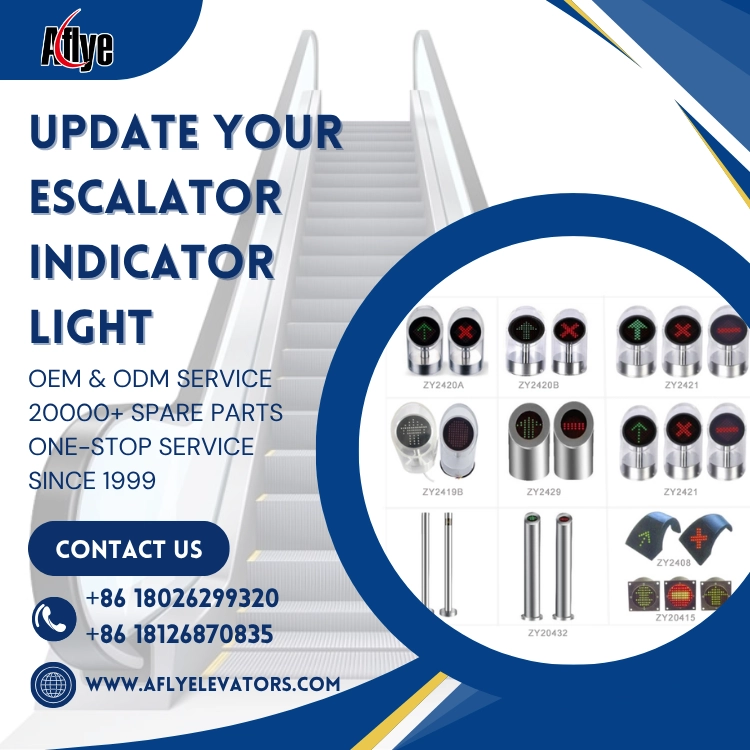
1. Why Do Escalator Indicator Lights Have Uneven Brightness?
1. Aging Escalator LED Lights
After long-term operation, the performance of LED components gradually deteriorates. If lights within the same group have different operating hours or aging conditions, some may appear brighter while others become noticeably dimmer.
2. Unstable Power Supply Voltage
Escalator indicator lights normally require a stable operating voltage. Power supply fluctuations or deterioration of the LED driver can cause brightness changes or even frequent flickering.
3. Poor Wiring Connections
Loose terminals, oxidized wiring, or poor connector contact may result in an unstable power supply to the lights.
This can cause escalator indicator lights to flicker or turn off intermittently.
4. Poor Heat Dissipation
If escalator LED lights operate in a high-temperature environment for extended periods and the heat dissipation system is inadequate, the LED chips and driver circuits may age more quickly.
This can reduce brightness and shorten the service life of the lighting components.
2. What Problems Can Uneven Brightness or Flickering Cause?
Long-term uneven brightness not only affects the overall appearance of the escalator but may also reduce the visibility and clarity of operating information.
Common symptoms include:
Some indicator lights becoming noticeably dimmer;
Frequent LED flickering;
Significant brightness differences within the same group of lights;
Some lights completely failing to illuminate;
Intermittent flickering after the escalator starts.
If multiple lights develop problems at the same time, the power supply and control components of the escalator lighting system should be inspected instead of simply replacing individual lights.
3. How to Solve Escalator Indicator Light Problems
During escalator maintenance, technicians should inspect the following components in sequence:
Power supply voltage;
LED driver or power supply module;
Wiring terminals and connectors;
Indicator light assemblies.
If the LED chips or driver modules are confirmed to be aging or damaged, they should be replaced promptly.
If a large number of lights from the same batch have deteriorated, replacing them as a complete group may help reduce visible brightness differences between old and new lighting components.
4. Escalator Electrical Parts Purchasing Tips
When purchasing escalator indicator lights, the following specifications should be carefully confirmed:
Escalator model;
Mounting dimensions;
Operating voltage;
Connector type;
Illumination color;
Light assembly structure.
Lighting specifications may vary between different escalator models and systems.
Before purchasing, it is recommended to provide photos of the original light, model information, and measured dimensions to avoid voltage, connector, or installation compatibility problems.
5. A-FLY Elevator & Escalator Parts Supply Capability
A-FLY supplies a wide range of elevator and escalator spare parts, including:
Escalator LED lights;
Escalator lighting components;
Escalator control switches;
Other escalator electrical components.
A-FLY also supplies escalator rollers, step chains, handrails, comb plates, and other commonly used elevator and escalator spare parts.
For escalator maintenance, repair, and modernization projects, A-FLY supports model matching, dimensional confirmation, and OEM/ODM customization services, providing customers with one-stop elevator and escalator spare parts purchasing solutions.
Conclusion
Uneven brightness or flickering in escalator indicator lights is commonly associated with LED aging, power supply fluctuations, or poor electrical connections.
Timely inspection of the escalator lighting system and replacement of aging escalator LED lights can help maintain stable indication performance and improve the overall reliability of the escalator operating environment.