
Causes of Escalator Handrail Slipping, Cracking, and Misalignment
During escalator operation, the escalator handrail must move synchronously with the steps to provide passengers with stable support. If the handrail begins to slip, crack, drift off track, or lose synchronization with the steps, it can not only affect passenger comfort but also create potential safety hazards. Therefore, maintenance technicians should regularly inspect the handrail and related elevator and escalator spare parts, identify problems early, and replace worn components when necessary.
1. Common Causes of Escalator Handrail Slipping
Handrail slipping is typically caused by a worn handrail drive wheel, insufficient friction, inadequate tension, or aging of the handrail's inner layer. When the drive wheel surface becomes worn smooth, hardened, or contaminated with oil, it cannot provide sufficient traction. As a result, the handrail may move more slowly, fluctuate in speed, or lose synchronization with the escalator steps.
Solution
Inspect the handrail drive wheel for wear, cracks, or signs of slipping, and verify that the tensioning device is functioning properly. If the drive wheel is severely worn, replace it with a matching model and clean the drive area to ensure stable handrail operation.
2. Causes of Escalator Handrail Cracking
After long-term service, the outer rubber layer of the escalator handrail is exposed to continuous friction, temperature changes, UV radiation, dust, and mechanical loads. Over time, this can cause aging, hardening, surface cracks, or edge damage. If left unaddressed, cracks may continue to expand, reducing the strength and safety of the handrail.
Maintenance Recommendation
Inspect the handrail for visible cracks, bulges, delamination, or deformation. If the handrail shows severe cracking, has become excessively hard, or has internal structural damage, it should be replaced promptly to prevent operational interruptions and safety risks.
3. Handrail Misalignment and Guide System Problems
Handrail misalignment is often related to worn or improperly adjusted guide rollers, pressure rollers, handrail entry devices, tensioning devices, or incorrect installation.
When the handrail continuously runs to one side, it can cause edge wear, rubbing at the entry point, and even jamming.
Inspection Method
Check that the guide rollers rotate smoothly, the pressure rollers are correctly positioned, and the handrail entry device is free of foreign objects and excessive wear. Also verify that the handrail tension is evenly adjusted to prevent misalignment caused by uneven loading.
4. Inspect Related Escalator Spare Parts
Handrail failures are rarely caused by the handrail alone. Wear of the handrail drive wheel, guide rollers, tensioning device, entry cover, friction wheel, and other escalator components can all affect handrail performance.
Therefore, maintenance personnel should perform a comprehensive system inspection instead of replacing only the handrail.
5. Escalator Handrail Procurement Recommendations
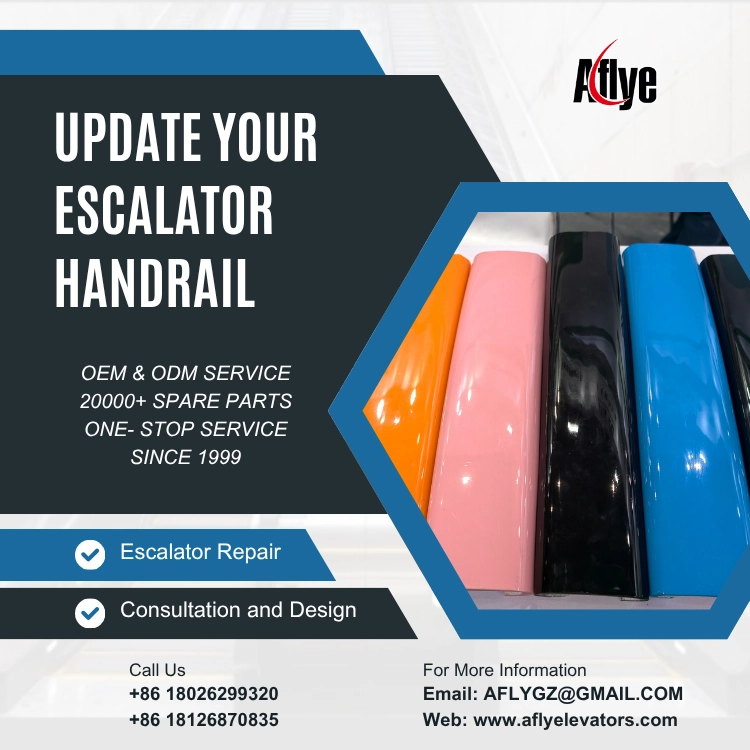
When purchasing an escalator handrail, be sure to confirm the following specifications:
Handrail width
Handrail length
Color
Cross-sectional profile
Internal construction
Brand compatibility
Operating environment
In addition, components such as the handrail drive wheel, guide rollers, and pressure rollers should be matched with the original system to prevent recurring slipping or misalignment after installation.
As a professional elevator and escalator spare parts supplier, A-FLY supplies escalator handrails, handrail drive wheels, guide rollers, step rollers, comb plates, step chains, and a comprehensive range of elevator and escalator spare parts for maintenance companies, engineering contractors, and distributors worldwide.
A-FLY supports multi-model compatibility, bulk supply, OEM/ODM customization, and fast delivery, helping customers improve escalator maintenance efficiency and reduce downtime.
Conclusion
Escalator handrail slipping, cracking, and misalignment can directly affect operational safety and passenger comfort. Maintenance personnel should conduct a comprehensive inspection of the handrail itself, the handrail drive wheel, the guide system, and the tensioning device, and replace worn components with reliable escalator spare parts in a timely manner to ensure long-term safe and stable escalator operation.