
Frequent Escalator Handrail Misalignment and Unstable Tension on Older Escalators?
After years of operation, older escalators may develop recurring handrail misalignment, fluctuating tension, unstable speed, or abnormal edge wear. Some maintenance projects replace the handrail directly, only for the problem to return after a period of operation. The underlying cause is often not simply handrail aging, but changes in the tensioning and guiding conditions of the entire escalator handrail system.
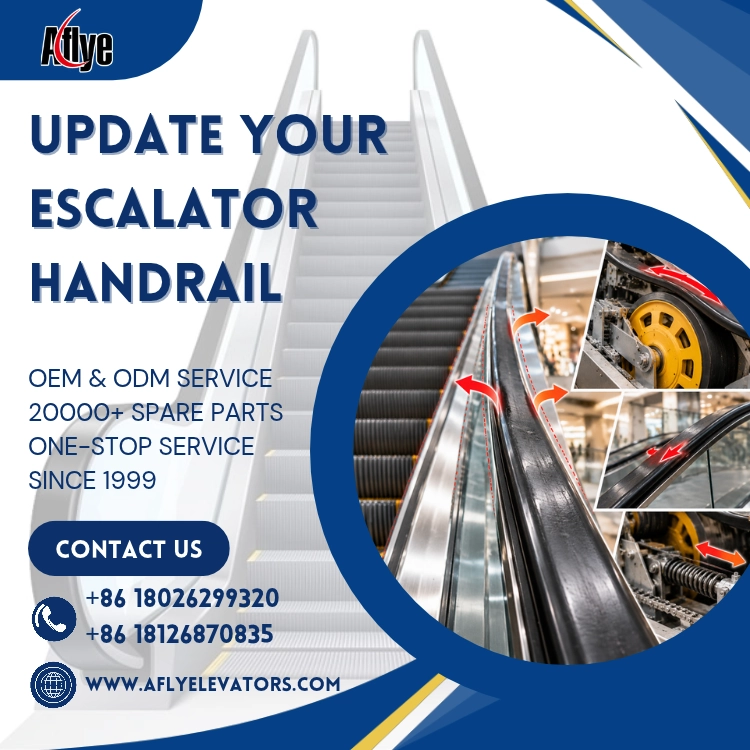
1. Why Does the Escalator Handrail Keep Moving Off Track?
1. Restricted Movement of the Tensioning Device
After prolonged operation, the slides, rollers, bearings, or adjustment mechanisms in the escalator handrail tensioning device may suffer from wear, corrosion, or sticking. This prevents the handrail tension from remaining stable.
2. Uneven Force Distribution
If the tensioning mechanism is misaligned or the adjustment is uneven, the handrail may gradually drift to one side during operation, causing abnormal edge wear.
3. Worn Guide Rollers and Support Rollers
Uneven wear or excessive bearing clearance in guide rollers, support rollers, and pressure rollers can alter the handrail's running path. As a result, the handrail may continue to drift even after its tension has been readjusted.
4. Handrail Aging
After long-term use, the handrail may stretch, harden, or develop internal structural deformation, requiring frequent tension adjustments.
2. Why Should the Entire Tensioning System Be Inspected During Modernization?
During escalator handrail replacement or modernization, installing a new handrail while continuing to use a sticking or worn tensioning device can still lead to unstable handrail tension.
Therefore, escalator modernization should include a comprehensive inspection of the tensioning frame, slide rails, adjustment mechanism, guide rollers, support rollers, pressure rollers, and friction drive wheels to ensure that the entire handrail running path operates smoothly.
3. How Can Unstable Handrail Tension Be Resolved?
During maintenance, inspect handrail tension, the movement of the tensioning device, roller bearings, and the handrail's running centerline.
Sticking tensioning mechanisms, unevenly worn rollers, and severely aged handrails should be adjusted or replaced according to the equipment manufacturer's technical requirements.
After maintenance, conduct continuous running tests and observe the handrail's return sections at both ends for misalignment, slipping, or abnormal friction.
4. Escalator Spare Parts Purchasing Recommendations
When purchasing escalator spare parts, provide the escalator model, handrail cross-sectional dimensions and length, tensioning device structure, roller diameter, bearing specifications, and mounting dimensions.
For older or discontinued escalator models, providing photos of the original parts and actual measurements helps ensure accurate matching rather than relying on appearance alone.
5. A-FLY Elevator & Escalator Parts Supply
A-FLY supplies escalator handrails, handrail tensioning devices, friction wheels, guide rollers, support rollers, pressure rollers, and other escalator wear parts for escalator repairs, handrail system upgrades, and modernization projects.
We support model identification, dimensional matching, sample confirmation, and OEM/ODM customization. We also supply a comprehensive range of mechanical, electrical, and safety components for elevators and escalators, providing one-stop sourcing solutions for contractors, maintenance companies, and distributors.
Conclusion
Frequent escalator handrail misalignment and unstable tension are usually system-wide problems rather than isolated handrail defects. Inspecting the handrail, tensioning device, guide rollers, and drive components together during modernization helps address the root causes and reduce recurring misalignment, slipping, and abnormal wear.