
Why Do Old Elevator Traveling Cables Develop Intermittent Signal Faults?
In older elevators, the elevator traveling cable continuously bends as the car moves up and down every day. After years of operation, the internal conductors, insulation, and shielding structure may gradually suffer from fatigue and deterioration, resulting in intermittent elevator signal faults that appear and disappear unpredictably.
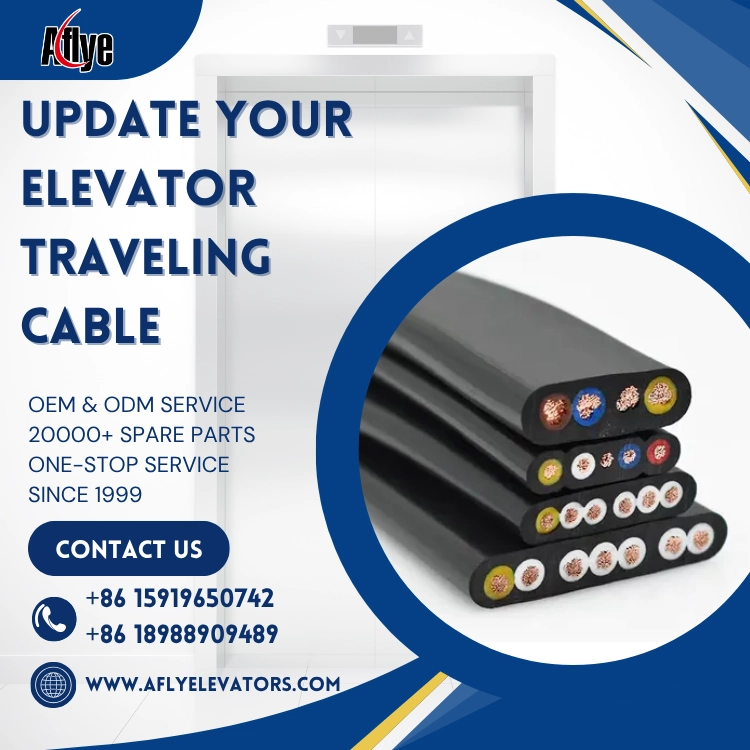
1. Why Do Elevator Traveling Cables Develop Intermittent Faults?
1. Conductor Fatigue and Broken Strands
After repeated bending over a long period, the internal copper conductors may develop broken strands.
The circuit may appear normal when the elevator is stationary. However, when the car reaches a certain position, changes in cable tension and bending can cause the damaged conductor to temporarily lose continuity, resulting in an intermittent open circuit.
2. Aging and Cracked Insulation
As an elevator traveling cable ages, its outer sheath and internal insulation may harden or crack.
This can increase the risk of short circuits, leakage current, or signal interference between conductors.
3. Loose Connectors and Terminals
Terminals on the car top, inside the control cabinet, or in junction boxes are exposed to long-term vibration.
Over time, they may become loose or oxidized, resulting in unstable control signals and intermittent electrical faults.
4. Incorrect Cable Suspension
Twisting, excessive tension, or an insufficient bending radius can accelerate damage to the internal conductors.
Incorrect traveling cable installation can therefore increase the frequency of intermittent signal problems.
2. What Are the Common Symptoms?
A faulty traveling cable may cause:
Elevator buttons or display signals to fail occasionally;
Intermittent problems with the door operator, lighting, or intercom system;
Faults that occur only when the elevator car reaches certain floors or positions;
Elevator control signals that appear and disappear intermittently;
Temporary recovery after restarting or resetting the elevator.
If the fault is clearly related to the elevator car position, the traveling cable should be one of the key components inspected.
3. How Should Traveling Cable Problems Be Handled During Old Elevator Modernization?
During old elevator modernization or an elevator electrical modernization project, technicians should inspect the cable condition, bending behavior, terminal connections, and electrical continuity.
If the traveling cable has already developed hardening, cracks, broken conductor strands, or repeated signal faults, replacing the complete cable is generally recommended rather than repeatedly repairing individual conductors.
After replacement, the cable suspension position and bending radius should also be correctly adjusted to reduce unnecessary mechanical stress during elevator operation.
4. Elevator Traveling Cable Purchasing Tips
When purchasing an elevator traveling cable, the following specifications should be confirmed:
Number of conductors;
Conductor size;
Rated voltage;
Shielding requirements;
Cable width;
Cable length;
Required signal and power functions.
For an elevator modernization project, it is also important to determine in advance whether additional lines are required for video, intercom, network communication, or other signal transmission.
Planning these requirements before purchasing can help avoid replacing the traveling cable again later.
5. A-FLY Elevator & Escalator Parts Supply Capability
A-FLY supplies a wide range of elevator modernization and electrical components, including:
Other elevator modernization parts.
These products are suitable for elevator maintenance, old elevator modernization, and system upgrade projects.
A-FLY can provide model confirmation, parameter matching, dimensional customization, and OEM/ODM services according to different project requirements. We also supply various escalator wear parts, providing customers with one-stop elevator and escalator spare parts purchasing support.
Conclusion
Intermittent faults in old elevator traveling cables are often caused by conductor fatigue and insulation deterioration resulting from years of repeated bending.
During elevator modernization, inspecting and replacing aging traveling cables in advance can help reduce hidden electrical faults and improve the operating stability and reliability of the elevator control system.