
Why Do the Left and Right Elevator Safety Gears Operate Asynchronously? How Does This Affect Braking Stability?
The elevator safety gear is a critical mechanical safety device. When triggered by the speed governor, the safety gear uses a linkage mechanism to activate both sides and clamp onto the guide rails. If there are significant differences in activation timing, lifting travel, or clamping conditions between the left and right safety gears, asynchronous operation may occur, affecting the stability of the stopping process.
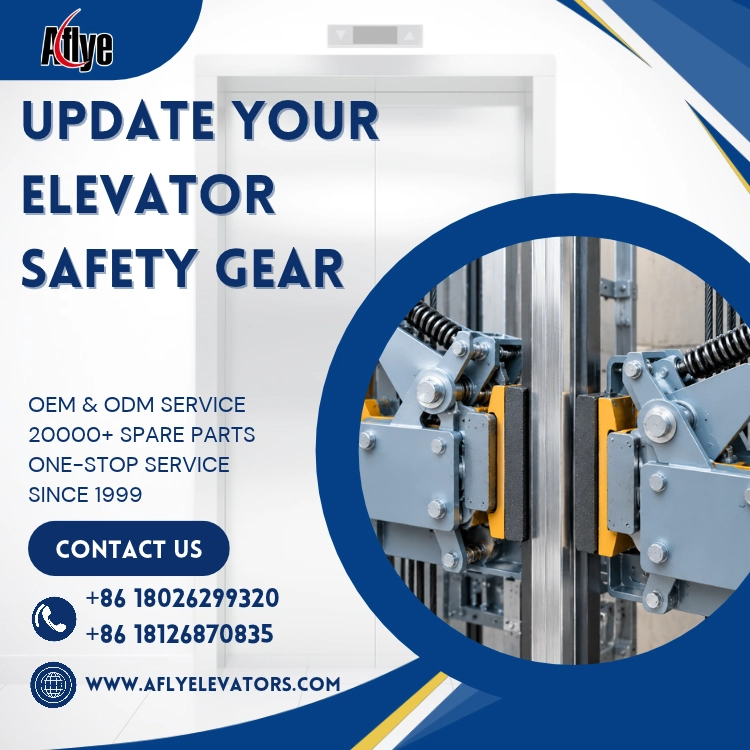
1. Why Do the Left and Right Safety Gears Operate Asynchronously?
1. Abnormal Clearance in the Safety Gear Linkage Mechanism
After prolonged operation, the shafts, connecting components, or pivot pins in the safety gear linkage may become worn or loose, causing differences in the transmitted movement between the two sides.
2. Inconsistent Adjustment of the Safety Gear Lifting Rods
Differences in the length, mounting position, or adjustment of the left and right lifting rods may cause one side to activate earlier than the other.
3. Sticking Wedges or Moving Components
Corrosion, dirt, mechanical wear, or restricted movement of the safety gear wedges may increase resistance on one side, resulting in asynchronous operation.
4. Misalignment Between the Guide Rails and Safety Gears
Incorrect guide rail installation or abnormal clearance between the safety gear bodies and guide rails may cause the two sides to contact the rails at different times and under different loading conditions.
2. Why Does Asynchronous Operation Affect Stopping Stability?
Under normal conditions, the left and right elevator safety gears should operate in coordination according to their design specifications.
If one side clamps onto the guide rail significantly earlier than the other, the car may experience uneven forces during stopping. This can increase transient lateral loading, vibration, and localized stress on the guide rails, potentially affecting the actual stopping behavior.
Therefore, inspection should not focus solely on whether the safety gear activates. The consistency of operation between both sides is equally important.
3. How Should Asynchronous Operation Be Addressed?
During elevator maintenance, pay particular attention to the safety gear linkage mechanism, lifting rods, shafts, pivot pins, wedge movement, and installation clearances between the safety gears and guide rails.
If any components show wear, deformation, or sticking, adjustments or replacements should be carried out according to the manufacturer's requirements.
As the safety gear is a critical elevator safety device, all inspections and adjustments after repair or replacement, including the required safety gear tests, must be performed by qualified personnel in accordance with applicable regulations.
4. Elevator Safety Gear Purchasing Recommendations
When purchasing elevator safety components, confirm the safety gear model, rated load, applicable speed, guide rail specifications, safety gear type, mounting dimensions, and linkage configuration.
For older elevators, do not select replacement parts based on appearance or dimensions alone. The governor, safety gear, and guide rail specifications must be matched as a complete system.
5. A-FLY Elevator & Escalator Parts Supply
A-FLY supplies elevator safety gears, safety gear components, speed governors, tension devices, buffers, rope grippers, and other elevator safety components for elevator maintenance, repairs, and modernization projects.
We support model identification, specification matching, and project parameter verification. We also supply a wide range of traction system components, door system parts, control system components, and escalator wear parts to support one-stop procurement for engineering contractors and maintenance companies.
Conclusion
Asynchronous operation of the left and right elevator safety gears is often associated with the linkage mechanism, lifting rods, wedge movement, or installation clearances. Inspecting the operating consistency of both sides, rather than checking only one side individually, helps ensure that the stopping process remains stable and reliable.