
Why Do Aging Elevator Relay Contacts Cause Intermittent Failures?
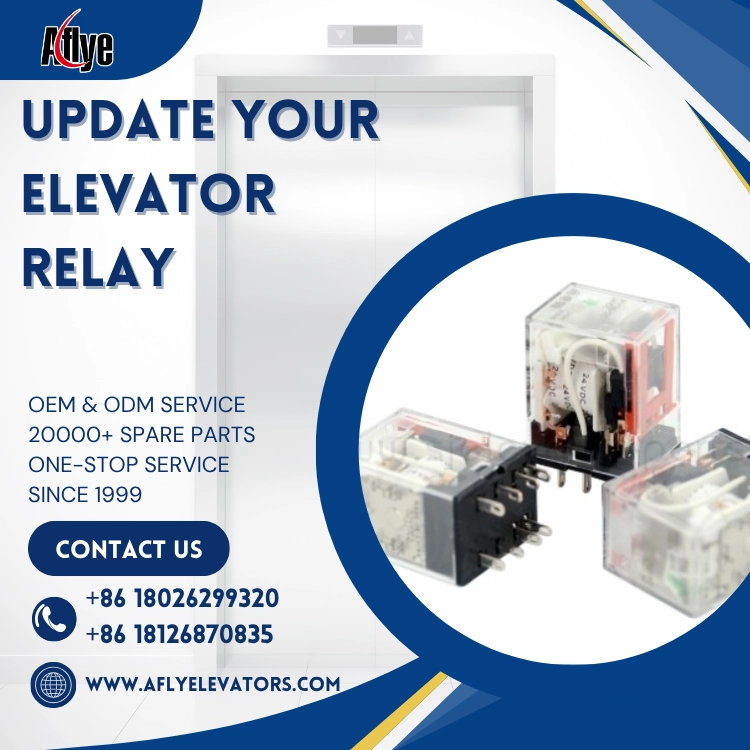
In an elevator control cabinet, elevator relays are responsible for control signal switching, safety circuits, and the operation of certain electrical components. After long-term elevator operation, relays repeatedly energize and release, causing their internal contacts to gradually develop oxidation, electrical erosion, or mechanical fatigue. This can result in typical intermittent elevator relay failures.
These faults may appear and disappear unpredictably, making troubleshooting more difficult during elevator maintenance.
1. Why Do Elevator Relay Contacts Age?
1. Frequent Switching Over Long-Term Operation
Elevators start, stop, open, and close their doors many times every day, requiring relays to switch frequently.
Electrical arcing may occur when relay contacts open or close. Over time, repeated arcing can cause:
Contact surface erosion;
Pitting;
Increased contact resistance;
Unstable electrical contact.
2. Contact Oxidation or Contamination
Dust, moisture, and temperature changes inside the elevator control cabinet may cause relay contacts to oxidize or become contaminated.
This increases contact resistance and may result in unstable signal transmission.
3. Load Exceeding the Rated Capacity
If the actual current remains close to or exceeds the relay's rated capacity for long periods, the contact temperature may increase significantly.
This can accelerate contact aging and, in severe cases, cause the contacts to stick or weld together.
4. Aging Coil or Mechanical Mechanism
Reduced coil performance, spring fatigue, or a sticking mechanical mechanism may prevent the contacts from closing completely.
As a result, the relay may operate inconsistently and cause intermittent elevator faults.
2. What Problems Can Aging Relay Contacts Cause?
Common symptoms include:
Elevator occasionally fails to start;
Door operator or other components fail intermittently;
Safety circuit occasionally opens;
Relays inside the control cabinet chatter or switch repeatedly;
Elevator returns to normal operation after a fault reset.
Because relay contacts may temporarily restore electrical contact after vibration or temperature changes, these problems can easily be misdiagnosed as control board or wiring faults.
3. How Should Relay Problems Be Handled During Elevator Maintenance?
When an intermittent elevator fault occurs, technicians should carefully inspect:
Relay contact condition;
Relay coil voltage;
Wiring terminals;
Electrical connections.
If the contacts are severely burned or oxidized, relay engagement is unstable, or abnormal overheating is detected, timely elevator relay replacement is recommended instead of repeatedly attempting to repair the contacts.
The load current and related control wiring should also be checked to identify the root cause and prevent the replacement relay from developing the same problem.
4. Elevator Relay Purchasing Tips
When purchasing elevator electrical components, the following relay specifications should be confirmed:
Relay model;
Coil voltage;
Contact rating;
Contact configuration;
Pin layout;
Installation method.
Different relays may look similar but have different electrical specifications and may not be interchangeable.
Providing the original relay model, clear product photos, or control cabinet specifications can help improve matching accuracy and reduce purchasing errors.
5. A-FLY Elevator & Escalator Parts Supply Capability
A-FLY supplies a wide range of elevator and escalator spare parts, including:
Other elevator electrical components.
Our product range also covers elevator door system parts, elevator safety components, escalator wear parts, and other commonly used elevator and escalator spare parts.
For elevator maintenance, control cabinet repair, and modernization projects, A-FLY supports model confirmation, sample matching, and OEM/ODM services, providing customers with one-stop elevator and escalator spare parts purchasing solutions.
Conclusion
Aging elevator relay contacts can cause intermittent faults that are difficult to diagnose. Regular inspection of relay contacts, coils, and wiring connections, together with timely replacement of deteriorated relays, can effectively reduce unexpected elevator shutdowns and improve the operating stability of the elevator control system.