
What Should You Consider When Purchasing Elevator Modernization Parts? A Complete Guide from Fault Assessment to Component Matching
As elevators age, older equipment may experience unstable operation, increasing maintenance costs, and discontinued spare parts. Unlike replacing individual components, complete elevator modernization requires a comprehensive assessment of the mechanical, electrical, safety, and door systems. Focusing only on the price of individual spare parts during procurement may lead to compatibility issues and repeated maintenance later.
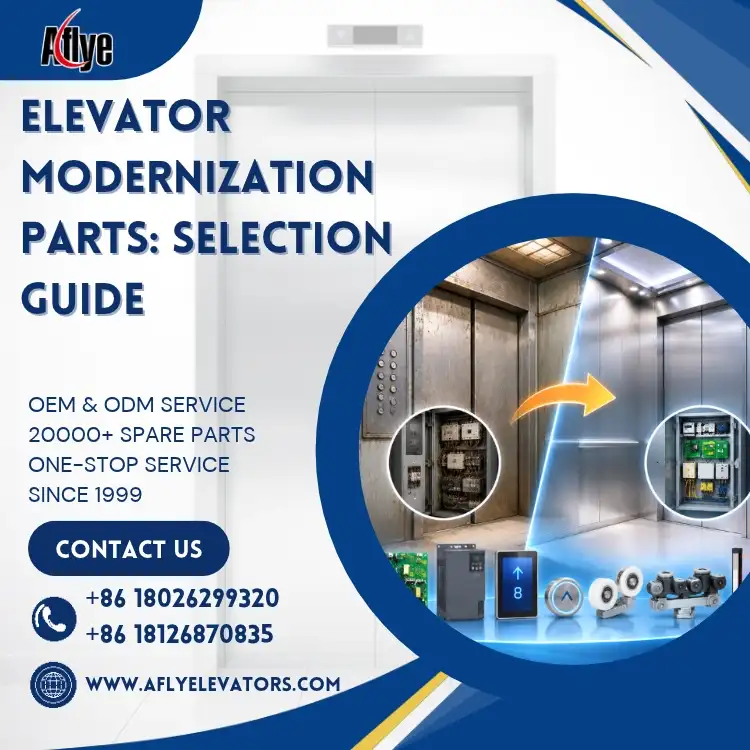
1. Why Do Old Elevators Need Complete Modernization?
1. Aging of Core Components
After years of operation, the performance of key components such as traction machines, control cabinets, inverters, and door operator systems gradually deteriorates. Common problems include abnormal operating noise, leveling inaccuracies, and starting impacts.
2. Discontinued Original Spare Parts
For some older elevator models, spare parts such as control boards, display boards, push buttons, and drive modules become increasingly difficult to source. This results in longer repair times and higher maintenance costs.
3. Safety Performance No Longer Meets Current Requirements
Safety components such as safety gears, overspeed governors, door locks, and buffers require regular inspection and evaluation after long-term use. Upgrades or replacements may be necessary depending on their condition and applicable safety requirements.
2. What Should You Consider When Purchasing Parts for Complete Elevator Modernization?
1. System Compatibility
Complete elevator modernization is not simply a matter of replacing several components. It is essential to confirm:
Compatibility between the control system and inverter
Compatibility between the encoder and traction machine
Proper communication between COP/HOP push buttons and display systems
Consistent control signals between the door operator and control cabinet
Ignoring system compatibility may result in communication failures or abnormal elevator operation after installation.
2. Condition of Core Mechanical Components
During modernization, the following components should be inspected:
Wear condition of the traction machine and traction sheave
Condition of wire ropes or steel belts
Wear of guide rails and guide shoes
Elevator door components, including door hanger rollers, door vanes, and door locks
Continuing to use worn mechanical components may affect the performance of the newly upgraded control system.
3. Safety Component Upgrades
The safety system is an essential part of complete elevator modernization. Key components include:
Elevator safety gears
Overspeed governors
Elevator buffers
Door protection devices
Emergency communication systems
These safety components not only affect equipment operation but also play an important role in passenger safety.
3. Complete Elevator Modernization Solutions
Before starting an old elevator modernization project, it is recommended to conduct an on-site assessment and develop a suitable solution based on the elevator brand, model, rated load, operating speed, number of floors, and existing operational problems.
Depending on actual project requirements, the following upgrades can be considered:
Control system upgrades
Traction system upgrades
Elevator door system modernization
COP/HOP replacement
Safety component replacement
Lighting and energy-saving system upgrades
A systematic modernization approach can improve elevator operating stability and help reduce long-term maintenance costs.
4. Purchasing Recommendations for Elevator Modernization Parts
When sourcing elevator modernization parts, it is recommended to provide the following information:
Original elevator brand and model
Spare part photos and dimensions
Control system model
Motor and inverter specifications
Details of existing operational problems
Avoid selecting replacement parts based only on appearance. Electrical components such as control boards, push buttons, display boards, and encoders require careful verification of their interfaces, electrical parameters, and communication methods.
5. A-FLY Elevator & Escalator Spare Parts Supply Capabilities
A-FLY provides a wide range of elevator and escalator spare parts for complete modernization projects, including:
Elevator push buttons, COP/HOP panels, and display boards
Control cabinets, control boards, and inverters
Door operators, door vanes, door hanger rollers, and door locks
Traction sheaves, wire ropes, and guide shoes
Safety gears, overspeed governors, and buffers
Escalator steps, handrails, chains, and other wear parts
We support model identification, dimensional matching, OEM/ODM customization, and project-based component supply.
As a one-stop elevator and escalator spare parts supplier, A-FLY serves elevator contractors, maintenance companies, and distributors with comprehensive sourcing solutions.
Conclusion
The key to complete elevator modernization is not simply replacing old components, but ensuring proper compatibility across the mechanical, electrical, and safety systems.
Choosing an experienced elevator spare parts supplier and confirming component models and system requirements in advance can help reduce modernization risks and improve long-term equipment reliability.