
Occasional Elevator Leveling Inaccuracies in Older Elevators: Why Replacing Only the Encoder May Not Be Enough During Modernization
After years of operation, older elevators may experience occasional leveling inaccuracies, such as stopping slightly above or below floor level on certain floors, while temporarily returning to normal after another run. When this happens, many maintenance teams initially consider replacing the elevator encoder. However, elevator leveling accuracy depends on the combined performance of the position feedback system, traction system, controller, and inverter. Replacing only the encoder may not solve the underlying problem.
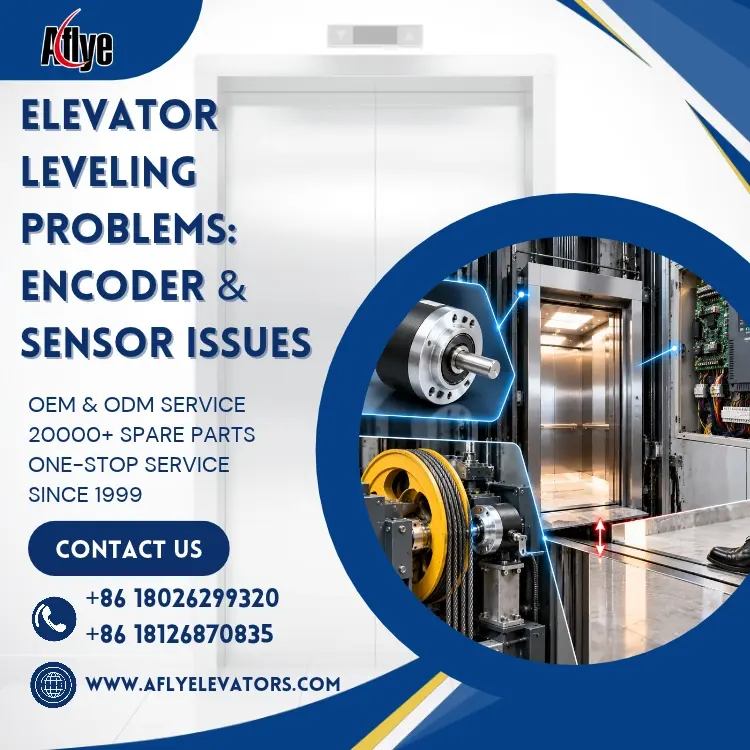
1. Why Do Elevator Leveling Errors Keep Occurring?
1. Abnormal Encoder Position Feedback
An aging elevator encoder, loose installation, mismatched resolution, or signal interference may cause the control system to receive inaccurate position data.
2. Changes in Traction Machine Mechanical Condition
Wear in the elevator traction machine bearings, traction sheave, or brake may cause differences between the actual operating position and the calculated position. This is particularly noticeable during low-speed operation and stopping.
3. Reduced Low-Speed Control Performance of the Inverter
Parameter drift or declining performance in an older elevator inverter can affect speed control during startup, deceleration, and leveling, resulting in inconsistent stopping positions.
4. Abnormal Controller Parameters or Position Learning
After years of maintenance and parameter adjustments, the control system may develop incorrect leveling settings, deceleration curves, or position learning data.
2. Why Isn't Replacing Only the Encoder Enough?
The elevator position feedback system is just one part of the overall leveling control process.
During elevator modernization, installing a new encoder while continuing to use an aging traction machine, inverter, or controller may still result in inaccurate floor leveling.
A more effective approach is to inspect the encoder signals, traction machine condition, brake, inverter, and controller parameters together before deciding whether an elevator controller upgrade is necessary.
3. How Can These Problems Be Resolved During Modernization?
The following components and parameters should be checked:
Encoder model, resolution, and installation condition
Encoder signal cables and interfaces
Traction sheave, wire rope, and brake condition
Inverter low-speed operating parameters
Controller leveling parameters and position learning
Floor leveling sensors and related wiring
After replacing components, position learning, leveling parameter adjustments, and operational testing should be performed again to verify accurate floor stopping.
4. Purchasing Recommendations for Elevator Modernization Parts
Before purchasing elevator modernization components, provide the elevator rated load, speed, traction machine model, original encoder model, inverter model, controller model, and details of the leveling problems.
When selecting an elevator encoder, do not focus only on appearance and mounting dimensions. It is also important to confirm the power supply, resolution, signal type, shaft diameter, and interface to ensure compatibility with the traction machine and control system.
5. A-FLY Elevator & Escalator Parts Supply
A-FLY supplies elevator encoders, traction machines, inverters, controllers, control boards, brakes, and related elevator modernization components for elevator repairs, old elevator upgrades, and modernization projects.
We support model identification, parameter matching, sample confirmation, and OEM/ODM customization. We also supply a wide range of elevator door system components, safety parts, escalator mechanical components, and other elevator and escalator spare parts to meet the procurement needs of engineering contractors and maintenance companies.
Conclusion
Occasional elevator leveling inaccuracies in older elevators may result from the combined effects of the encoder, traction machine, inverter, and control system. During elevator modernization, the entire position control system should be evaluated before deciding whether encoder replacement is necessary. This helps prevent recurring leveling problems caused by replacing only the encoder while overlooking other aging components.