
Why Does Elevator Door Lock Contact Oxidation Cause Intermittent Door Lock Signal Problems?
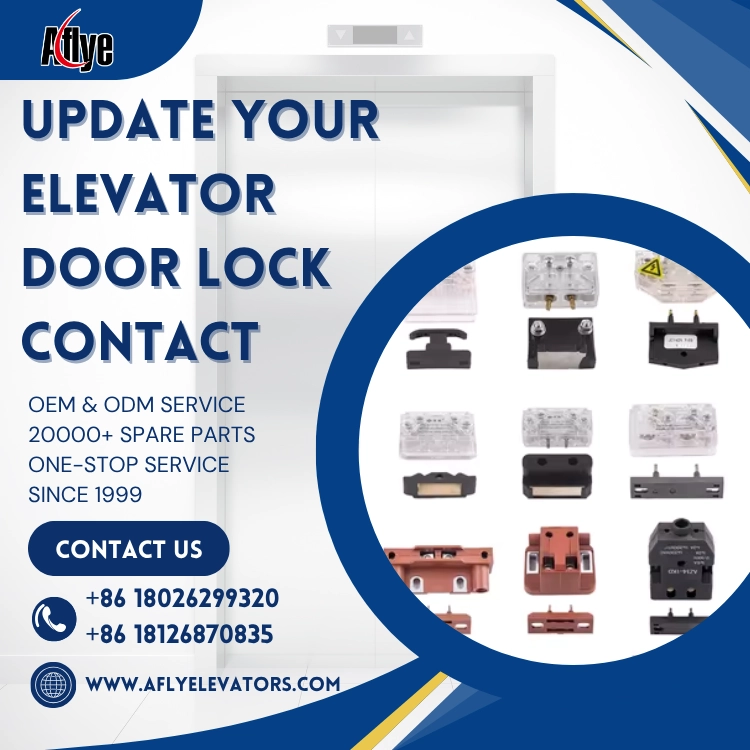
In an elevator door system, the elevator door lock contact provides feedback to the control system to confirm whether the landing door is securely closed and locked. After long-term use, oxidation, contamination, or reduced contact pressure may increase electrical resistance, causing the elevator door lock signal to become intermittent. This may result in occasional elevator shutdowns or startup failures.
1. Why Do Elevator Door Lock Contacts Oxidize?
1. Oxidation Caused by Frequent Switching
Elevator doors open and close frequently, causing the elevator door lock switch to operate repeatedly.
Over time, exposure to air and repeated electrical arcing can create an oxide layer on the contact surface, reducing electrical conductivity.
2. Dust and Moisture Contamination
The environment around elevator landing doors can contain dust, moisture, and other contaminants.
If these enter the door lock mechanism and accumulate on the contact surfaces, electrical contact performance may gradually deteriorate.
3. Reduced Contact Pressure
After long-term mechanical operation, the contact spring may become fatigued, reducing contact pressure.
Even if there is no obvious surface damage, insufficient pressure may still cause unstable electrical contact and intermittent signals.
2. Why Does Contact Oxidation Cause Intermittent Failures?
Under normal conditions, once the landing door is closed and securely locked, the door lock contact should remain electrically closed and provide a stable signal to the elevator control system.
When the contacts become oxidized or develop poor electrical contact, contact resistance may fluctuate. During elevator operation, vibration, temperature changes, or slight movement of the door lock mechanism may cause the electrical contact to alternate between connected and disconnected states.
This may result in:
Elevator occasionally failing to start;
Door lock fault remaining after the door closes;
Intermittent elevator shutdown during operation;
Temporary recovery after a fault reset;
Intermittent opening of the landing door safety circuit.
Because these faults appear intermittently, they can easily be misdiagnosed as elevator control board or wiring problems.
3. How to Solve Elevator Door Lock Contact Problems
During elevator maintenance, technicians should inspect:
Door lock contact surfaces;
Contact pressure;
Wiring terminals;
Mechanical operation of the door lock mechanism.
Minor contamination may be handled according to maintenance requirements.
However, if the contacts are severely oxidized, electrically eroded, or unable to maintain sufficient contact pressure, timely replacement of the elevator door lock switch or contact assembly is recommended.
After replacement, the door lock signals at each landing and the elevator safety circuit should also be checked to confirm that the complete door system operates reliably.
4. Elevator Door Lock Parts Purchasing Tips
When purchasing elevator door lock contacts, the following specifications should be carefully confirmed:
Door lock switch model;
Contact configuration;
Rated voltage and current;
Mounting dimensions;
Wiring method;
Compatibility with the original door lock assembly.
Door lock structures may vary between different elevator models and systems. Therefore, replacement parts should not be selected based only on appearance.
Before purchasing, it is recommended to provide the original part model, clear photos, or dimensional information to reduce the risk of installation or signal compatibility problems.
5. A-FLY Elevator & Escalator Parts Supply Capability
A-FLY supplies a wide range of elevator and escalator spare parts, including:
Elevator door lock switches;
Elevator door lock assemblies;
Other elevator door system parts.
A-FLY also supplies escalator steps, rollers, handrails, chains, and other commonly used elevator and escalator spare parts.
For elevator maintenance, repair, and modernization projects, A-FLY supports model confirmation, dimensional matching, sample confirmation, and OEM/ODM customization services, providing customers with one-stop elevator and escalator spare parts purchasing solutions.
Conclusion
Elevator door lock contact oxidation is a common cause of intermittent door lock signal problems. Unstable door lock signals may lead to occasional startup failures, safety circuit interruptions, or unexpected elevator shutdowns.
Regular inspection of door lock contacts, mechanical operation, and landing door safety circuits, together with timely replacement of aging elevator door components, can help reduce intermittent elevator faults and improve the reliability of the elevator door system.