
Why Does Elevator Door Operator Encoder Coupling Wear Cause Door Position Errors?
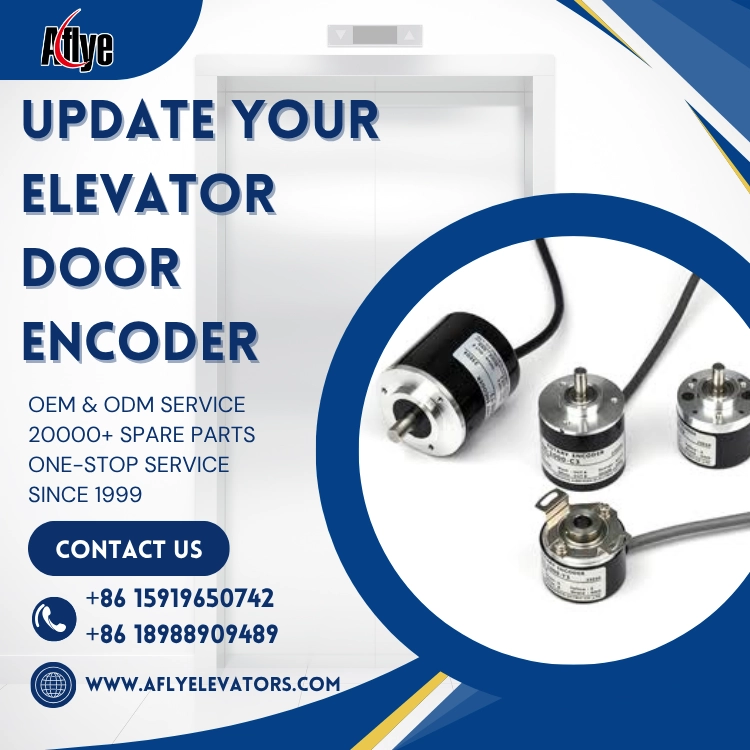
In an elevator door system, the elevator door operator encoder detects the speed and rotational position of the door motor and sends feedback signals to the door operator controller. In some door operator systems, a coupling connects the encoder to the motor shaft.
When the encoder coupling becomes worn, loose, or begins to slip, the position detected by the encoder may no longer correspond accurately to the actual door panel position. This can result in elevator door opening and closing position errors.
1. Why Does the Encoder Coupling Wear?
1. Frequent Starting and Stopping
Elevator doors open and close repeatedly every day. The encoder coupling is continuously exposed to starting and stopping impacts as well as torque variations.
After long-term operation, the coupling may develop excessive clearance, while its elastic components may gradually deteriorate.
2. Shaft Misalignment
If the motor shaft and elevator door operator encoder are not properly aligned, the coupling may be subjected to additional radial loads during operation.
Long-term misalignment can accelerate localized coupling wear and affect the accuracy of encoder feedback.
3. Loose Coupling Connections
Loose fastening screws or wear at the connection points may allow relative movement between the coupling and shaft.
When this occurs, the encoder may no longer rotate precisely with the motor, resulting in inaccurate position feedback.
2. Why Does Coupling Wear Cause Door Position Errors?
Under normal conditions, the rotational position detected by the encoder should correspond accurately to the actual travel distance of the elevator door panels.
When the coupling develops excessive clearance or begins to slip, the motor may already be rotating while the encoder does not respond simultaneously. The amount of encoder feedback may also differ from the actual door movement.
Common elevator door operator problems include:
Door fails to reach the fully open position;
Incorrect door closing position;
Door continues moving after reaching the end position;
Unstable door opening or closing speed;
Door operator repeatedly corrects its position or reopens the doors.
3. How Should This Problem Be Handled During Elevator Maintenance?
During elevator maintenance, technicians should inspect the encoder coupling for:
Looseness;
Cracks;
Deformation;
Excessive mechanical clearance.
The encoder mounting condition and connection to the motor shaft should also be checked.
If the problem is caused only by loose fastening screws, they can be retightened according to the equipment requirements. If the coupling is significantly worn or its elastic components have failed, timely replacement is recommended.
After repair, the door operator position feedback and door opening/closing end positions should be checked again. If necessary, door operator learning or parameter calibration should also be performed.
4. Elevator Door Operator Parts Purchasing Tips
When purchasing replacement parts, the following specifications should be carefully confirmed:
Elevator door operator encoder model;
Coupling inner diameter;
Coupling outer diameter;
Coupling length;
Shaft bore structure;
Installation method.
Different elevator door operator systems may use different encoder and coupling specifications.
Before purchasing, it is recommended to provide the original part model, clear photos, and measured dimensions to avoid new position errors caused by mechanical incompatibility.
5. A-FLY Elevator & Escalator Parts Supply Capability
A-FLY supplies a wide range of elevator door system parts, including:
Elevator door operator encoders;
Encoder couplings;
Door operator belts;
Other elevator door system components.
A-FLY also supplies escalator rollers, step chains, handrails, and other commonly used elevator and escalator spare parts.
For elevator repair, maintenance, and modernization projects, A-FLY supports model matching, dimensional confirmation, and OEM/ODM customization, providing customers with one-stop elevator and escalator spare parts purchasing solutions.
Conclusion
Wear in the elevator door operator encoder coupling can cause the encoder feedback position to become inconsistent with the actual door panel position, making it an important mechanical cause of door opening and closing position errors.
Regular inspection of the encoder coupling, encoder, and door operator drive system can help reduce repeated door movements and abnormal opening or closing while improving the operating stability of the elevator door system.