
Common Causes of False Triggering of Elevator Light Curtains
In elevator door systems, the elevator light curtain is one of the most important safety components. It uses infrared beams to detect the doorway area. Once an obstacle is detected, the system prevents the door from closing or reopens it, effectively avoiding passenger entrapment.
However, in real-world applications, false triggering of light curtains is quite common—for example, doors reopening frequently without any obstacle present or failure to close properly.
As a professional elevator and escalator parts supplier, A-FLY has found through extensive maintenance cases that false triggering is usually related to installation, environment, and component condition. Below are the typical causes:
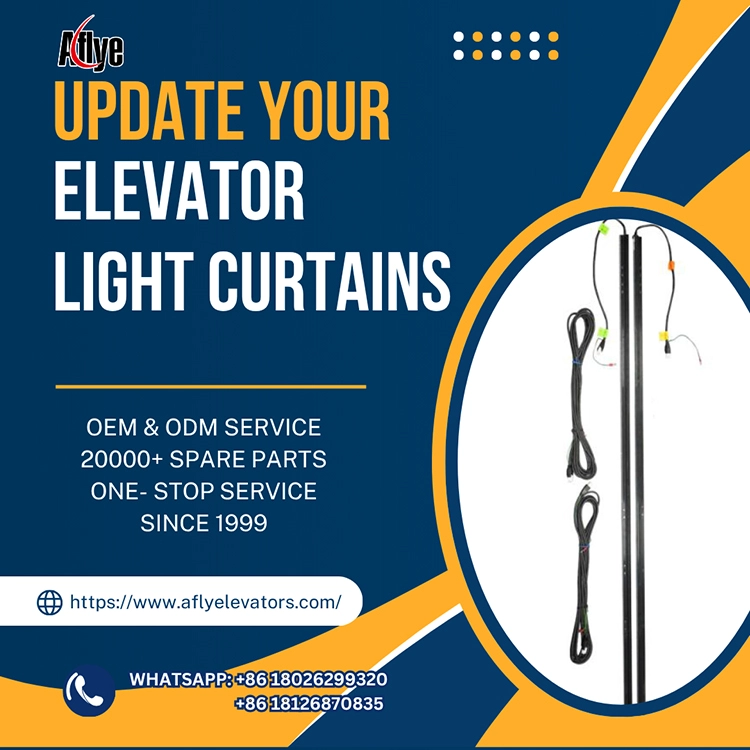
1. Dirt or Dust on the Light Curtain Surface
Light curtains rely on infrared transmission and reception. If dust, oil, or moisture accumulates on the surface, it can interfere with the signal and cause the system to falsely detect an obstacle.
This issue is especially common in environments such as factories, underground parking garages, or dusty areas. Poor maintenance increases the likelihood of false triggering.
2. Misalignment or Improper Installation
A light curtain consists of a transmitter and a receiver, which must be precisely aligned. If installation is inaccurate, or if vibration causes misalignment over time, signal reception may become unstable.
When beams fail to align correctly, the system may interpret it as obstruction, triggering unnecessary door reopening. This often occurs after parts replacement or maintenance.
3. External Light Interference
Strong external light sources can also interfere with infrared signals, such as:
Direct sunlight
Welding light
High-intensity lighting
This issue is more prominent in glass buildings or outdoor elevators. Therefore, selecting light curtains with strong anti-interference capability is essential.
4. Unstable Power Supply
Light curtains are electronic components that require stable voltage. If voltage fluctuates, it may cause abnormal operation, such as:
Intermittent failure
Frequent false triggering
Unstable signal transmission
In unstable power environments, using voltage stabilizers is recommended to improve reliability.
5. Aging or Damaged Internal Components
Over time, internal components such as transmitters, receivers, or circuit boards may degrade, leading to unstable signal transmission.
Common symptoms include:
Frequent door reopening without obstruction
Slow response
Partial detection failure
In such cases, replacing the relevant elevator or escalator parts is necessary.
6. Loose Wiring or Poor Connections
The light curtain system connects to the control system via cables. Loose terminals or poor connections can result in unstable signals and false triggering.
This problem is more common in elevators subject to vibration or lacking regular maintenance.
7. Interference from Other Door System Components
Sometimes, false triggering is not caused by the light curtain itself, but by other components, such as:
Unstable door operator performance
Excessive door vibration
Abnormal door lock system
These factors may affect the detection zone and lead to incorrect triggering. Therefore, a comprehensive inspection of the entire door system is necessary.
8. How to Reduce False Triggering
To minimize false triggering, maintenance personnel should:
Regularly clean the light curtain surface
Check alignment accuracy
Ensure stable power supply
Inspect wiring connections
Replace aging components in time
Proper maintenance significantly improves system stability.
9. Importance of High-Quality Light Curtain Components
High-quality light curtains offer better anti-interference capability, higher detection accuracy, and longer service life. For maintenance teams and buyers, choosing a reliable supplier is crucial.
A-FLY provides a wide range of elevator light curtains and related parts compatible with various systems, helping customers reduce false triggering issues and improve operational efficiency.
Conclusion
False triggering of elevator light curtains is a common issue, often caused by multiple factors.
Through systematic troubleshooting, proper maintenance, and the use of high-quality components from a professional supplier like A-FLY, the safety and stability of elevator door systems can be significantly improved.
For maintenance teams, accurately identifying the root cause is the key to reducing failure rates.