
Causes of Loose Escalator Entrance Cover Plates and Maintenance Recommendations
The escalator entrance cover plate is located at the upper and lower entrances of an escalator. It is an important structural component connecting the building floor and the escalator body, as well as an access point for maintenance inspection.
Due to long-term exposure to passenger stepping, trolley impacts, and equipment vibration, the escalator cover plate may develop problems such as looseness, abnormal noise, or deformation. If not addressed in time, it can affect operation quality, accelerate wear of nearby components, and increase maintenance costs.
Therefore, the entrance cover plate should be included as a key inspection item during escalator maintenance, not just moving components such as steps and handrails.
1. Loose Fixing Bolts Are the Most Common Cause
The escalator entrance cover plate is usually fixed to the frame using bolts, clamps, or support brackets. During long-term operation, continuous vibration can gradually loosen these fixing components, creating small gaps between the cover plate and support structure.Common symptoms include:
Noise when passengers step on it
Slight up-and-down movement of the cover plate
Metal impact sounds during operation
Changes in gaps around the cover plate edges
Solution:During maintenance, check the tightening torque of all fixing bolts. If necessary, retighten them or replace anti-loosening washers to prevent repeated loosening caused by vibration.
2. Support Structure Wear or Deformation
For escalators operating under heavy loads for long periods, the support components under the entrance cover plate may suffer from wear, corrosion, or deformation, causing uneven force distribution.Even if the bolts are tightened, problems may still occur, such as:
Local lifting or warping
Uneven sinking under pressure
Noticeable movement when stepped on
Inspection recommendation:After removing the escalator entrance cover plate, check the support beams, brackets, and welded areas for cracks, corrosion, or permanent deformation.
3. Installation Dimension Errors Cause Abnormal Stress
During escalator modernization or cover plate replacement, incorrect dimensions, thickness, or installation position may reduce the contact area between the cover plate and frame.Over time, this may result in:
Local stress concentration
Repeated bolt loosening
Metal fatigue
Increased abnormal noise
Therefore, newly installed entrance cover plates should be checked for flatness, installation height, and fitting gaps to ensure proper integration with the escalator structure.
4. Vibration Transmission from Nearby Components
Sometimes, a loose entrance cover plate is not caused by the cover plate itself, but by vibration from surrounding components, such as:
Excessive vibration from the main drive system
Abnormal step chain tension
Drive chain wear
Reduced frame rigidity
These vibrations can continuously transfer to the cover plate, gradually loosening the fixing components.
Maintenance focus:If the cover plate repeatedly becomes loose, inspect the overall vibration source instead of simply tightening the bolts repeatedly.
5. Daily Maintenance Recommendations
To reduce entrance cover plate problems, establish regular inspection procedures, including:
Checking cover plate flatness
Testing stepping stability
Checking bolt tightening torque
Cleaning dust and debris underneath the cover plate
Inspecting support structure corrosion
Checking nearby escalator parts for abnormal vibration
For high-traffic locations such as shopping malls, metro stations, and airports, inspection intervals should be shortened to improve equipment reliability.
Escalator Entrance Cover Plate Purchasing Tips
When purchasing an escalator entrance cover plate, confirm:
Length, width, and thickness
Material type (stainless steel, aluminum alloy, etc.)
Anti-slip surface treatment
Mounting hole dimensions
Support structure design
Compatible escalator brand and model
It is recommended to match products according to original drawings, site measurements, or samples to avoid installation problems caused by manufacturing errors.
A-FLY Escalator Spare Parts Supply Capability
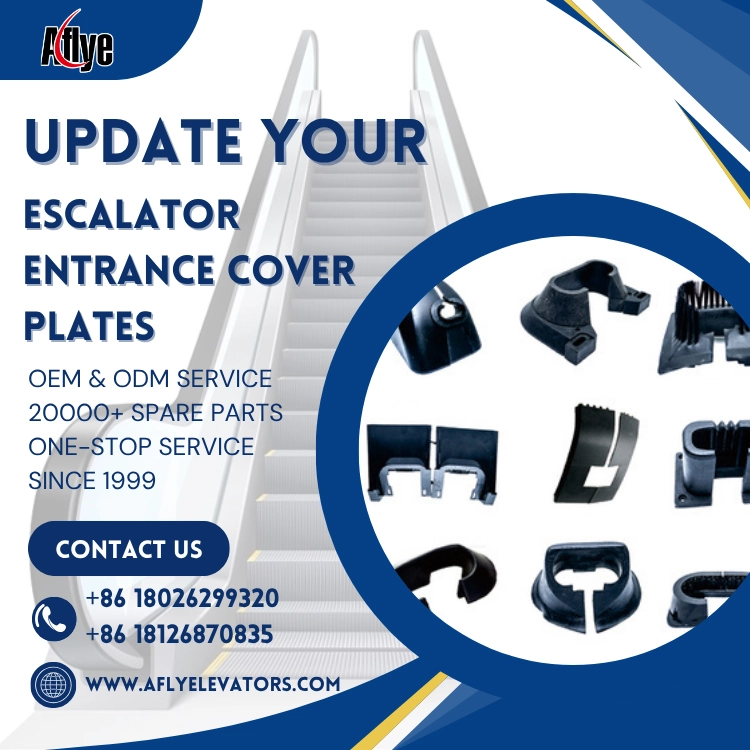
As a professional elevator and escalator spare parts supplier, A-FLY provides escalator entrance cover plates, escalator cover plates, steps, step chains, handrails, comb plates, safety switches, and various elevator and escalator spare parts for maintenance companies, engineering companies, and distributors worldwide.
A-FLY supports:
Multi-brand model matching
OEM/ODM customization
Custom manufacturing based on drawings
Fast delivery
Based on site dimensions or samples, A-FLY can provide suitable solutions to improve maintenance efficiency and reduce equipment failures.
Conclusion
A loose escalator entrance cover plate may appear to be a simple structural issue, but it can involve multiple factors such as fixing systems, support structures, overall equipment vibration, and installation accuracy.
Maintenance teams should conduct comprehensive inspections from both mechanical structure and operating conditions. Choosing high-quality elevator and escalator spare parts helps ensure long-term safe and stable escalator operation while reducing future maintenance costs.