
Are Waterproof Elevator Buttons Worth It? Uses & Selection Tips
In elevator maintenance and modernization projects, more and more customers actively raise a specific requirement: “We need waterproof elevator buttons.”
At the same time, there are still doubts: Are waterproof elevator buttons really effective? Are they just a marketing gimmick? Would a standard button with an extra panel be enough?
Based on extensive real-world project experience, the answer is clear: in the right scenarios, waterproof elevator buttons are not only useful—they are critical.
As a professional elevator & escalator spare parts supplier serving global markets for many years, A-FLY has found that moisture ingress and humidity are among the most common causes of button failure, backlight malfunction, and false triggering.
1. What Do Waterproof Elevator Buttons Actually Protect Against?
Many people assume waterproof buttons only protect against direct water splashes. In reality, the biggest threats to button lifespan are long-term humidity, condensation, and cleaning liquid penetration, not one-time water exposure.
Standard elevator buttons are prone to issues such as:
Oxidation of internal micro switches due to moisture
Leakage or malfunction of the button PCB caused by humidity
Backlight LED failure from water vapor
Rusting of springs and metal components, leading to slow return
The core value of waterproof elevator buttons lies in blocking these long-term, cumulative damage factors at the source.
2. In Which Scenarios Are Waterproof Elevator Buttons Truly Necessary?
Not every elevator requires waterproof buttons, but in the following environments, waterproof design is almost a must-have:
Underground parking garages and semi-basement areas
High humidity and large temperature differences make condensation easy to form inside buttons, resulting in one of the highest failure rates for standard buttons.
Coastal and high-humidity regions
In Southeast Asia, South America, coastal Africa, and parts of the Middle East, consistently high humidity significantly accelerates button aging.
Hospitals, shopping malls, and high-cleaning-frequency environments
Frequent use of disinfectants and cleaning agents allows moisture and chemicals to gradually penetrate the button interior.
Outdoor or semi-outdoor elevators
Scenic-area elevators or external parking-building elevators are exposed to rain, dust, and temperature fluctuations—waterproof buttons are often the only reliable option.
3. What Makes a Waterproof Elevator Button Truly Effective?
A genuinely effective waterproof elevator button is not achieved by simply adding glue or a surface film. Its performance depends on structural and design details, such as:
Integrated sealing structure to prevent moisture ingress through gaps
Waterproof micro switches or contactless sensing designs to reduce exposed contacts
Waterproof backlight design to protect LEDs and PCBs from humidity
Corrosion-resistant materials to prevent rust in long-term damp conditions
These factors directly determine whether a waterproof button is truly waterproof and long-lasting.
4. Waterproof Button ≠ All Buttons Are Waterproof
Common selection mistakes include:
Focusing only on stainless-steel appearance while ignoring internal structure
Protection against splashing water but not against humidity
Insufficient waterproof rating for long-term exposure
Incompatibility with existing COP/LOP systems
The result is often the same: waterproof buttons are installed, but problems keep recurring.
5. How to Properly Select Waterproof Elevator Buttons
When selecting waterproof elevator buttons, it is recommended to focus on:
Clear labeling of waterproof or moisture-resistant design
Compatibility with the existing elevator control system
Support for common voltages (e.g., DC 12V / DC 24V)
Suitability for high-frequency usage environments
Stable backlight and clear character display
For modernization projects, special attention should also be paid to button dimensions, mounting method, and compatibility with the original system.
6. Are Waterproof Elevator Buttons Worth the Extra Cost?
In the short term, waterproof elevator buttons cost slightly more than standard buttons.
In the long run, however, they significantly reduce:
Frequent button replacement
Elevator downtime caused by button failure
Maintenance labor and complaint-related costs
In high-humidity or high-usage environments, waterproof buttons are often the more cost-effective solution overall.
7. A-FLY’s Multi-Scenario Waterproof Elevator Button Solutions
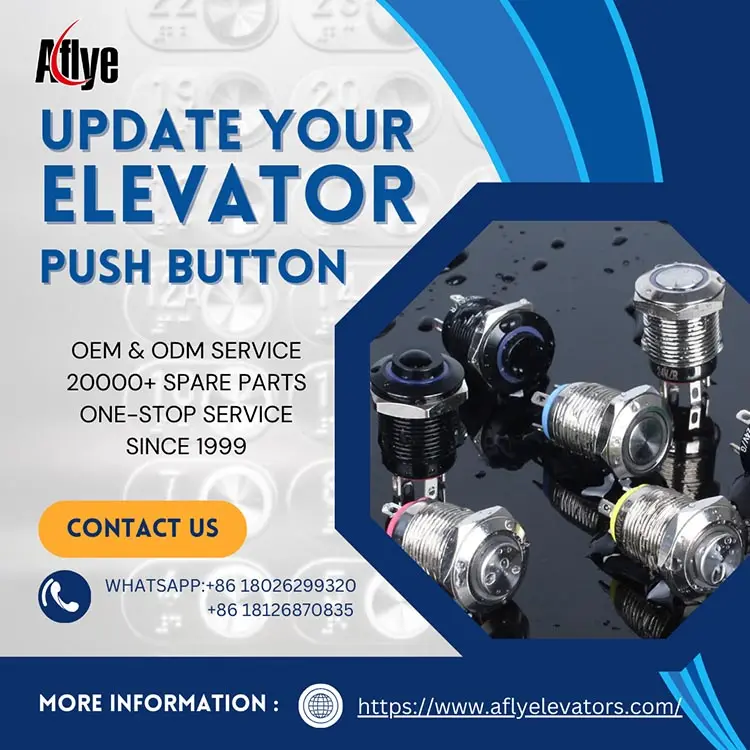
As a professional elevator & escalator spare parts supplier, A-FLY provides a wide range of waterproof elevator buttons, COP/LOP button modules, and related elevator components. These solutions are suitable for underground garages, hospitals, shopping malls, coastal regions, and outdoor elevator projects.
All products are validated through real-world projects for sealing performance, durability, and system compatibility, helping customers effectively reduce button failure rates caused by moisture and humidity.
Conclusion
Waterproof elevator buttons are not a “nice-to-have”—they are a matter of choosing the right solution for the right scenario.
In high-humidity, high-frequency, or hygiene-intensive environments, selecting appropriate waterproof elevator buttons can significantly improve elevator reliability and user experience.
If you are facing recurring button failures caused by moisture, choosing a reliable elevator & escalator spare parts supplier like A-FLY will provide a more stable and long-term solution.